
Septic Tank Installation Cost Calculator
What does it cost to put in a septic tank? Pick your state, the job and your bedrooms. You get the system price and the all-in project cost side by side, itemized with sources, and every system type compared for your home.
- You needYour state and bedrooms
- Takes1 minute
- CostFree, no sign-up
Short answer: putting in a conventional septic system costs $3,000 to $8,000 for the tank, drain field and installation. Add the perc test and permits and most homes budget $4,100 to $12,500 all in. If the soil fails the perc test and you need a mound or aerobic system, plan on $11,000 to $24,500. The tank itself is only $500 to $2,500 of that.
The calculator above gives you two numbers: what the system costs to install, and what the whole project costs once the soil test, permits and extras are in. This guide explains every number behind them, why your soil matters more than your zip code, and how to check an installer’s quote line by line.
How much does it cost to put in a septic tank?
When people ask what a septic tank costs, they usually mean the whole system: the tank, the drain field that the tank empties into, and the crew that digs it all in. That full job is what moves the price, and the type of system your land needs moves it the most.
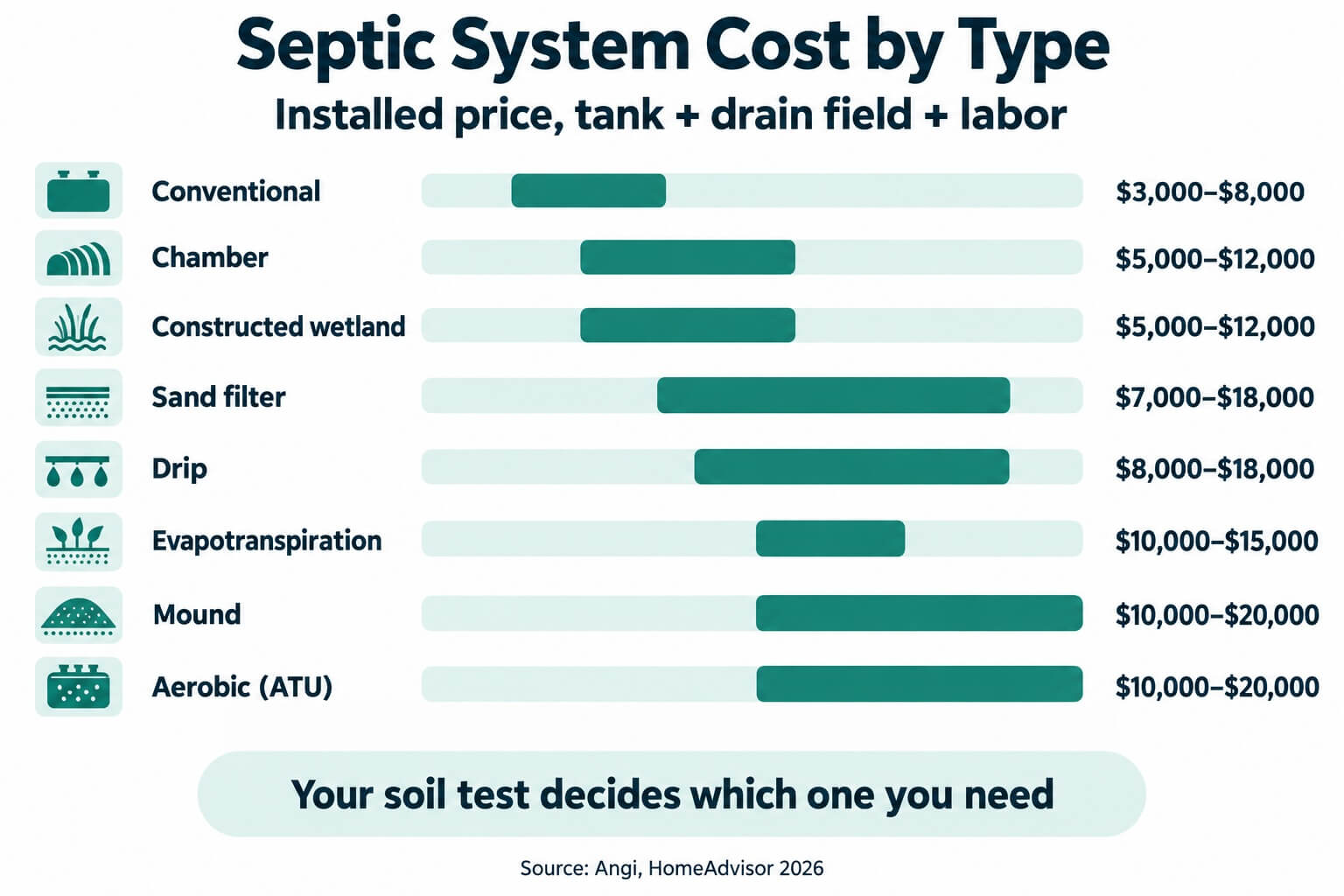
Angi and HomeAdvisor publish the same installed ranges for each system type. Here they are, with the all-in budget our calculator adds for a typical 3-bedroom home (the system plus a perc test at $700 to $2,000 and permits at $450 to $2,300):
| System type | System installed | All-in budget, 3 bedrooms |
|---|---|---|
| Conventional (gravity) | $3,000 to $8,000 | $4,100 to $12,500 |
| Chamber | $5,000 to $12,000 | $6,000 to $16,500 |
| Constructed wetland | $5,000 to $12,000 | $6,000 to $16,500 |
| Sand filter | $7,000 to $18,000 | $8,000 to $22,500 |
| Drip distribution | $8,000 to $18,000 | $9,000 to $22,500 |
| Evapotranspiration | $10,000 to $15,000 | $11,000 to $19,500 |
| Mound | $10,000 to $20,000 | $11,000 to $24,500 |
| Aerobic treatment unit | $10,000 to $20,000 | $11,000 to $24,500 |
System prices: Angi (updated August 2026) and HomeAdvisor (updated June 2026). All-in budget: our calculator at the national price level, totals rounded outward to the nearest $500.
Notice the jump in the middle of that chart. A conventional system and a mound system can go on the same road, and the mound can cost two to three times as much. The only thing that decides which one you get is how fast your soil soaks up water, and you find that out with a perc test. More on that below.
How to use the septic tank cost calculator
You only need your state to get a result. Each extra answer makes the estimate fit your project better.
| Question | Why it matters | If you don’t know |
|---|---|---|
| State | Adjusts the labor part of the job to your state’s price level. | Required |
| The job | A new system, a full replacement, the tank only or the drain field only are priced differently. | Defaults to a new system |
| Bedrooms | Codes size the tank by bedrooms. More bedrooms, bigger tank. | Defaults to 3 |
| Soil and site | Picks the system your land is likely to need. | We price a conventional system and show the mound price if the soil fails |
| System type | Overrides the soil guess if you already know. | Leave it on “let my site decide” |
| Tank material | Plastic can cost a little less than concrete, fiberglass a little more. | Priced as concrete |
| Large tub | A whirlpool or soaking tub adds 250 gallons to the tank in Nebraska’s guidance. | Leave unchecked |
| Survey, clearing, riser | Each adds a published line to the all-in cost. | Left out, and we say so |

How the calculator does the math
No black box. Here is the whole thing:
- System. The installed range for your system type from Angi and HomeAdvisor. It covers the tank, drain field and installation.
- State. Angi says labor is 50% to 70% of a septic job. We take the 60% middle and scale only that part by your state’s price level from the U.S. Bureau of Economic Analysis. Materials stay at national prices.
- Tank size. Your bedrooms set the required tank size. If it is bigger than 1,000 gallons, we add the price difference from Angi’s tank-size table.
- Material. Plastic or fiberglass changes the tank line by the gap Angi publishes against concrete.
- Project costs. The perc test and permits go into every new system. A survey, land clearing, a riser and pumping out the old tank go in when they apply.
- Rounding. Totals are rounded outward, so the range never looks more exact than it is.
Permit fees are not adjusted by state because your county sets them. Where our sources stop, the result says so instead of guessing.
Septic tank vs. complete septic system
This is where most price confusion starts. A supplier might say “$1,200 for the tank” while a neighbor says their septic cost $15,000. Both can be right, because they’re talking about different things.
The tank only
The buried box that holds the wastewater.
- The tank itself: $500 to $2,500 by size
- Digging and setting it
- The drain field
- Perc test, design and permits
A complete septic system
Everything needed for a working, approved system.
- Perc test and soil evaluation
- Permit and inspections
- Excavation
- Tank, set and connected
- Drain field (leach field) with pipe and gravel or chambers
- Backfill and final grade
When you collect quotes, ask each installer which column their price belongs in. Two quotes that look $5,000 apart are often the same job, with one leaving out the drain field or the permit.
How a septic system works
Wastewater from the house flows into the tank. The EPA explains that heavy solids settle to the bottom and grease and lighter solids float to the top. The liquid in the middle flows out to the drain field, where it soaks into the soil and microbes in the soil finish treating it. That last step is why the soil decides so much of the price: if the ground can’t take the water, you need a system that treats it harder or builds better soil on top.
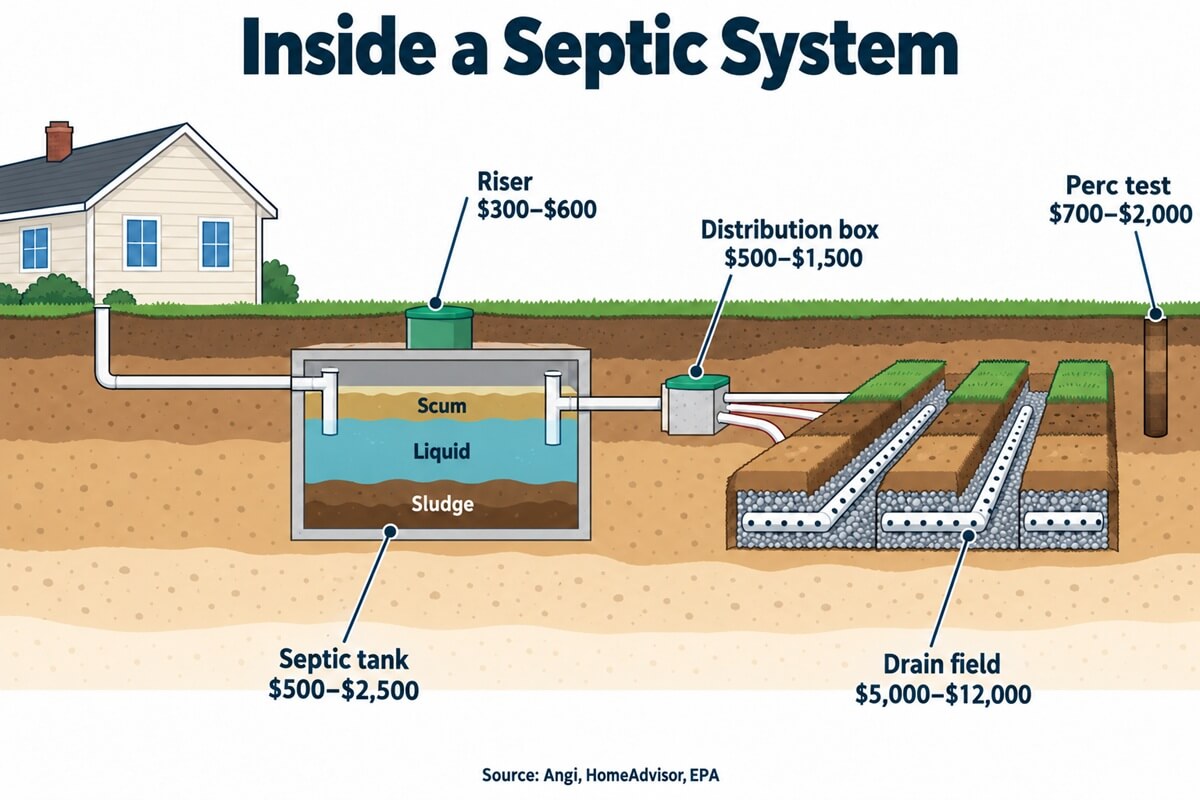
| Term | What it is |
|---|---|
| Drain field (leach field) | Trenches or beds where treated water soaks into the soil. |
| Perc test | A soil test that measures how fast water drains into the ground. |
| Distribution box | Splits the flow evenly between the drain field lines. |
| Effluent filter | A screen at the tank outlet that keeps solids out of the drain field. |
| Riser | A pipe that brings the tank lid up to ground level so it can be pumped without digging. |
| Dosing pump | Pushes water uphill or under pressure, as in mound and drip systems. |
Where the money goes
Here is every line in a septic project with the published range behind it. Labor is the biggest single piece. Angi puts it at 50% to 70% of the total.
| Item | Typical cost | Source |
|---|---|---|
| Septic tank (material) | $500 to $2,500 | Angi, by size and material |
| Septic installer (labor) | $1,500 to $4,000 | HomeAdvisor |
| Excavation, if billed separately | $1,500 to $6,300 | Angi |
| Drain field (leach field) | $5,000 to $12,000 | Angi and HomeAdvisor |
| Perc test and soil evaluation | $700 to $2,000 | Angi and HomeAdvisor |
| Permits | $450 to $2,300 | Angi and HomeAdvisor |
| Land survey | $330 to $900 | Angi |
| Land clearing | $1,200 to $4,800 | Angi |
| Tank riser | $300 to $600 | Angi and HomeAdvisor |
| Distribution box | $500 to $1,500 | Angi and HomeAdvisor |
| Landscaping afterward | $5 to $24 per sq ft | Angi |
These are the parts of a job as the cost guides list them. Don’t add them all up: the system prices in the first table already include the tank, labor, excavation and drain field.
Septic tank cost by size and bedrooms
Septic codes size the tank by bedrooms, not by how many people live in the house. The University of Nebraska explains why: the number of people can change, but bedrooms set how many the house can hold.
| Bedrooms | Minimum tank in our calculator | Tank price (material) | All-in, conventional | All-in, mound |
|---|---|---|---|---|
| 1 to 3 | 1,000 gallons | $900 to $1,500 | $4,100 to $12,500 | $11,000 to $24,500 |
| 4 | 1,250 gallons | $1,200 to $1,600 | $4,200 to $13,000 | $11,000 to $25,000 |
| 5 | 1,500 gallons | $1,500 to $2,500 | $4,700 to $13,500 | $11,500 to $25,500 |
| 6 | 1,750 gallons | Quote needed | $4,700 to $13,500+ | $11,500 to $25,500+ |
Tank sizes: University of Nebraska-Lincoln (1,000 gallons minimum, 1,250 for 4 bedrooms) and Washington WAC 246-272A-0232 (1,000 gallons for 4 or fewer, plus 250 per added bedroom); we use the larger of the two. Tank prices: Angi, with the 1,200 gallon row standing in for 1,250. All-in: our calculator, national price level.
You may see cost guides list a 500 gallon tank for a 1-bedroom home or 750 gallons for 2 bedrooms. Both Nebraska and Washington set 1,000 gallons as the floor, so check your county’s rule before you price a small tank. Going bigger than the minimum costs little at install time and gives solids more room between pump-outs.
A bigger tank barely moves the total. Going from 3 to 5 bedrooms adds about $600 to $1,000 for the tank. The drain field may need to grow too, and that part depends on your soil, so ask the designer.
Septic tank cost by material
| Material | Tank price | Good to know |
|---|---|---|
| Concrete | $700 to $2,000 | The most common choice. Heavy, so it needs a truck that can set it in place. |
| Plastic (polyethylene) | $500 to $2,000 | Light and easy to get onto tight or remote lots. Must be installed to the maker’s rules so it can’t shift. |
| Fiberglass | $1,200 to $2,000 | Light and doesn’t rust, but costs the most to start. |
| Steel | Not priced | This Old House notes steel tanks are not used for new installs. |
Prices: Angi, material only.
Material moves the total by a few hundred dollars at most. Pick the one your installer and county are used to. A tank they know how to set right is worth more than a small saving.
Septic system types: what each costs and when you need one
You rarely get to pick the system type on price alone. The soil test, the water table and how close you are to wells and water decide what the health department will approve. Here’s what each one is for, from the EPA’s guide to septic systems:
| System | Installed | How it works | Where it’s used |
|---|---|---|---|
| Conventional | $3,000 to $8,000 | Tank plus a gravel or stone drain field | Deep, well-drained soil with room for a drain field |
| Chamber | $5,000 to $12,000 | Plastic chambers instead of gravel in the field | High water tables, or where gravel is scarce |
| Mound | $10,000 to $20,000 | A raised sand bed, dosed by a pump | Shallow soil, high groundwater or shallow bedrock |
| Aerobic treatment unit | $10,000 to $20,000 | Air pumped into the tank for extra treatment | Small lots, poor soil or a high water table |
| Sand filter | $7,000 to $18,000 | Water pumped through sand before the field | High water tables, or close to lakes and streams |
| Drip distribution | $8,000 to $18,000 | Small tubing near the surface, fed from a dosing tank | Shallow soil where no mound is wanted. Needs power. |
| Evapotranspiration | $10,000 to $15,000 | A lined bed where water evaporates | Dry, hot climates only |
| Constructed wetland | $5,000 to $12,000 | A lined cell of gravel, sand and wetland plants | Sites that suit a planted treatment cell |
Prices: Angi and HomeAdvisor. Descriptions and site conditions: EPA, Types of Septic Systems.
Conventional vs. mound vs. aerobic
These three cover most homes. A conventional system is the simplest and cheapest because gravity does the work. A mound costs more because you’re building the soil your lot doesn’t have, plus a pump to feed it. An aerobic unit treats the water harder before it reaches the soil, so it works on smaller or tougher lots, but the EPA says to expect regular maintenance for its whole life.
Anything with a pump, a float or an aerator also has running costs a gravity system doesn’t: electricity, alarm checks and more frequent service. The EPA says these systems should generally be inspected once a year, against every three years for a conventional one.
The perc test: the number that decides your price
A perc (percolation) test measures how fast water soaks into your soil. Angi and HomeAdvisor price soil testing at $700 to $2,000. It’s the cheapest line in the project and the one that decides the biggest.
- Soil passes: you can usually use a conventional or chamber system. All-in for a 3-bedroom home: about $4,100 to $16,500.
- Soil drains too slowly, or water or rock is too close to the surface: expect a mound, aerobic unit, sand filter or drip system. All-in: about $8,000 to $24,500.
- Soil fails outright: some lots can’t take a septic system at all. Find that out before you buy land.
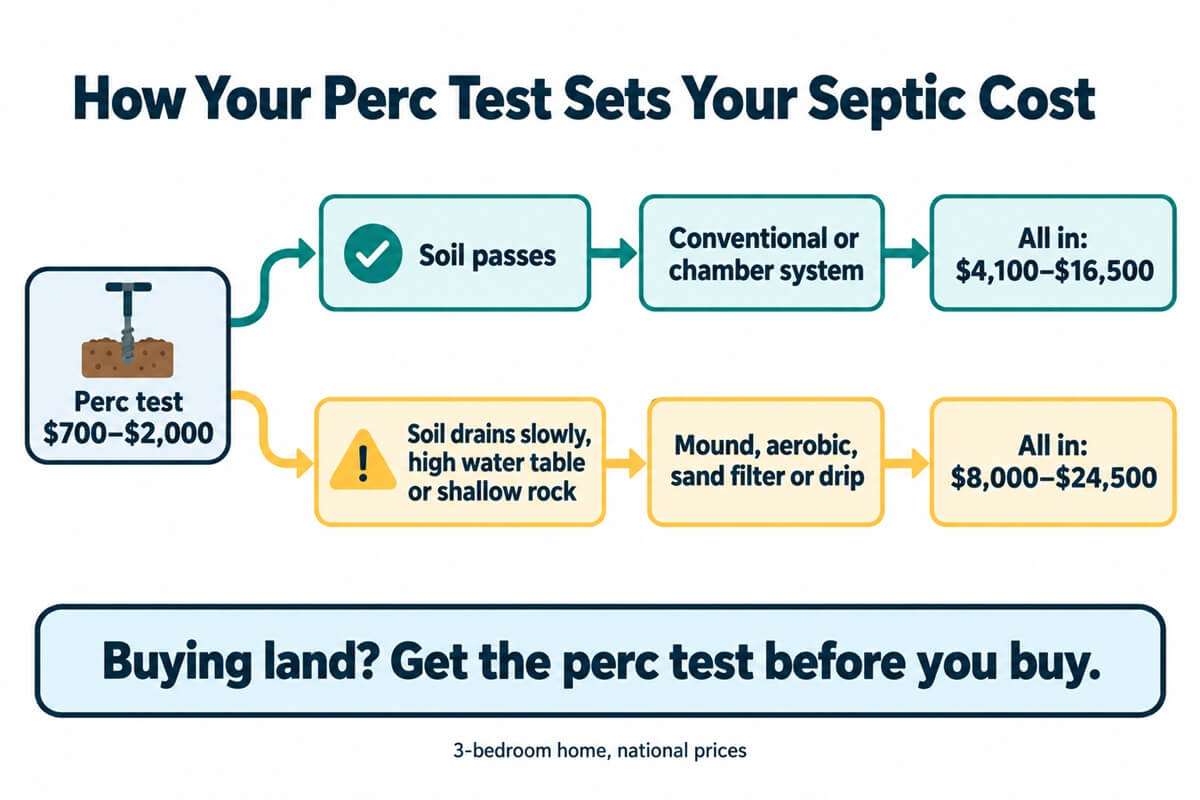
The calculator handles this for you. Pick “Not sure yet” for your soil and it prices a conventional system, then shows what the project becomes if the soil fails.
Septic system cost by state
Most cost guides give one national number. We adjust ours with the U.S. Bureau of Economic Analysis Regional Price Parities, which measure how expensive each state is against the national average of 100. Because labor is about 60% of a septic job, only that share is adjusted.
The result surprises most people. Your state moves the price by about 8% at most. Your soil can more than double it.
| State | Price level (U.S. = 100) | Conventional, all-in | Mound, all-in |
|---|---|---|---|
| Alabama | 88.8 | $3,900 to $12,000 | $10,000 to $23,000 |
| Alaska | 102.4 | $4,200 to $12,500 | $11,000 to $25,000 |
| Arizona | 100.7 | $4,100 to $12,500 | $11,000 to $24,500 |
| Arkansas | 86.9 | $3,800 to $12,000 | $10,000 to $23,000 |
| California | 110.7 | $4,300 to $13,000 | $11,500 to $26,000 |
| Colorado | 103.1 | $4,200 to $12,500 | $11,000 to $25,000 |
| Connecticut | 103.6 | $4,200 to $13,000 | $11,000 to $25,000 |
| Delaware | 99.8 | $4,100 to $12,500 | $11,000 to $24,500 |
| Florida | 103.4 | $4,200 to $13,000 | $11,000 to $25,000 |
| Georgia | 96.3 | $4,000 to $12,500 | $10,500 to $24,000 |
| Hawaii | 110.0 | $4,300 to $13,000 | $11,500 to $26,000 |
| Idaho | 95.5 | $4,000 to $12,500 | $10,500 to $24,000 |
| Illinois | 100.0 | $4,100 to $12,500 | $11,000 to $24,500 |
| Indiana | 93.3 | $4,000 to $12,000 | $10,500 to $23,500 |
| Iowa | 87.8 | $3,800 to $12,000 | $10,000 to $23,000 |
| Kansas | 90.1 | $3,900 to $12,000 | $10,500 to $23,000 |
| Kentucky | 90.2 | $3,900 to $12,000 | $10,500 to $23,500 |
| Louisiana | 88.2 | $3,800 to $12,000 | $10,000 to $23,000 |
| Maine | 97.1 | $4,000 to $12,500 | $10,500 to $24,000 |
| Maryland | 105.0 | $4,200 to $13,000 | $11,000 to $25,000 |
| Massachusetts | 105.8 | $4,200 to $13,000 | $11,500 to $25,500 |
| Michigan | 96.2 | $4,000 to $12,500 | $10,500 to $24,000 |
| Minnesota | 98.6 | $4,100 to $12,500 | $11,000 to $24,500 |
| Mississippi | 87.0 | $3,800 to $12,000 | $10,000 to $23,000 |
| Missouri | 90.8 | $3,900 to $12,000 | $10,500 to $23,500 |
| Montana | 94.6 | $4,000 to $12,000 | $10,500 to $24,000 |
| Nebraska | 90.1 | $3,900 to $12,000 | $10,500 to $23,000 |
| Nevada | 100.0 | $4,100 to $12,500 | $11,000 to $24,500 |
| New Hampshire | 104.2 | $4,200 to $13,000 | $11,000 to $25,000 |
| New Jersey | 108.8 | $4,300 to $13,000 | $11,500 to $25,500 |
| New Mexico | 92.2 | $3,900 to $12,000 | $10,500 to $23,500 |
| New York | 107.9 | $4,300 to $13,000 | $11,500 to $25,500 |
| North Carolina | 94.3 | $4,000 to $12,000 | $10,500 to $24,000 |
| North Dakota | 89.0 | $3,900 to $12,000 | $10,000 to $23,000 |
| Ohio | 92.8 | $3,900 to $12,000 | $10,500 to $23,500 |
| Oklahoma | 87.8 | $3,800 to $12,000 | $10,000 to $23,000 |
| Oregon | 103.4 | $4,200 to $13,000 | $11,000 to $25,000 |
| Pennsylvania | 97.6 | $4,000 to $12,500 | $10,500 to $24,000 |
| Rhode Island | 102.3 | $4,200 to $12,500 | $11,000 to $25,000 |
| South Carolina | 93.7 | $4,000 to $12,000 | $10,500 to $23,500 |
| South Dakota | 88.6 | $3,800 to $12,000 | $10,000 to $23,000 |
| Tennessee | 91.9 | $3,900 to $12,000 | $10,500 to $23,500 |
| Texas | 97.1 | $4,000 to $12,500 | $10,500 to $24,000 |
| Utah | 98.9 | $4,100 to $12,500 | $11,000 to $24,500 |
| Vermont | 98.0 | $4,100 to $12,500 | $11,000 to $24,500 |
| Virginia | 101.1 | $4,100 to $12,500 | $11,000 to $24,500 |
| Washington | 107.0 | $4,300 to $13,000 | $11,500 to $25,500 |
| West Virginia | 89.5 | $3,900 to $12,000 | $10,000 to $23,000 |
| Wisconsin | 94.1 | $4,000 to $12,000 | $10,500 to $24,000 |
| Wyoming | 92.7 | $3,900 to $12,000 | $10,500 to $23,500 |
3-bedroom home, new system, perc test and permits included. Price levels: U.S. Bureau of Economic Analysis, Regional Price Parities 2024, released February 2026. System prices: Angi and HomeAdvisor.
A price index can’t see everything. Some counties require advanced treatment near lakes or the coast, and some have only a few licensed installers. Treat the state numbers as a starting point and let local quotes have the last word.
New septic system vs. replacement
Replacing a system that has failed costs about the same as a new one, plus the work of dealing with the old one. If only one part has failed, you may not need the whole thing.
| Job | Main cost | All-in, national level |
|---|---|---|
| New conventional system | $3,000 to $8,000 | $4,100 to $12,500 |
| Replace a failed conventional system | $3,000 to $8,000 | $4,400 to $13,000, with the old tank pumped |
| Replace the tank only | $3,000 to $10,000 | $3,700 to $13,000 |
| Replace the drain field only | $5,000 to $12,000 | $6,000 to $16,500 |
Tank replacement: HomeAdvisor. Drain field: Angi and HomeAdvisor; Angi puts a typical drain field replacement near $7,000. All-in adds permits, a soil test for new fields, and pumping the old tank ($300 to $600).
Old tanks are usually pumped out and then removed or crushed and filled in place, depending on your county. Angi prices tank removal labor at $45 to $200 an hour, so ask for it as a separate line.
A new drain field generally goes on fresh ground. University of Maryland Extension notes that when a field’s soil clogs, the replacement has to be built in undisturbed soil. Keep a spare area clear of sheds, driveways and trees for that day.
Three example projects, priced with the calculator
Same calculator, three very different jobs. Totals are rounded outward.
Tennessee, 3 bedrooms
- New system, soil drains well
- Conventional, concrete tank
- Tennessee price level: 91.9
- The system
- $2,850 to $7,650
- All in
- $3,900 to $12,000
Permits and the perc test are a real share of the bill on a job this size.
Wisconsin, 4 bedrooms
- Replacing a failed system
- High water table, so a mound
- 1,250 gallon tank, riser added
- The system
- $9,700 to $19,600
- All in
- $11,000 to $25,000
The mound does almost all the damage. The bigger tank adds only $100 to $300.
New York, 5 bedrooms
- New build, no soil test yet
- Survey and land clearing needed
- 1,500 gallon tank
- If the soil passes
- $6,500 to $20,000
- If it fails (mound)
- $13,500 to $32,500
Clearing alone adds $1,250 to $5,050. The perc test decides which column you’re in.
Costs most quotes leave out
These don’t show up in every quote. Ask for each as a written line item.
| Item | When it comes up | What to ask |
|---|---|---|
| Engineered design | Mound, aerobic, sand filter and drip systems | “Is the design and the designer’s site visit in your price?” |
| Electrical work and alarm | Any system with a pump or aerator | “Who runs the circuit, and is the alarm included?” Angi puts a pump alarm near $500. |
| Rock or water in the hole | Shallow bedrock, wet sites | “What happens to my bill if you hit rock or water?” |
| Long pipe run from the house | The field has to go far from the house | “How many feet of pipe is in this price?” |
| Old tank removal | Replacements | “Do you remove it or fill it in place, and at what price?” |
| Landscaping | After any dig | Angi prices it at $5 to $24 per square foot |
Septic systems and your well
If your home is on a private well, where the septic system goes matters as much as what it costs. The drain field is designed to send water into the ground, and your well draws water from the ground.
Every state sets minimum distances between the two. Washington’s rule is a good example: the drain field must be at least 100 feet from a private well, and the tank and the sewer line from the house at least 50 feet. Local health officers can make those distances bigger where the risk is higher. Your state’s rule may differ, so check your state page before you or the installer pick a spot.
- Plan both together on new land. The well and the septic system compete for the same space, and the setbacks can decide where the house goes.
- Test the well after septic work. Heavy digging and a new drain field are good reasons to test for bacteria and nitrate. Use a state-certified lab.
- Need a new well too? Price it with our well drilling cost calculator. If a test shows bacteria, the shock chlorination calculator gives the exact bleach dose.
What a septic system costs to own
The install is the big bill, but upkeep is what makes the system last. The EPA says household tanks are typically pumped every three to five years and the whole system inspected at least every three years.
| Upkeep or repair | Typical cost | How often |
|---|---|---|
| Pumping the tank | $300 to $600 | Every 3 to 5 years |
| Pumping over 30 years | $1,800 to $6,000 | 6 to 10 visits |
| Effluent filter replacement | $230 to $280 | When it wears out |
| Baffle replacement | $300 to $500 | Repair |
| Effluent pump replacement | $800 to $1,400 | Pump systems only |
| Distribution box replacement | $500 to $1,500 | Repair |
| Tank lid replacement | $30 to $70 | Repair |
| Drain field replacement | About $7,000 | Every 25 to 40 years |
Prices: Angi and HomeAdvisor. Intervals: EPA. Drain field life: University of Maryland Extension.
Habits that keep the drain field alive
- Spread out laundry. The EPA says doing it all in one day can flood the drain field.
- Fix running toilets. One leaking toilet can add up to 200 gallons of water a day, per the EPA.
- Flush only toilet paper. Wipes, grease, coffee grounds and chemicals clog the tank and the field.
- Go easy on the garbage disposal. It adds solids, which means more pump-outs.
- Keep cars and roof water off the field. Parking compacts the soil, and gutter water floods it.
How to compare septic installation quotes
Lay your quotes side by side and fill in this table for each one. Gaps show up fast.
| Check | Quote A | Quote B | Quote C |
|---|---|---|---|
| System type and design included? | |||
| Tank size, material and number of compartments | |||
| Drain field size and type | |||
| Perc test and permit included? | |||
| Risers and effluent filter included? | |||
| Pump, alarm and wiring (if needed) | |||
| Old tank pumped and removed or filled? | |||
| Backfill, grading and seed included? | |||
| Policy if they hit rock or water | |||
| License and insurance checked |
Questions worth asking every installer:
- What system will the county approve on my lot, and why?
- Who does the soil evaluation and the design?
- Who pulls the permit and schedules the inspections?
- Is the tank priced at the size my bedrooms need, or the minimum?
- Where will the drain field go, and where is the spare area for a future one?
- How far will it be from my well?
- Are you licensed for this system type in this state?
Your state page lists the agency in charge of private wells and what is required where you live.
How to keep the cost down
You can’t change your soil. A few choices still make a real difference to the final bill.
- Get the perc test before you buy land. It’s the only way to know whether you’re budgeting for a $4,000 system or a $24,000 one.
- Get three itemized quotes. Itemized quotes are the only way to see where two prices really differ.
- Keep the field close to the house, where setbacks allow. Long pipe runs and extra digging add up.
- Add risers at install time. At $300 to $600 each, they save digging at every pump-out for the life of the tank.
- Clear and landscape yourself, if the installer agrees and your county allows it.
- Maintain it. Pumping at $300 to $600 every few years is cheap next to a $7,000 drain field.
Red flags in a quote
- One lump sum with no tank size, field size or system type
- No mention of the permit, soil test or inspections
- A system type picked before anyone has tested the soil
- No license number, or a license you can’t find in state records
- Pressure to sign the same day
Why national prices can look low
Angi’s national average is $8,016, with most jobs between $3,590 and $12,463. That average mixes simple replacements on easy lots with full new builds, so a new home on tough ground can land well above it.
A county fact sheet from Montgomery County, Maryland shows what a high-cost area can look like. It listed $10,000 for a 3-bedroom trench system, $20,000 for a sand mound and $37,000 for drip disposal, all before engineering, permits and testing. Those figures are from 2011 and 2012, and costs have risen since.
That’s why our calculator shows the system and the all-in project separately, adjusts for your state, and tells you what isn’t included. If your quotes come in above our range, ask the installer which line explains the gap. Usually it’s design, rock, electrical work or a long pipe run.
Paying for a septic system
If you live in a rural area and your income is low, check USDA Rural Development’s Section 504 home repair program before you borrow elsewhere.
| USDA Section 504 | Details |
|---|---|
| Loan | Up to $40,000 at a fixed 1% for 20 years |
| Grant | Up to $10,000 for homeowners 62 and older |
| Combined | Up to $50,000 |
| Who qualifies | Owner-occupants in eligible rural areas, under the county’s low or very-low income limit |
Source: USDA Rural Development, page updated October 1, 2026. Ask your local USDA office whether a septic repair qualifies for your home.
Some states and counties also help pay for repairs or advanced treatment. Montgomery County’s fact sheet, for example, mentions grants of up to $15,000 from Maryland’s Bay Restoration Fund toward nitrogen-reducing systems. Ask your county health department what’s available where you live.
Septic tank installation cost FAQ
How much does it cost to put in a septic tank?
A conventional septic system costs $3,000 to $8,000 installed, according to Angi and HomeAdvisor. With the perc test and permits, most homes budget $4,100 to $12,500. Mound and aerobic systems run $10,000 to $20,000 installed, or about $11,000 to $24,500 all in.
How much is a septic system for a 3-bedroom house?
A 3-bedroom home usually needs a 1,000 gallon tank. All in, our calculator puts a conventional system at $4,100 to $12,500 and a mound system at $11,000 to $24,500 at national prices.
How much does a septic tank cost by itself?
$500 to $2,500 for the tank alone, depending on size and material. A 1,000 gallon tank runs $900 to $1,500 and a 1,500 gallon tank $1,500 to $2,500, per Angi. Installation and the drain field cost far more than the tank.
What size septic tank do I need?
Codes size tanks by bedrooms. The University of Nebraska sets 1,000 gallons as the minimum, with 1,250 gallons for 4 bedrooms. Washington requires 1,000 gallons for up to 4 bedrooms plus 250 for each extra one. Your county’s rule is the one that counts.
How much does a mound septic system cost?
$10,000 to $20,000 installed, per Angi and HomeAdvisor, or about $11,000 to $24,500 with the perc test and permits. Mounds are used where the soil is shallow or the water table or bedrock is close to the surface.
How much does a perc test cost?
Angi and HomeAdvisor price soil engineers at $700 to $2,000. Some county health departments do the soil evaluation themselves, so ask them first.
How much does it cost to replace a septic system?
About the same as a new one, plus pumping the old tank at $300 to $600 and removing or filling it. Replacing just the tank runs $3,000 to $10,000 (HomeAdvisor), and just the drain field $5,000 to $12,000 (Angi and HomeAdvisor).
Does the state I live in change the price much?
Less than you’d think. Adjusting labor for each state’s price level moves the total by about 8% at most. Your soil, and the system it forces, can more than double it.
Can I install a septic system myself?
In most places you’ll need a permit, an approved design and an inspection, and many states require a licensed installer. Ask your county health department before you plan any of the work yourself.
How long does a septic system last?
University of Maryland Extension says tanks can last many decades and drain fields 25 to 40 years. Pumping every three to five years, as the EPA advises, is the best way to reach the long end.
How far does a septic system have to be from a well?
It depends on your state. In Washington, the drain field must be at least 100 feet from a private well and the tank at least 50 feet. Check your state page for your rule.
How accurate is this calculator?
It’s a planning range, not a quote. It uses published national prices, adjusts labor to your state’s price level and sizes the tank to your bedrooms. Your actual cost depends on your soil, the system your county approves and what the crew finds in the ground.
Prices checked October 2026. Cost estimates are for planning only and are not a contractor quote. Sources: Angi, HomeAdvisor, This Old House, EPA, University of Nebraska-Lincoln, Washington State Legislature (WAC 246-272A), University of Maryland Extension, University of Rhode Island Extension, Montgomery County (MD), U.S. Bureau of Economic Analysis and USDA Rural Development.