
Well Pump Replacement Cost Calculator
Pump type and well depth drive most of the price. Enter what you know and get a realistic installed range, what each extra adds, and the cheaper fixes to rule out before you replace the pump.
- You needWell depth if you know it
- Takes1 minute
- CostFree, no sign-up
Short answer: replacing a well pump costs about $1,000 to $2,800 for most homes, and Angi’s national average is $1,897. A deep well, a constant pressure system or a new pressure tank can push the bill past $4,000. A small repair might fix the problem for a few hundred dollars instead.
The calculator above gives you a range for your own well. This guide covers everything around that number: what’s in a fair quote, which repairs to rule out first, when a new pressure tank makes sense, and how to tell a good price from a padded one.
How much does it cost to replace a well pump?
Angi looked at 1,339 real pump replacements and found most homeowners paid between $974 and $2,821. The average was $1,897.
That covers most jobs, but not all of them. Three things push a job past the top of that range:
- A deep well, where the crew has to pull and reset hundreds of feet of pipe and wire
- Upgrading to a constant pressure system
- Replacing the pressure tank, switch or wiring at the same time
On the other end, a shallow well with a jet pump in the basement can come in well under $1,000.
Well pump replacement cost by city
Where you live changes the price more than most people expect. Here’s what Angi reports in a few metro areas:
| Area | Average | Typical range |
|---|---|---|
| Tampa, FL | $3,609 | $1,560 to $5,658 |
| Austin, TX | $2,937 | $1,936 to $4,310 |
| Denver, CO | $2,102 | $1,065 to $3,139 |
| New York, NY | $2,051 | $1,290 to $2,832 |
| Chicago, IL | $1,285 | $845 to $2,165 |
| National | $1,897 | $974 to $2,821 |
Source: Angi city cost pages, updated July 2026; national figure updated August 2026.
Local labor rates explain part of the gap. Typical well depth explains the rest: in areas where wells run deep, every replacement means pulling more pipe.
How to use the well pump replacement cost calculator
You can get a result with no inputs at all. Each answer you add makes it closer to your real job.
| Question | Why it matters | Where to find it |
|---|---|---|
| Pump type | A shallow jet pump and a deep submersible are very different jobs. | If nothing sits next to the tank, the pump is down in the well. |
| Well depth | The biggest driver. More depth means more pipe, more wire and a longer pull. | Your well log, or a tag on the well cap. |
| What’s happening | Shows the cheaper fixes to check before replacing anything. | What you notice at the tap. |
| New pressure tank | Adds the installed price for the size you pick. | The size is printed on the tank label. |
| Constant pressure | Prices the job as a constant pressure system instead of a standard pump. | Only tick it if you want steady pressure. |
| Emergency call | Adds Angi’s $150 to $300 after-hours fee. | Tick it if you can’t wait for a weekday. |
Don’t know your depth? Our well record finder shows where your state keeps well logs. The log also tells the contractor what pump size and how much pipe to bring, which saves a second trip.
Well pump replacement cost by pump type
Your pump type is mostly decided by how deep the water is. You usually replace like with like.
| Pump type | Installed cost | Where it’s used |
|---|---|---|
| Shallow well jet pump | $400 to $1,500 | Water close to the surface. The pump sits above ground. |
| Deep well jet pump | $500 to $2,200+ | Deeper water, pump still above ground |
| Submersible pump | $1,000 to $2,500+ | Most drilled wells. The pump sits down in the water. |
| Constant pressure pump | $1,300 to $5,000 | Steady pressure when several taps run |
| Solar pump | $1,500 to $6,500+ | Off-grid homes, cabins, livestock |
| Hand pump | $200 to $2,000 | Backup water during power outages |
Ranges cover both HomeGuide (August 2025) and Angi (August 2026).
Which type do you have?
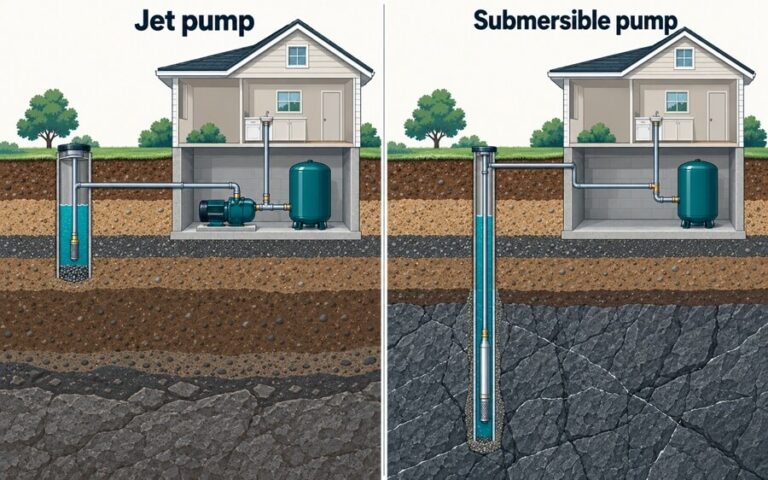
Go to the pressure tank, usually in the basement, garage or a utility room. If a pump with a motor sits right next to it, you have a jet pump. If there’s only the tank, a pressure switch and maybe a gray control box on the wall, your pump is a submersible down in the well.
Can you switch types? Sometimes. When a shallow jet pump keeps losing its prime, a contractor may suggest a submersible if the well casing is wide enough. Ask before you agree, since it changes the price.
Jet pump vs. submersible
| Jet pump | Submersible pump | |
|---|---|---|
| Where it sits | Above ground, near the tank | Down in the well, under water |
| Best for | Shallow water | Deep drilled wells |
| Replacement cost | Lower, no pulling from the well | Higher, the crew pulls pipe and wire |
| Noise | You can hear it run | Quiet, it’s underground |
| Common trouble | Losing prime, leaks at fittings | Motor or wiring failure down the hole |
| Service | Easy to reach | Needs a pump hoist to reach |
Less common pumps and what they cost
| Pump | Installed cost | When it makes sense |
|---|---|---|
| Booster pump | $1,000 to $2,000+ | Adds pressure after the tank, for example in a home on a hill |
| Solar pump | $1,500 to $6,500+ | No power line at the well, cabins, stock tanks |
| Hand pump | $200 to $2,000 | A backup for power outages |
| Windmill pump | $4,000 to $21,500+ | Remote livestock water |
HomeGuide and Angi ranges.
A hand pump is worth a thought if you lose power often. Some models can be installed in the same well as your electric pump, so you still have water when the lights go out. Ask a contractor whether your casing has room for both.
Well pump replacement cost by depth
Depth matters more than the pump. A submersible pump can cost about the same at 100 feet or 400 feet. What changes is everything around it: the length of pipe and wire, how big the motor has to be to push water up, and how long the crew spends pulling the old pump out.
| Well depth | Replacement cost | Usual pump |
|---|---|---|
| Under 25 ft | $400 to $3,000+ | Shallow well jet pump |
| 25 to 150 ft | $1,200 to $5,500+ | Deep well jet or submersible |
| Over 150 ft | $2,000 to $10,000+ | Submersible |
Source: Angi, updated August 2026.
Want to know how deep wells usually go where you live? Our water well drilling cost calculator shows typical depths by county for the states where we have well records.
How a well pump system works
It helps to know the parts before you read a quote. Water takes this path from the well to your tap:
- The pump pushes water upA submersible sits below the water line inside the casing. A jet pump sits above ground and pulls water up instead.
- The drop pipe carries it to the surfaceThe pump hangs on this pipe, along with its power wire.
- The pitless adapter turns it toward the houseBelow the frost line, the water leaves the casing through a buried line.
- The pressure tank stores some under pressureSo the pump doesn’t have to start every time you open a tap.
- The pressure switch runs the showWhen tank pressure drops to the low setting, it starts the pump. At the high setting, it shuts it off.
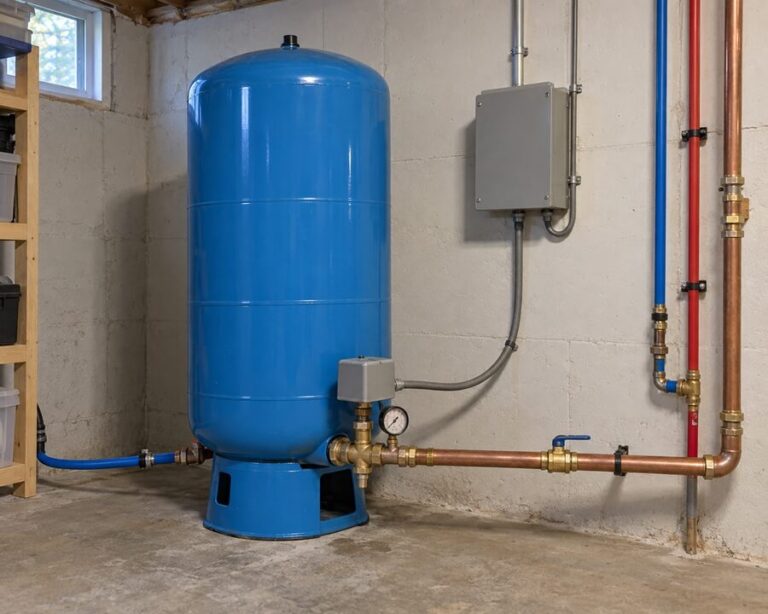
That’s why a “no water” call can come from any of these parts. The pump is just the most expensive one.
What’s included in the price
A pump replacement is more than the pump. Here’s what a full job usually covers, and what to check for on your quote.
| Part of the job | What it is | Always replaced? |
|---|---|---|
| The pump | The motor and pump unit itself | Yes |
| Drop pipe | The pipe that carries water from the pump to the top of the well | Often, if it’s old or damaged |
| Pump wire | The power cable that runs down to the pump | Often, especially if it’s spliced or brittle |
| Control box | Wall box that starts the motor on 3-wire pumps | Only if it’s failed or doesn’t match the new pump |
| Pressure switch | Tells the pump when to turn on and off | Cheap, so often swapped while the crew is there |
| Check valve | Stops water draining back down the well | Sometimes |
| Labor | Pulling the old pump, setting the new one, testing | Yes |
What labor costs
| Labor item | Cost | Source |
|---|---|---|
| Plumbing labor for a pump job | $250 to $1,000 | HomeGuide $250–$800; Angi $250–$1,000 |
| Pump technician hourly rate | $45 to $150 per hour | Angi |
| Electrician hourly rate | $50 to $130 per hour | HomeGuide $50–$130; Angi $50–$100 |
| House call fee | $100 to $150 | Angi |
The one question to ask every contractor: “Are you replacing the pipe and wire, or reusing them?” Reusing old pipe and wire lowers the quote. But if either fails in a year or two, the crew has to pull the whole thing again, and you pay that labor twice.
Repair or replace the pump?
Plenty of “dead pump” calls turn out to be something cheaper. Angi says the average well pump repair costs $974, and most fall between $373 and $1,624. Small parts cost far less than that.
| Repair | Typical cost | Source |
|---|---|---|
| Pressure switch | $120 to $175 installed | Angi |
| Motor start capacitor | $100 to $150 | Angi |
| Pressure gauge | $100 to $175 | Angi |
| Control box | $200 to $500 | Angi |
| Pressure tank bladder (part) | $50 to $100 | HomeGuide |
| Shallow jet pump repair | $200 to $500 | Angi |
| Deep jet pump repair | $400 to $800 | Angi |
| Pump motor | $500 to $1,000 | HomeGuide |
| New pressure tank, installed | $800 to $1,500 | HomeGuide |
Repairs vary by area too. Angi found the average repair in Washington state ran about $1,710, while in Miami it was roughly $400.
A simple way to decide
Lean toward repair
- The pump is less than about 8 years old
- The problem is above ground: switch, tank, gauge or control box
- Water was fine until it suddenly stopped
- The repair costs well under half of a new pump
Lean toward replacing
- The pump is past its 8 to 15 years
- The motor itself has failed
- Pressure has been getting weaker for months
- Your power bill crept up with no other reason
- The crew is already pulling the pump for another repair
That last point matters. Pulling a submersible is a big part of the labor. If the pump is old and has to come up anyway, putting a new one in while it’s out often costs less than paying for two trips.
What your symptoms usually mean
Start at the top of this list. The first checks are free.
- Check the breakerA tripped breaker or blown fuse is the cheapest fix there is. If it trips again right away, stop and call a pro.
- Look at the pressure gaugeNo pressure with the pump off points to the pump or its power. Pressure that bounces up and down points to the tank or switch.
- Listen at the tankIf the pump clicks on and off every few seconds while a tap runs, the tank has likely lost its air.
- Check the filterA clogged sediment filter can make pressure drop slowly over weeks.
- Call a licensed pump contractorIf none of that explains it, the problem is likely down the well.
| What you notice | Common cause | Ballpark cost |
|---|---|---|
| No water at all | Breaker, pressure switch, capacitor or the pump itself | $0 to $175 for small parts; a new pump if the motor is gone |
| Pump clicks on and off fast | Waterlogged pressure tank or failing switch | $120 to $175 for a switch, $800 to $1,500 for a tank |
| Weak pressure | Clogged filter, switch setting, worn pump | A filter cartridge up to a new pump |
| Pump never shuts off | A leak, a bad check valve or a worn pump | Varies; find the leak first |
| Sputtering taps or air | Water level dropping near the pump, or a leak in the drop pipe | Needs a contractor to check |
| Sand or mud in the water | Pump set too low, or a worn well screen | Needs a contractor to check |
| Higher power bill | A worn pump running longer to keep up | Often a sign replacement is coming |
Repair costs from Angi and HomeGuide. Water problems like sand, smell or color? Try our well water symptom checker.
Low pressure that isn’t the pump’s fault
The National Ground Water Association’s well owner site points to two causes people often miss:
- The pump is too small for the house. If your home needs 10 gallons a minute and the pump gives 5, you get a trickle. This often shows up after adding a bathroom.
- Scale in the pipes. Hard water leaves deposits that narrow the pipes and cut pressure, even with a healthy pump.
In both cases, a new pump of the same size won’t fix it. Tell the contractor if you’ve added fixtures or have hard water, so they size the fix correctly.
Early warning signs
Pumps rarely die without a few hints first. HomeGuide and Angi both list the same early signs. Catching them early lets you replace the pump on a weekday, at normal rates, instead of in a Sunday-night emergency.
| Sign | What it can mean | How soon to act |
|---|---|---|
| Pressure slowly getting weaker | A worn pump, or a clogged filter | Within weeks |
| Faucets spitting air | Water level near the pump, or a leak in the drop pipe | Soon, running dry damages the motor |
| Cloudy or sandy water | The pump is stirring up sediment | Soon |
| Odd noises at the tank or pump | Worn bearings, or rapid cycling | Within weeks |
| Power bill creeping up | The pump runs longer to do the same work | Plan a replacement |
| Pump running all the time | A leak, or a pump that can’t reach cut-off pressure | Now |
| Bad smell in the water | Bacteria or a water quality change | Test the water now |
Should you replace the pressure tank too?
Pumps and tanks wear out on a similar schedule. HomeGuide puts both at roughly 10 to 15 years. And a failing tank can kill a new pump early by making it start and stop far too often.
So if your tank is about as old as your pump, it’s worth replacing them together while the crew is already there.
| Tank size | Tank only | Installed |
|---|---|---|
| 20 to 29 gallons | $200 to $500 | $450 to $1,000 |
| 30 to 39 gallons | $300 to $850 | $550 to $1,350 |
| 40 to 59 gallons | $350 to $1,100 | $600 to $1,600 |
| 60 to 79 gallons | $500 to $1,300 | $750 to $1,800 |
| 80 to 99 gallons | $600 to $1,800 | $850 to $2,300 |
| 100 to 119 gallons | $850 to $2,000 | $1,100 to $2,500 |
Source: HomeGuide, July 2025. Labor alone runs $250 to $500+.
Signs the tank is the problem
- The pump turns on and off every few seconds while water runs
- Pressure swings up and down at the tap
- The whole tank sounds solid when you tap it, instead of hollow near the top
- Rust or water around the base
Picking the right size pump
A pump that’s too small leaves you with a trickle when two people shower. One that’s too big costs more and can pull the well down faster than it refills. The Water Systems Council gives two simple ways to size it.
Quick rule: the pump should supply about one gallon per minute for every water fixture in the house.
Peak demand method: size for the busiest few minutes of the morning.
| Bathrooms | Water used in peak 7 minutes | Pump size needed |
|---|---|---|
| 1 | 45 gallons | 7 gpm |
| 2 to 2.5 | 98 gallons | 14 gpm |
| 3 to 4 | 122 gallons | 17 gpm |
Source: Water Systems Council, “Sizing a Well Pump.”
There’s one limit no pump can get around: the well itself. If the well only gives 5 gallons a minute, a 14 gpm pump won’t change that. The well log shows the yield measured when it was drilled.
Pressure settings matter too. The Water Systems Council says most home systems run between 30 and 50 psi or between 40 and 60 psi.
Is a constant pressure system worth it?
A standard pump runs at one speed and switches on and off as the tank pressure rises and falls. A constant pressure (variable speed) pump speeds up and slows down to match how much water you’re using, so pressure stays steady.
| Standard pump | Constant pressure | |
|---|---|---|
| Installed cost | $1,000 to $2,500+ (submersible) | $1,300 to $5,000 |
| Pressure at the tap | Rises and falls between switch settings | Steady |
| Tank needed | Larger tank | Smaller tank |
| Best for | Most homes | Larger homes, many bathrooms, irrigation |
Costs: HomeGuide and Angi.
The National Ground Water Association’s well owner site also points to a cheaper middle option: a constant pressure valve added to a standard pump. It calls it a “good, economic solution” for uneven pressure.
Our take: if your pressure was fine before the pump died, a standard replacement is the sensible choice. A constant pressure system is an upgrade, not a repair.
Three example jobs
These are run through the calculator above, so you can see how the pieces add up.
Shallow jet pump, 20 ft
- Pump in the basement
- Keep the existing tank
- Weekday visit
- Wells under 25 ft
- $400 to $3,000+
- Total
- $400 to $3,000+
The jet pump itself runs $400 to $1,500 installed. Extra repairs push it toward the top.
Submersible, 180 ft
- Replace the pump
- New 40-gallon tank
- Weekday visit
- Wells over 150 ft
- $2,000 to $10,000+
- Tank, installed
- $600 to $1,600
- Total
- $2,600 to $11,600+
A submersible alone is $1,000 to $2,500+. Pipe, wire and labor at this depth decide the rest.
Constant pressure, 120 ft
- Switch to a variable speed system
- Saturday emergency call
- System, installed
- $1,300 to $5,500+
- After-hours fee
- $150 to $300
- Total
- $1,450 to $5,800+
In a well over 150 ft, the top end climbs toward $10,000.
Emergency calls and how long it takes
No water is stressful, and contractors know it. Angi says after-hours service adds $150 to $300, on top of a typical $100 to $150 house call fee.
| When you call | What to expect |
|---|---|
| Weekday, business hours | Standard rates |
| Evening, weekend or holiday | $150 to $300 extra (Angi) |
| The job itself | About 3 to 6 hours for most replacements (HomeGuide) |
If you can get by for a day or two, it’s often worth waiting for a weekday. Fill some jugs, ask a neighbor, and use the time to get a second quote.
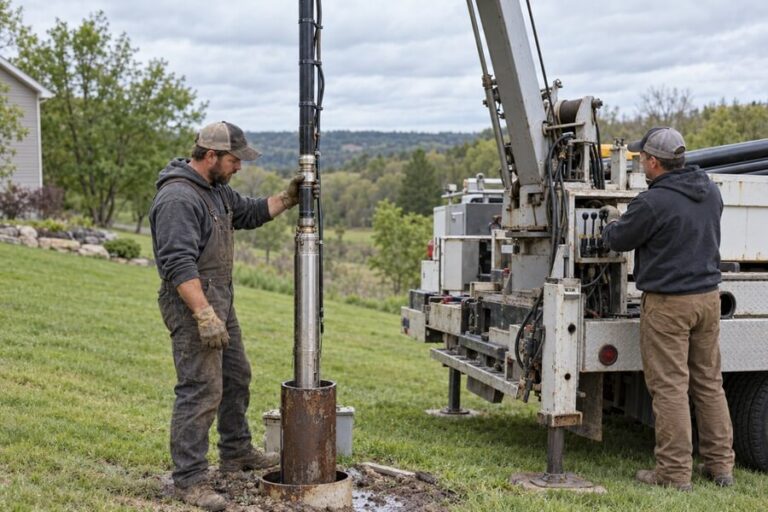
What happens on replacement day
- Power off and diagnosisThe tech confirms the pump is the problem, not the switch or the tank.
- Pulling the pumpFor a submersible, the crew lifts the pump, pipe and wire out of the well, often with a pump hoist truck.
- InspectionThey check the pipe, wire and fittings to see what can be reused.
- New pump setThe new pump goes in at the right depth, with new pipe and wire if needed.
- TestingPressure settings are checked and the system runs through several cycles.
- DisinfectionMany contractors chlorinate the well after it’s been opened. Ask if yours does.
Can you replace a well pump yourself?
A shallow jet pump swap is within reach for a handy homeowner. A submersible is a different story.
- You’re working with 240-volt power and water at the same time.
- A deep pump with water-filled pipe can weigh hundreds of pounds.
- Dropping the pump down the well turns a repair into a much bigger bill.
- Opening the well can let bacteria in if it isn’t disinfected after.
- Angi notes that DIY repair can void the manufacturer’s warranty.
The National Ground Water Association puts it plainly: installing valves, tanks and pumps “is not for amateurs.”
Before the contractor arrives
A few minutes of prep can shorten the visit and make the quote more accurate.
| Do this | Why it helps |
|---|---|
| Find your well log | Shows depth, pump setting and yield, so they bring the right parts |
| Read the tank label | Size and date tell them if the tank should be replaced too |
| Note what happened and when | Sudden failure and slow decline point to different problems |
| Take a photo of the gauge, switch and control box | Helps with phone quotes |
| Clear a path to the wellhead | A pump truck needs to get close to the well |
| Find old receipts | The old pump may still be under warranty |
Getting by without water
- Keep a few gallons of bottled water for drinking and cooking.
- Fill buckets from a neighbor’s outdoor tap to flush toilets.
- Turn off the power to your water heater if it’s electric, so it doesn’t heat an empty tank.
- Once water is back, run the cold taps until the water runs clear.
How to compare well pump quotes
Ask for itemized quotes and line them up. Most price gaps come from what’s included, not from the pump.
| Check | Quote A | Quote B | Quote C |
|---|---|---|---|
| Pump brand, model and horsepower | |||
| Flow rating (gpm) at your depth | |||
| New drop pipe? Type and length | |||
| New wire? Length | |||
| Pressure switch, check valve included? | |||
| Pressure tank included? Size | |||
| Disinfection after the job? | |||
| Warranty on parts and labor | |||
| After-hours fee | |||
| License number checked |
Questions worth asking every contractor:
- Have you confirmed it’s the pump and not the switch, tank or wiring?
- Are you replacing the pipe and wire, or reusing them?
- What size pump are you putting in, and why that size?
- How old is my pressure tank, and does it need replacing too?
- What warranty comes with the pump and with your labor?
- Will you disinfect the well before you leave?
- Are you licensed for pump installation in this state?
What a clear quote looks like
Here’s the shape of a well-written quote for a typical submersible job. The prices are the published ranges from this page, so you can see where each line should land.
| Line item | What it should say | Published range |
|---|---|---|
| Service call | Trip and diagnosis | $100 to $150 |
| Pump, installed | Brand, model, horsepower, gpm rating | $1,000 to $2,500+ |
| Pipe and wire | New or reused, type and length | Should be listed, not hidden |
| Pressure switch | New or reused, pressure settings | $120 to $175 |
| Pressure tank (if needed) | Size in gallons | $450 to $2,500 by size |
| Disinfection | Chlorinate the well after the job | Ask if included |
| Warranty | Parts and labor, in writing | Ask for the terms |
If a quote can’t fill in most of these lines, ask for a revised one before you agree to anything.
Red flags
- A replacement quote before anyone has checked the switch or tank
- One lump sum with no brand, horsepower or parts list
- Pushing a constant pressure upgrade when your old system worked fine
- No license number, or one you can’t find in state records
Find licensed well and pump contractors in your county, with license details from state records.
Common mistakes that cost well owners money
| Mistake | What it costs you | Do this instead |
|---|---|---|
| Replacing the pump without checking the switch and tank | A $1,000+ job for a $150 problem | Ask for a diagnosis first |
| Keeping a dying tank with a new pump | A shorter life for the new pump | Check the tank’s age and air charge |
| Reusing 20-year-old pipe and wire to save money | A second pull, and paying labor twice | Ask what condition they’re in |
| Buying a bigger pump than the well can supply | Running the well dry and burning out the motor | Size the pump to the well’s yield |
| Calling on a Saturday when it could wait | $150 to $300 in after-hours fees | Get by for a day if you safely can |
| Skipping the water test afterward | Drinking water that may carry bacteria | Disinfect and test at a certified lab |
| Taking the only quote you got | Overpaying, or missing a cheaper repair | Get two or three itemized quotes |
Making the new pump last
| Part | Typical life | Source |
|---|---|---|
| Well pump | 8 to 15 years | HomeGuide |
| Pressure tank | 10 to 15 years | HomeGuide |
| The well itself | 30 to 50 years | HomeGuide |
Where your pump lands in that range depends a lot on how it’s treated. The habits that help most:
- Keep the tank healthy. A waterlogged tank makes the pump start and stop over and over, which wears out the motor.
- Don’t let it run dry. If taps sputter during heavy use, the pump may be drawing the water down too far. Spread out laundry, showers and watering.
- Protect it from power surges. Ask an electrician about surge protection if you get a lot of lightning.
- Deal with sediment. Sand wears pump parts. If you see grit, have the setting depth and screen checked.
- Test the water yearly. The CDC suggests a yearly check for bacteria, nitrate, total dissolved solids and pH. Opening the well for pump work is another good reason to test. Find a certified lab near you.
Does homeowners insurance cover a well pump?
Usually not for normal wear. A pump that simply wore out after 12 years is a maintenance cost under most policies. Sudden damage is different: a lightning strike or a fire may be covered. Call your insurer before the work starts and keep the old pump and the contractor’s notes in case you need to file a claim.
Planning ahead: what to budget
Well owners don’t get a water bill, but the system still costs money over time. Spreading the big replacements across their expected life gives you a rough yearly number to set aside.
| Item | Cost | How often | Per year, roughly |
|---|---|---|---|
| Pump replacement | $1,897 average | Every 8 to 15 years | $125 to $240 |
| Pressure tank | $800 to $1,500 | Every 10 to 15 years | $55 to $150 |
| Water test | Varies by lab | Every year (CDC) | Check our lab finder for fees |
Costs from Angi and HomeGuide; yearly figures are simple division, rounded.
Putting a couple hundred dollars a year aside means a dead pump is an annoyance, not an emergency loan.
Buying a home with a well?
The pump is easy to overlook during a home purchase, and it’s one of the first big bills new owners face. Before closing, ask the seller:
- How old is the pump, and when was the pressure tank replaced?
- Who services the well, and are there any receipts?
- Is there a well log? Our well record finder shows where your state keeps them.
- When was the water last tested, and by which lab?
If the pump is near the end of its 8 to 15 years, use this page’s numbers to ask for a credit or plan the cost into your first year.
Cold weather and jet pumps
A jet pump and the pipe to it sit above ground, so they can freeze in an unheated well house, crawl space or garage. A frozen pump can crack its housing, which turns into a replacement. If your pump lives somewhere cold, insulate the space or add a small heat source made for the job, and keep the door shut in winter. Submersible pumps sit below the frost line and don’t have this problem.
Warranties
Pumps usually come with a manufacturer’s warranty, and many contractors add their own warranty on labor. They’re two different things. The manufacturer covers the pump. The contractor covers the installation. Get both in writing, and keep the receipt with the pump’s model number. If the new pump fails early, that paperwork is what gets it replaced for free. Angi also warns that doing the repair yourself can void the manufacturer’s warranty.
When the problem is the well, not the pump
Sometimes a new pump won’t help. If the water level in the well has dropped below where the pump can reach, if the casing has failed, or if the well keeps running out no matter what pump is in it, you may be looking at deepening the well or drilling a new one. A contractor can measure the water level to tell. If it comes to that, our water well drilling cost calculator shows what a new well costs.
Well pump terms in plain English
| Term | What it means |
|---|---|
| Cut-in / cut-out pressure | The pressures where the switch starts and stops the pump, such as 40 and 60 psi. |
| psi | Pounds per square inch, how water pressure is measured. |
| gpm | Gallons per minute, how much water the pump or well delivers. |
| Pump setting | How far down in the well the pump hangs. |
| Static water level | Where the water sits in the well when nothing is pumping. |
| Drawdown | How far the water level drops while the pump runs. |
| Prime | Water a jet pump needs inside it to start pumping. |
| Foot valve | A one-way valve at the bottom of a jet pump’s suction pipe that keeps its prime. |
| Check valve | A one-way valve that stops water from draining back down the well. |
| Control box | A wall box that starts the motor on 3-wire submersible pumps. |
| Capacitor | The part that gives the motor its starting kick. A common, cheap failure. |
| Torque arrestor | A rubber collar that keeps a submersible from twisting in the casing when it starts. |
| Pitless adapter | The fitting where the water line leaves the casing below the frost line. |
| Pump hoist | The truck-mounted rig used to pull a submersible out of the well. |
Well pump replacement cost FAQ
How much does it cost to replace a well pump?
Most homeowners pay $974 to $2,821, and Angi’s national average is $1,897. Deep wells, constant pressure systems and a new tank can push it higher.
How much does a submersible well pump cost to replace?
About $1,000 to $2,500+ installed, according to HomeGuide and Angi. Wells over 150 feet can run $2,000 to $10,000+ once all the pipe, wire and labor are counted.
How much is a shallow well jet pump?
$400 to $1,500 installed. It’s usually the cheapest replacement because the pump sits above ground.
Does a deeper well need a bigger pump?
Usually. The pump has to push water up the full height to the house and still deliver enough flow. The contractor picks the horsepower from your depth and how much water your home uses.
What size pump does my house need?
The Water Systems Council suggests about one gallon per minute per fixture, or 7 gpm for one bathroom, 14 gpm for two to two and a half, and 17 gpm for three to four.
Why does well pump replacement cost more in some cities?
Labor rates and typical well depth. Angi reports averages from $1,285 in Chicago to $3,609 in Tampa.
Can a jet pump be replaced with a submersible?
Often, if the well casing is wide enough and the well is deep enough. It costs more up front, but it can solve a jet pump that keeps losing its prime.
How long does a well pump last?
About 8 to 15 years. A healthy pressure tank, steady water levels and clean water help it reach the high end.
How long does it take to replace a well pump?
HomeGuide says about 3 to 6 hours for most jobs. Very deep wells or extra repairs can take longer.
Should I replace the pressure tank at the same time?
If it’s close to the pump’s age, yes. Both last roughly 10 to 15 years, and a bad tank can shorten the new pump’s life. An installed tank runs about $800 to $1,500.
How do I know if it’s the pump or the pressure switch?
If the pump hums or runs but pressure stays low, the pump may be worn. If nothing happens at all, check the breaker and the switch first. A switch costs about $120 to $175 installed.
Why is my well pump replacement quote so high?
Usually depth, new pipe and wire, a new tank, or a constant pressure upgrade. Ask for an itemized quote and compare it with the ranges on this page.
Is it worth paying extra for a constant pressure pump?
Only if you want steadier pressure, have a large home, or run irrigation. For most homes, a standard pump does the job for less.
What’s the most expensive part of replacing a well pump?
In a shallow well, the pump itself. In a deep well, usually the labor and the pipe and wire, because the crew has to pull and reset everything over the full depth.
Do I need a permit to replace a well pump?
It depends on your state and county. Some require a licensed pump installer and a permit, others don’t. Ask your contractor, and check your state page for the agency in charge.
Is my water safe after a pump replacement?
Opening the well can let bacteria in. Ask the contractor to disinfect the well, then test for bacteria at a certified lab before drinking it again.
What if I wait to replace a failing pump?
A pump that’s running constantly or cycling fast can fail completely, usually at the worst time. Then you pay after-hours rates on top of the replacement.
Prices checked September 2026. Cost estimates are for planning only and are not a contractor quote.