
Water Well Drilling Cost Calculator
What will it cost to drill a new well on your property? Pick your state and get two estimates side by side, drilling only and the complete working well, each itemized with its source.
- You needYour state and county
- Takes1 minute
- CostFree, no sign-up
Short answer: drilling a new water well for a home usually costs $6,000 to $16,000 for a complete, working well about 200 feet deep. The drilling alone runs $20 to $65 per foot. Depth and what’s under the ground move the price more than anything else.
The calculator above gives you two numbers: what the driller charges to make the hole, and what the whole job costs once water reaches your kitchen tap. This guide explains where those numbers come from, what pushes them up or down, and how to check a driller’s quote against them.
How much does it cost to drill a water well?
Most of the bill grows with every foot the driller goes down. A 100-foot well and a 400-foot well can be on the same street, and the deeper one can cost three or four times as much.
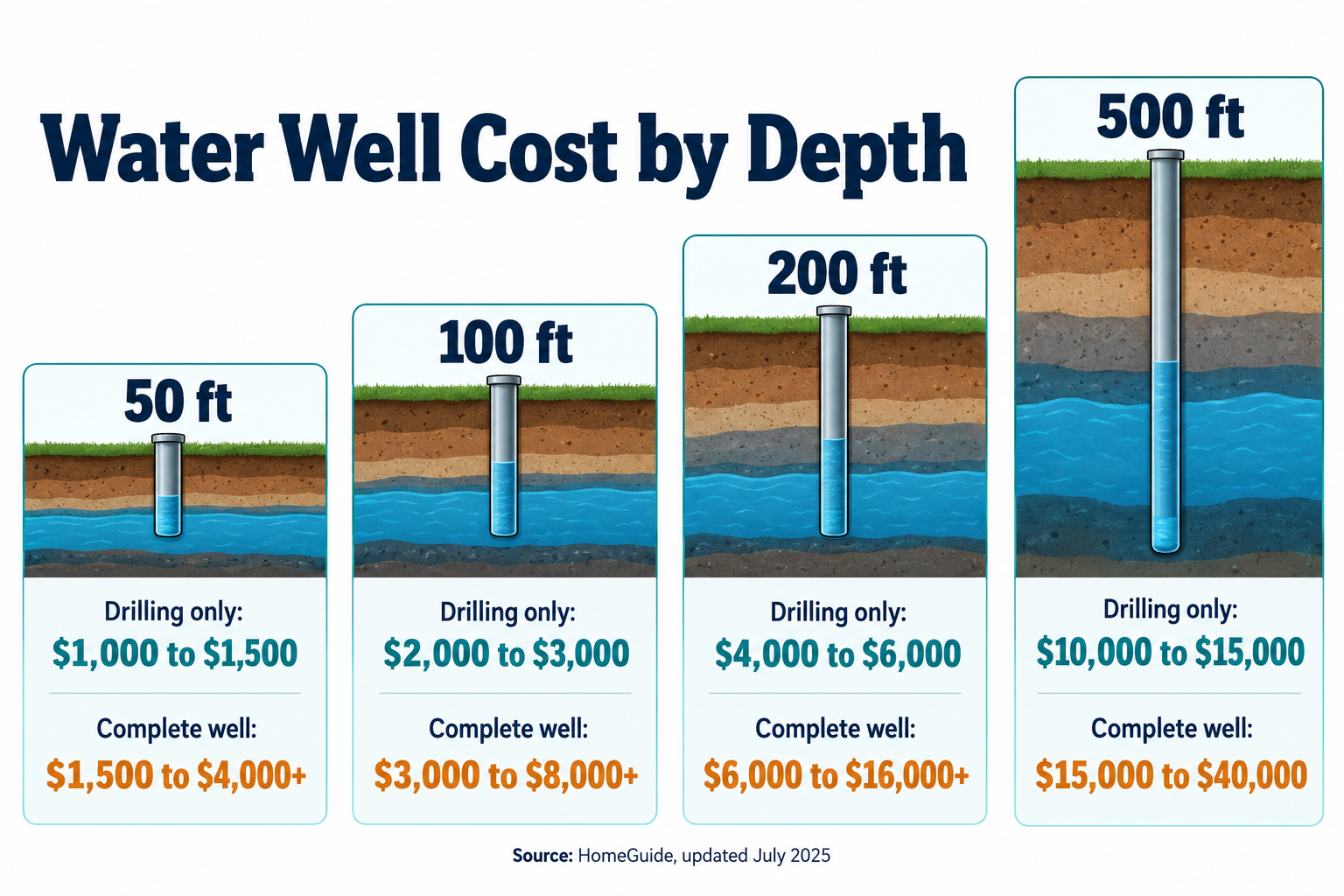
Here’s what HomeGuide publishes for wells at common depths, national averages:
| Well depth | Drilling only | Complete well |
|---|---|---|
| 50 ft | $1,000 to $1,500 | $1,500 to $4,000+ |
| 100 ft | $2,000 to $3,000 | $3,000 to $8,000+ |
| 200 ft | $4,000 to $6,000 | $6,000 to $16,000+ |
| 500 ft | $10,000 to $15,000 | $15,000 to $40,000 |
Source: HomeGuide, updated July 2025. “Complete” covers drilling, casing, pump, electrical work and permits.
Angi lands in the same ballpark. Its example well costs $7,100 at 200 feet with 4-inch PVC casing, and $12,240 with 6-inch steel casing. Same hole, about $5,000 apart, just from the pipe that lines it.
How to use the water well drilling cost calculator
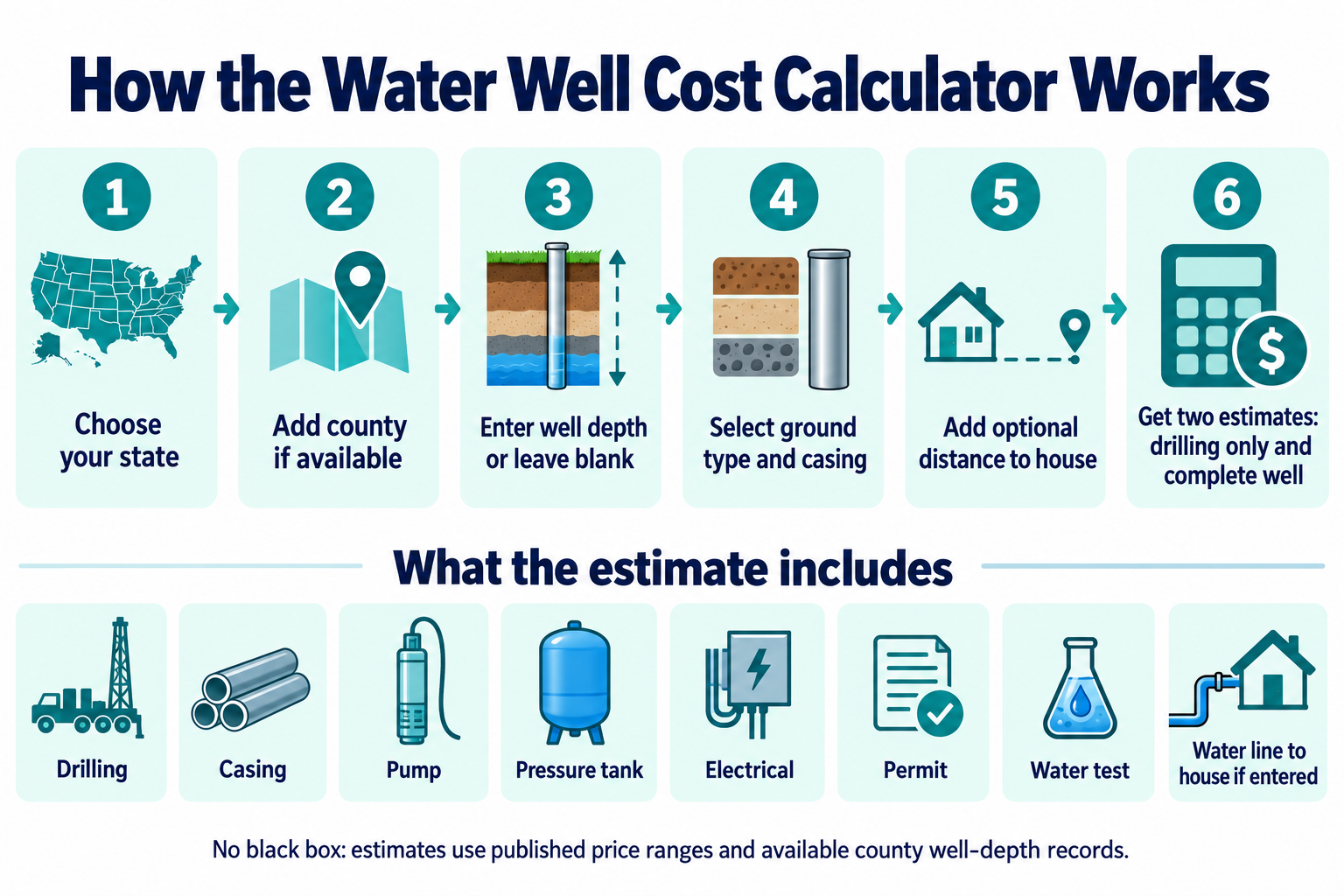
You only need your state to get a result. Each extra answer makes the range tighter.
| Question | Why it matters | If you don’t know |
|---|---|---|
| State | Sets the price per foot. Angi publishes state rates for 8 states. | Required |
| County | Pulls the typical well depth from state well records for that county. | Shows up when we have records for your state |
| Well depth | The biggest driver. You pay for every foot. | Leave it blank. We use county records or 100 to 300 ft. |
| Ground type | Sand and gravel wells are cased all the way down. Rock wells are cased only to the rock. | “Not sure” prices casing from 19 ft up to full depth |
| Casing material | Steel costs several times more per foot than PVC. | We use PVC and show the steel price next to it |
| Distance to house | Adds a buried water line at $30 to $150 per foot. | Left out of the total, and we say so |
| Rocky or hard-to-reach site | Switches drilling to Angi’s $50 to $75 per foot rate. | Leave unchecked |
How the calculator does the math
No black box. Here’s the whole thing:
- Depth. Your number, or the middle half of household wells in your county, or 100 to 300 feet if we have no records.
- Drilling. Depth times the price per foot for your state. The low estimate uses the shallow end and the low price. The high estimate uses the deep end and the high price.
- Casing. Feet of casing for your ground type, times the price per foot for PVC or steel.
- Equipment and fees. Pump, tank, wiring, permit and test, each added once at its published range.
- Water line. Only if you give the distance.
- Rounding. Totals are rounded outward, so the range never looks more exact than it is.
We don’t add regional markups or “difficulty factors” we can’t point to a source for. If we don’t have local data for you, the result says so instead of pretending.
Drilling only vs. complete installation
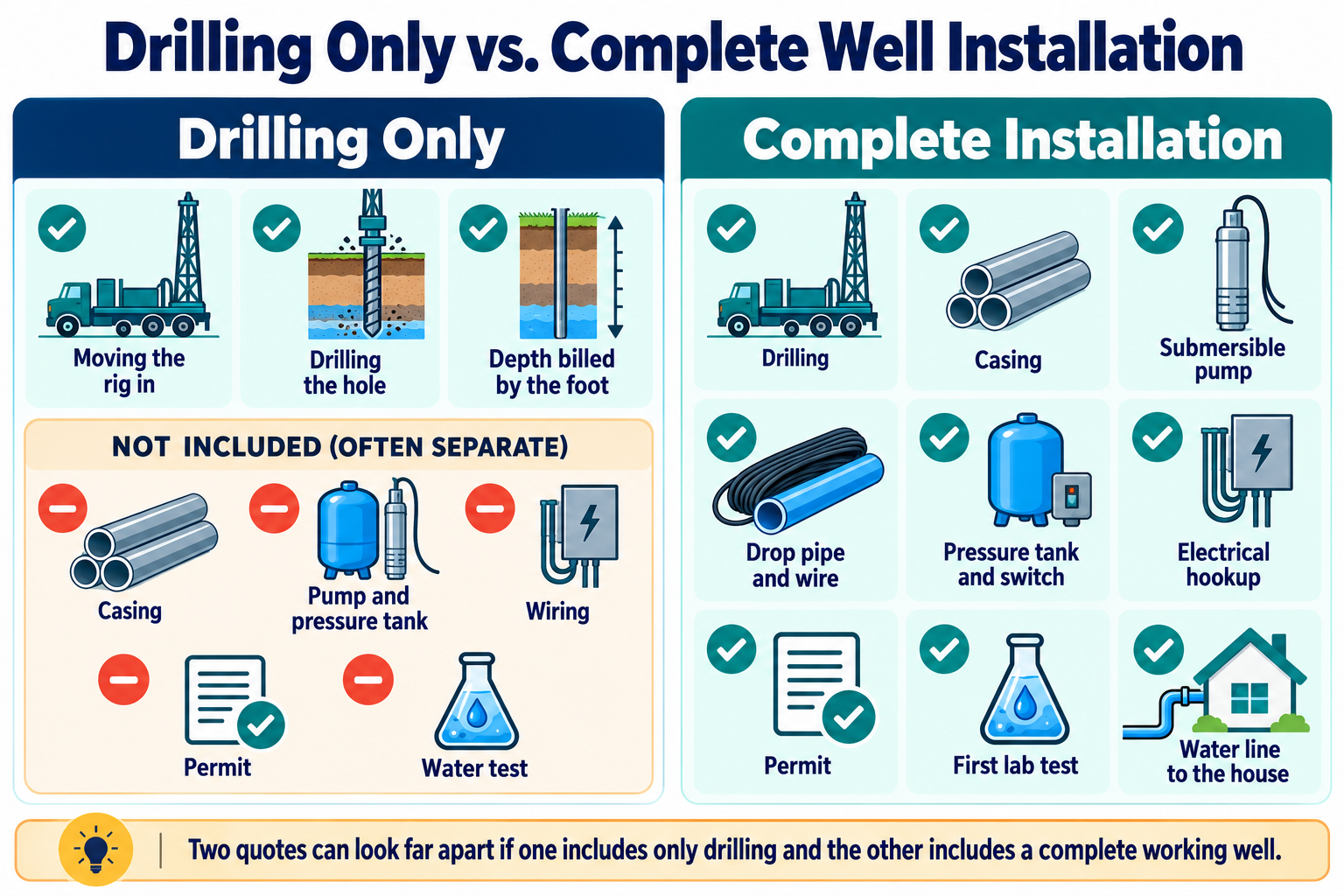
This is where most quote confusion starts. A driller might say “$35 a foot” while a neighbor says their well cost $14,000. Both can be right, because they’re talking about different things.
Drilling only
The hole itself, billed by the foot.
- Moving the rig in and boring to depth
- Casing (priced separately by HomeGuide, Angi and HomeAdvisor)
- Pump, pressure tank, wiring
- Permit and water test
Complete installation
Everything needed for water at the tap.
- Drilling
- Casing
- Submersible pump, drop pipe and wire
- Pressure tank and switch
- Electrical hookup
- Permit and first lab test
- Water line to the house (if you enter the distance)
When you collect quotes, ask each driller which column their price belongs in. Two quotes that look $6,000 apart are often the same job, with one leaving out the pump and tank.
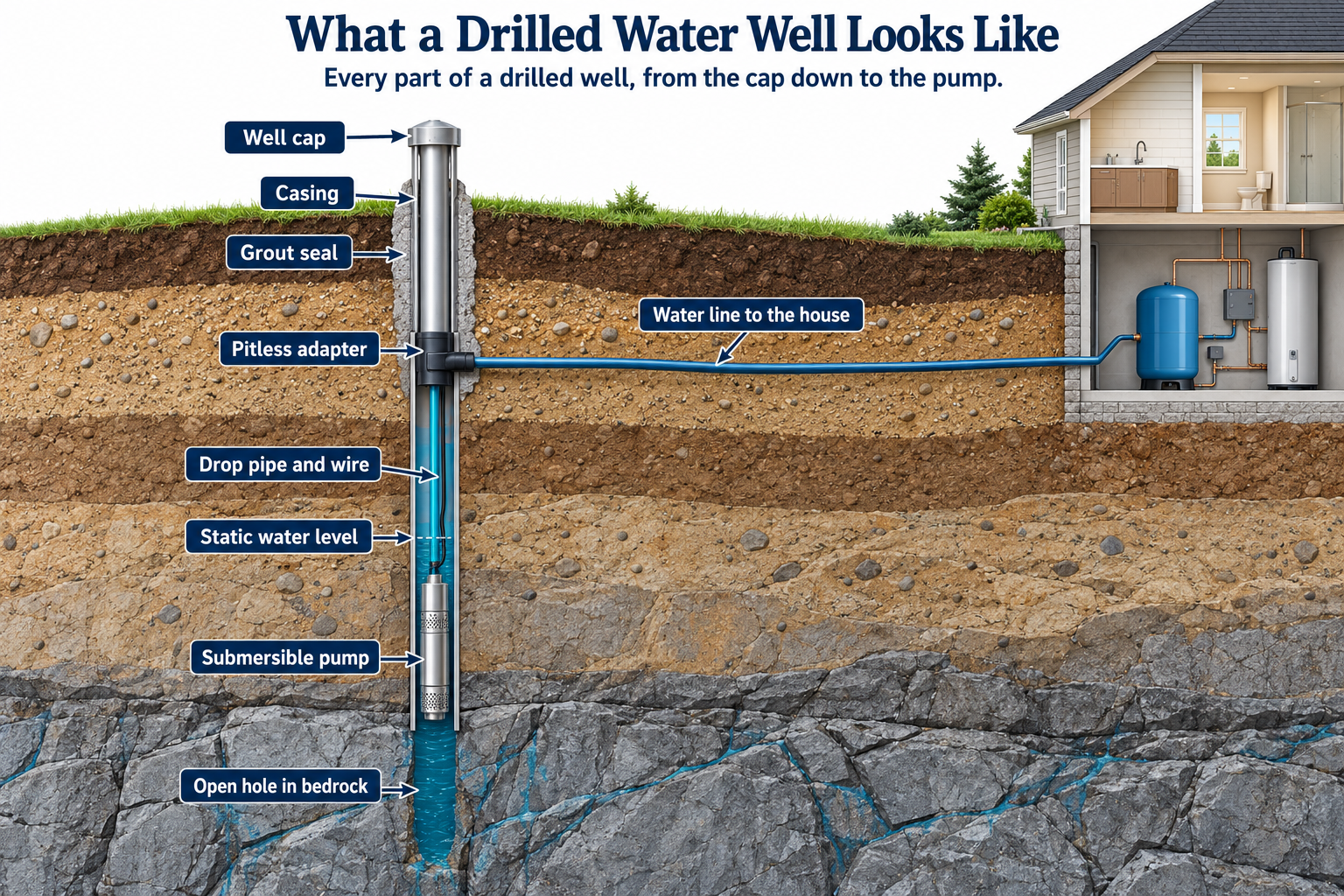
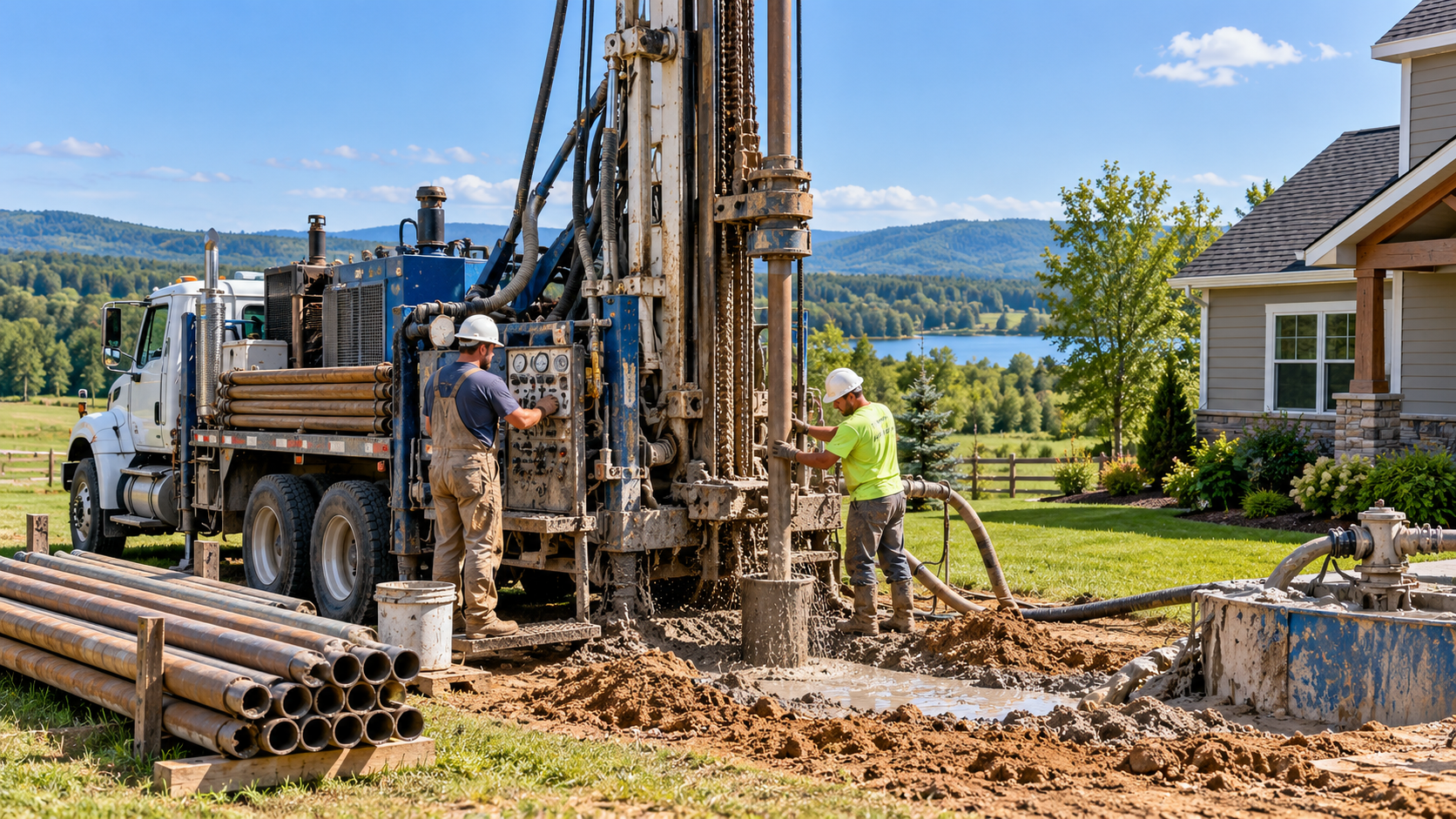
What a drilled well looks like
A few more terms you’ll hear
| Term | What it is |
|---|---|
| Well screen | A slotted section at the bottom of a sand or gravel well. Water gets in, sand stays out. |
| Pressure tank | Stores water under pressure so the pump doesn’t start every time you open a tap. |
| Yield | How many gallons per minute the well can supply. |
| Well log | The driller’s report: depth, casing, rock layers, water level and yield. |
| Hydrofracturing | Pumping water under high pressure into a rock well to open cracks and raise the flow. |
Where the money goes
Here’s every line in a complete installation, with the published price range behind it. When two sources disagree, we show the full span of both.
| Item | Typical cost | What the sources say |
|---|---|---|
| Drilling | $20 to $65 per foot | HomeGuide $20–$30; Angi and HomeAdvisor $25–$65 |
| PVC casing | $6 to $11 per foot | HomeAdvisor and Angi $6–$10; HomeGuide $7–$11 |
| Steel casing | $30 to $140 per foot | Angi and HomeGuide $30–$130+; HomeAdvisor $36–$140 |
| Pump system, installed | $900 to $2,500 | Angi and HomeAdvisor $900–$2,500; HomeGuide $1,000–$2,500 |
| Pressure tank and switch | $300 to $1,500 | Angi and HomeAdvisor $300–$500; HomeGuide $800–$1,500 |
| Electrical work | $1,000 to $3,000 | HomeGuide |
| Permit | $200 to $700 | Angi and HomeAdvisor $200–$500; HomeGuide $350–$700+ |
| Water quality test | $50 to $600 | Angi and HomeAdvisor $50–$600; HomeGuide $100–$350 |
| Water line to the house | $30 to $150 per foot | HomeGuide $30–$50 (water main); Angi $50–$150 (supply lines) |
- Drilling 59%
- Electrical 14%
- Pump 12%
- Tank 6%
- Permit 3%
- Casing (50 ft PVC) 3%
- Lab test 2%
Drilling takes well over half of a typical budget. That’s why depth is the first thing to pin down, and why a cheaper pump rarely saves as much as you’d hope.
Well drilling cost per foot by state
Angi publishes drilling rates for a handful of states. Where your state is on this list, the calculator uses its range. Everywhere else it uses the national $20 to $65.
A note on these ranges: the low end is a soft, easy hole close to the road. The high end is hard rock, a remote site, or a busy driller. Don’t assume your state’s top number is what you’ll pay. Ask drillers for their per-foot rate in your county.
How deep will your well need to be?
Nobody knows for sure until the drill hits enough water. But your neighbors’ wells are the best clue you’ve got, and most states keep a record of every well drilled.
We pulled those records for the states below, county by county. That’s more than 500,000 household wells. The chart shows how much the typical depth swings from one county to the next, even inside one state.
| State | Counties | Well records | Middle county | Shallowest | Deepest |
|---|---|---|---|---|---|
| California | 55 | 103,931 | 280 ft | Del Norte, 60 ft | San Diego, 540 ft |
| Illinois | 89 | 57,268 | 140 ft | Bond, 40 ft | Mercer, 430 ft |
| Kentucky | 64 | 18,995 | 120 ft | Lewis, 60 ft | Grayson, 300 ft |
| Maine | 16 | 55,786 | 260 ft | Aroostook, 200 ft | Androscoggin, 360 ft |
| Missouri | 101 | 106,787 | 330 ft | Andrew, 40 ft | McDonald, 660 ft |
| New Hampshire | 10 | 24,444 | 350 ft | Cheshire, 320 ft | Carroll, 420 ft |
| Oregon | 36 | 66,768 | 180 ft | Deschutes, 80 ft | Jefferson, 470 ft |
| Tennessee | 92 | 74,047 | 200 ft | Coffee, 80 ft | Sullivan, 400 ft |
Median depth of household wells in each county, from state well databases (CA DWR, ISGS, Kentucky Groundwater Data Repository, Maine Geological Survey, Missouri Geological Survey, NHDES, OWRD, TDEC). Most cover wells drilled since 2000; Kentucky since 1990.
Look at Missouri. Two families on opposite sides of the state could pay for 40 feet or 660 feet of well. A statewide average would be useless to either of them. That’s why the calculator asks for your county.
7 things that change the price the most
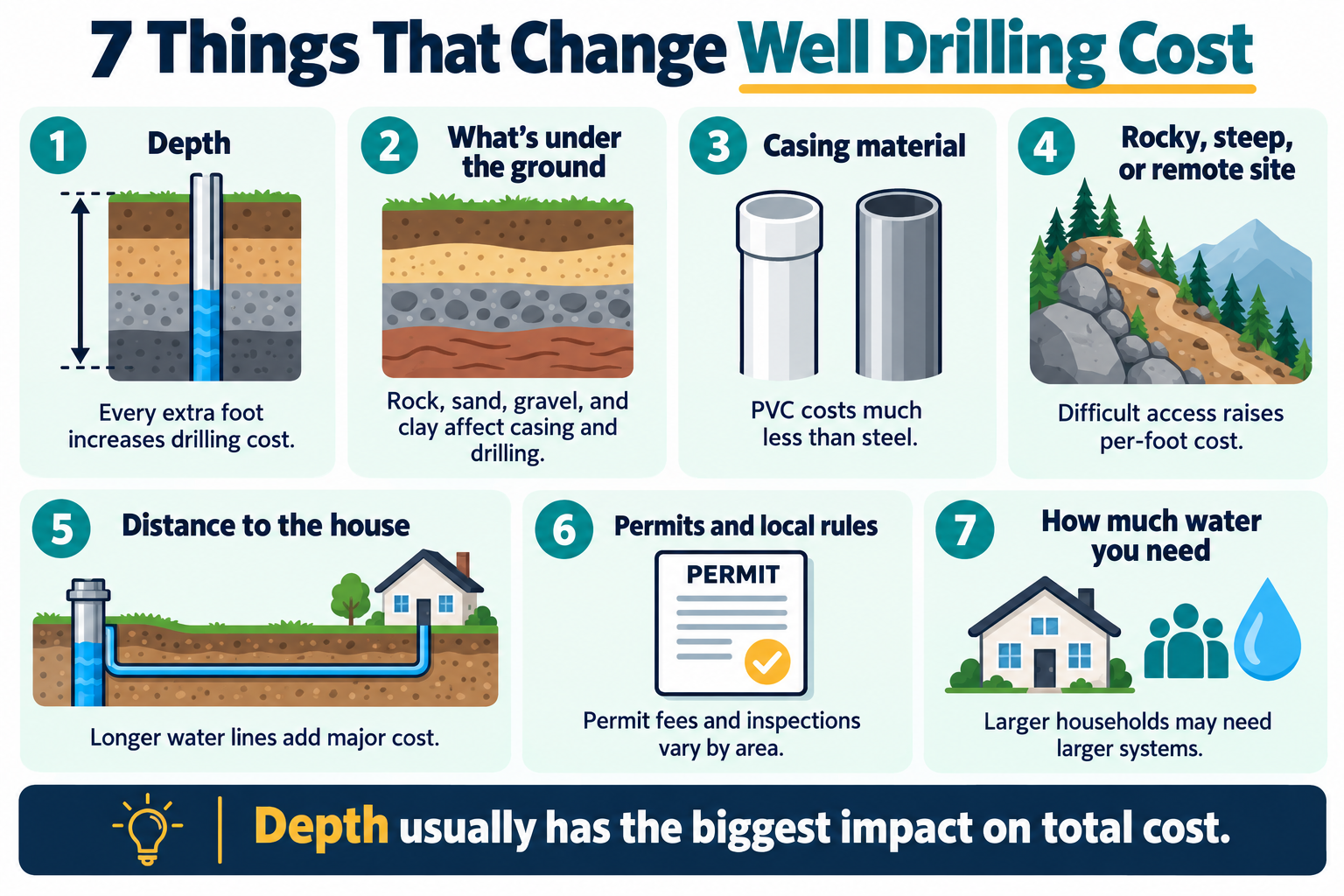
1. Depth
Every foot is billed. Going from 200 to 300 feet adds roughly $2,000 to $6,500 in drilling at $20 to $65 a foot, before any extra casing.
2. What’s under the ground
This changes how much casing you buy. Penn State Extension describes rock wells as cased down to the bedrock, with open hole below that. In sand and gravel, the casing and a screen run nearly the whole depth.
| Ground | Casing needed | Cost effect |
|---|---|---|
| Solid rock under a little soil | Through the soil and into the rock | Short casing run, but slower drilling |
| Sand, gravel or clay | Close to the full depth, plus a screen | Lots of casing, faster drilling |
| Not sure | Anywhere in between | Wider estimate |
State codes set the minimum. New York, for example, requires casing at least 19 feet below the ground, or 5 feet into solid rock, whichever is deeper.
3. Casing material
| Casing | Per foot | 50 ft of casing | 200 ft of casing |
|---|---|---|---|
| PVC | $6 to $11 | $300 to $550 | $1,200 to $2,200 |
| Steel | $30 to $140 | $1,500 to $7,000 | $6,000 to $28,000 |
For a rock well that only needs a short run of casing, the material barely moves the total. For a 200-foot sand well cased all the way down, it can be the biggest line on the bill. Some states or soils call for steel, so ask what your driller plans to use.
4. A rocky, steep or remote site
Angi puts rocky or remote drilling at $50 to $75 per foot. If the rig can’t drive straight to the spot, you may also pay for clearing or a temporary track. Get that priced up front.
5. Distance from the well to the house
| Distance | Water line cost at $30 to $150 per foot |
|---|---|
| 25 ft | $750 to $3,750 |
| 50 ft | $1,500 to $7,500 |
| 100 ft | $3,000 to $15,000 |
A well close to the house saves real money. But setback rules from septic systems and property lines come first, so the driller may not be able to put it where you’d like.
6. Permits and local rules
Fees run about $200 to $700. Some counties also want a site inspection or a water test before you can use the well. Your state page lists the agency in charge.
7. How much water you need
The EPA puts home water use at about 82 gallons per person per day. A bigger household needs a well and pump that can keep up.
| People in the home | Gallons per day | Gallons per month |
|---|---|---|
| 2 | 164 | about 4,900 |
| 4 | 328 | about 9,800 |
| 6 | 492 | about 14,800 |
Three example wells, priced with the calculator
Same calculator, three very different projects. Totals are rounded outward to the nearest $500.
Florida, 120 ft
- Sand all the way down, PVC casing
- 50 ft to the house
- Florida rate: $26 to $58 per foot
- Drilling only
- $3,100 to $7,000
- Complete well
- $7,500 to $24,500
The water line is the swing item here: $1,500 to $7,500 on its own.
Pennsylvania, 200 ft
- Bedrock at 20 ft, PVC casing
- No water line priced
- National rate: $20 to $65 per foot
- Drilling only
- $4,000 to $13,000
- Complete well
- $6,500 to $22,000
Close to HomeGuide’s $6,000 to $16,000+ for a 200-foot well.
North Carolina, 400 ft
- Rock at 30 ft, steel casing
- Steep site, 100 ft to the house
- Rocky rate: $50 to $75 per foot
- Drilling only
- $20,000 to $30,000
- Complete well
- $26,500 to $58,500
Depth and the rocky site do most of the damage. The steel casing only adds about $1,000 to $5,000 because the run is short.
Costs most quotes leave out
These don’t show up in every quote. None of the big cost guides prices them on its own, so we don’t either. Ask for each as a written line item.
| Item | When it comes up | What to ask |
|---|---|---|
| Dry or weak hole | The driller hits too little water | “Do I pay for footage if the hole is dry?” |
| Hydrofracturing | A rock well with low flow | “Do you offer it, and at what price?” |
| Grout, pitless adapter, well cap | Every drilled well | “Are these in your price?” |
| Sealing the old well | You’re replacing a well | “Does my state require it, and who does it?” |
| Site clearing or access | Woods, slopes, soft ground | “Can your rig reach the spot as is?” |
| Water treatment | The first test shows a problem | Filtration runs $800 to $4,000, a softener $1,200 to $3,800 (HomeGuide) |
Penn State Extension says a good well contract should spell out the grout seal, a sanitary well cap, disinfection after drilling, and delivery of the well log and pump test results. If those are missing, ask why.
How long it takes to drill a well
HomeGuide says the drilling itself takes 1 to 3 days for most homes, and the whole install about a week. Permits and the driller’s waiting list usually take longer than the work.
- Quotes and permitCompare 2 or 3 drillers. Most handle the permit.
- Site and setupThe spot is picked to meet setbacks, and the rig moves in.
- Drilling1 to 3 days, depending on depth and rock.
- Casing and groutThe hole is lined and sealed against surface water.
- Yield testThe driller checks how many gallons a minute the well gives.
- Pump, tank and wiringThen the line is trenched to the house.
- Disinfect and testShock the well, then send a sample to a certified lab.
Drilled, driven or dug: which kind of well?
Almost every new home well today is drilled. The other two types are cheaper per foot, but they can’t go deep.
| Well type | Cost per foot | Typical depth | Good to know |
|---|---|---|---|
| Drilled | $20 to $30 | 100 to 1,000+ ft | Reaches deeper, better-protected water |
| Driven | $25 to $40 | Up to 50 ft | A pipe pounded into sandy ground |
| Dug | $15 to $30 | 25 to 50 ft | Wide and shallow, most open to surface water |
Cost and depth: HomeGuide. Drilling price here is HomeGuide’s own figure; Angi and HomeAdvisor put it higher.
Shallow wells pick up whatever soaks into the ground nearby, from septic systems to lawn fertilizer. That’s the main reason drillers and health departments steer homeowners toward a drilled well, even when water is close to the surface.
How to compare well drilling quotes
Lay your quotes side by side and fill in this table for each one. Gaps show up fast.
| Check | Quote A | Quote B | Quote C |
|---|---|---|---|
| Price per foot of drilling | |||
| Casing type, size and price per foot | |||
| Estimated depth and casing length | |||
| Pump make, horsepower and price | |||
| Pressure tank size and price | |||
| Wiring from the panel included? | |||
| Water line to the house included? | |||
| Permit, grout, cap, disinfection included? | |||
| Dry hole policy | |||
| License number checked |
Questions worth asking every driller:
- How deep are wells near me, and how deep do you expect mine to go?
- Where do you usually hit rock around here?
- What casing will you use, and how far down?
- Is the price per foot drilling only, or does it include casing?
- What happens to my bill if the hole is dry or weak?
- Who pulls the permit?
- Will I get the well log and the yield test results?
- Are you licensed and insured in this state?
Find licensed well drillers in your county, with license details from state records.
How to keep the cost down
You can’t control the rock under your yard. But a few choices make a real difference to the final bill.
- Get the well logs first. Knowing how deep neighbors went lets you spot a quote that’s padded with extra footage.
- Put the well close to the house. At $30 to $150 per foot of water line, every 25 feet you save is worth $750 to $3,750. Setbacks still come first.
- Ask about PVC casing. Where your state and soil allow it, PVC costs a fraction of steel per foot.
- Size the pump to your home. A constant pressure system is nice to have, but HomeGuide prices it at $2,000 to $5,000 installed, well above a standard pump.
- Get three itemized quotes. Itemized quotes are the only way to see where two prices really differ.
- Hold off on treatment. Test the new well before buying any filter. Many wells need none.
Red flags in a quote
- One lump sum with no price per foot or casing details
- No mention of grout, the well cap or disinfection
- A “guaranteed water” promise at a set depth
- No license number, or a license you can’t find in state records
- Pressure to sign the same day
New well or fix the old one?
If you already have a well, make sure you actually need a new one. Plenty of “dead” wells only need a new pump, pressure switch or tank, and those jobs cost a fraction of drilling.
| What you’re seeing | Check this first | When a new well makes sense |
|---|---|---|
| No water at all | Breaker, pressure switch, pump | The pump is fine but the water level has dropped below it |
| Weak pressure | Pressure tank, switch, filters | The well can’t keep up even after those are fixed |
| Sand or mud in the water | Pump set too low, worn screen | The casing or screen has failed and can’t be repaired |
| Bad test results | Shock chlorination, treatment | The problem keeps coming back or treatment isn’t practical |
A licensed pump contractor can tell you which side of the table you’re on. Our pump cost estimator covers the repair side, and the symptom checker helps with water quality problems.
Paying for a new well
A well is a big bill to take on at once. If you live in a rural area, check USDA Rural Development’s home repair program before you borrow elsewhere.
| USDA Section 504 | Details |
|---|---|
| Loan | Up to $40,000 at a fixed 1% for 20 years |
| Grant | Up to $10,000 for homeowners 62 and older |
| Combined | Up to $50,000 |
| Who qualifies | Very-low-income homeowners in eligible rural areas |
| What it covers | Repairs and upgrades, including fixing health and safety hazards |
Source: USDA Rural Development, page updated September 2026. Ask your local USDA office whether a new well qualifies for your home.
Some drillers also offer payment plans, and a new well can sometimes be rolled into a home purchase or construction loan. Ask your lender early.
After the well is in
| Part | Typical life |
|---|---|
| The well itself | 30 to 50 years |
| Pump | 8 to 15 years |
| Pressure tank | 10 to 15 years |
Source: HomeGuide.
Test before you drink from it, then once a year. The CDC suggests a yearly check for bacteria, nitrate, total dissolved solids and pH. Our certified lab finder lists state-certified labs near you. If the pump gives out later, the pump cost estimator covers that job.
Irrigation and commercial wells
The calculator itemizes home wells only. Wells for crops, livestock or a business vary too much with the flow they need, and we couldn’t find a reliable item-by-item breakdown.
| Well use | Per foot, complete | Typical total |
|---|---|---|
| Home | $30 to $80+ | $3,000 to $24,000+ |
| Irrigation | $30 to $100+ | $3,000 to $40,000+ |
| Commercial | Varies | $50,000 to $100,000+ |
Source: HomeGuide, national ranges.
Larger wells may also need a water right or a high-capacity permit. Check with your state agency before you budget.
Water well drilling cost FAQ
How accurate is this calculator?
It’s a planning range, not a quote. It uses published national and state prices and real county well depths where we have them. Your actual cost depends on the depth the driller reaches and what’s under your land.
How much does it cost to drill a 100-foot well?
HomeGuide puts a complete 100-foot well at $3,000 to $8,000+, and drilling alone at $2,000 to $3,000. Using the wider $20 to $65 per foot range, our calculator gives $4,600 to $15,500 for a complete 100-foot rock well with PVC casing.
How much does a 300-foot well cost?
At $20 to $65 per foot, drilling alone runs $6,000 to $19,500. A complete 300-foot rock well with PVC casing comes to about $8,500 to $28,500 in our calculator.
How much does it cost to drill a well per foot?
$20 to $65 per foot for drilling only, across HomeGuide, Angi and HomeAdvisor. For a complete well, HomeGuide puts it at $30 to $80+ per foot, and rocky or remote sites can reach $100+.
Does the price per foot include casing?
Usually not. HomeGuide, Angi and HomeAdvisor all list casing on its own line. Ask every driller, so you compare quotes the same way.
Why is the range so wide?
Two reasons. Depth isn’t known until the hole is drilled, and the cost guides themselves disagree, from $20 to $65 per foot. Enter a depth and your ground type and the range narrows.
How do I find out how deep my well will be?
Pick your county in the calculator, then look up logs of nearby wells with our well record finder. Local drillers know their area best.
Do I need a permit to drill a well?
Rules differ by state and county, and fees run about $200 to $700. Ask whether your driller pulls the permit and whether the fee is in the quote.
How long does it take?
HomeGuide says 1 to 3 days to drill and about a week for the full install. Scheduling and permits often add a few weeks.
Is a dug or driven well cheaper?
Per foot, sometimes. HomeGuide lists dug wells at $15 to $30 per foot and driven wells at $25 to $40, but they only reach about 25 to 50 feet. Shallow water is easier to contaminate, so most new homes get a drilled well.
What if the driller doesn’t find water?
Many drillers still bill for the footage. Some go deeper, try another spot, or hydrofracture a rock well. Get the policy in writing before work starts.
Prices checked September 2026. Cost estimates are for planning only and are not a contractor quote. No estimate can promise water at a given depth.