
Well Shock Chlorination Calculator
How much bleach does it take to shock your well? Enter the casing size and depth for the exact dose for your well and plumbing, how to mix it, and a dated plan for flushing and retesting. Built on CDC, state health department and university extension guidance.
- You needWell depth and casing size
- Takes2 minutes
- CostFree, no sign-up
Short answer: to shock a well you need enough unscented household bleach to bring every gallon of water in the well and your plumbing to about 100 ppm of chlorine, the level the CDC aims for. For a 6-inch well with 100 feet of water, that’s about 4¼ cups of 6% bleach. Mix it with a few gallons of water, pour it in, circulate it through every tap, let it sit at least 12 hours, flush it out away from your septic system, and test for bacteria 7 to 10 days later.
The calculator above does the math for your exact well. This guide covers the rest: where the numbers come from, how the official guides differ, the step-by-step process, and what to do when the bacteria come back anyway.
How much bleach do you need to shock a well?
It comes down to two things: how much water is sitting in the well, and how strong your bleach is. The wider the casing and the more water standing in it, the more bleach you need. Stronger bleach means you pour less.
Here’s the amount for the well alone at 100 ppm. Use the depth of the water, not the depth of the well (more on that in the next section).
| Feet of water in the well | 4-inch casing | 6-inch casing | 8-inch casing |
|---|---|---|---|
| 25 ft | ¼ cup + 3½ tbsp | 1 cup + ½ tbsp | 1¾ cups + 1½ tbsp |
| 50 ft | ¾ cup + 3 tbsp | 2 cups + 1 tbsp | 3½ cups + 2½ tbsp |
| 100 ft | 1¾ cups + 1½ tbsp | 4¼ cups | 7½ cups |
| 150 ft | 2¾ cups | 6¼ cups | 11 cups |
| 200 ft | 3½ cups + 2½ tbsp | 8¼ cups | 14¾ cups |
| 300 ft | 5½ cups | 12½ cups | 1 gallon + 1 quart + 2 cups |
| Feet of water in the well | 4-inch casing | 6-inch casing | 8-inch casing |
|---|---|---|---|
| 25 ft | ¼ cup + 1½ tbsp | ¾ cup | 1¼ cups + 1½ tbsp |
| 50 ft | ½ cup + 3 tbsp | 1½ cups | 2½ cups + 3 tbsp |
| 100 ft | 1¼ cups + 1½ tbsp | 3 cups | 5½ cups |
| 150 ft | 2 cups | 4½ cups | 8 cups |
| 200 ft | 2½ cups + 3 tbsp | 6 cups | 10¾ cups |
| 300 ft | 4 cups | 9 cups | 1 gallon |
Calculated by Well Water Insider from casing volume and the available chlorine in each bleach. Amounts are rounded up and land between 100 and 103 ppm. 16 tablespoons = 1 cup, 4 cups = 1 quart.
These numbers cover the well only. Your pressure tank, water heater and pipes hold water too, and that water needs the same dose, so the calculator adds it in. In the worked example further down, the plumbing adds 106 gallons, almost a third of the total.
How do our numbers compare to the official tables? The CDC’s bleach table for drilled wells lists 5 cups for 100 feet of water in a 6-inch well. We get 4¾ cups for the same well with the 5.25% bleach the CDC’s numbers fit. The CDC rounds to easy kitchen amounts, which is why its table runs a little high in some spots and a little low in others. The calculator gives you the exact figure for your well instead.
How much water is in your well?
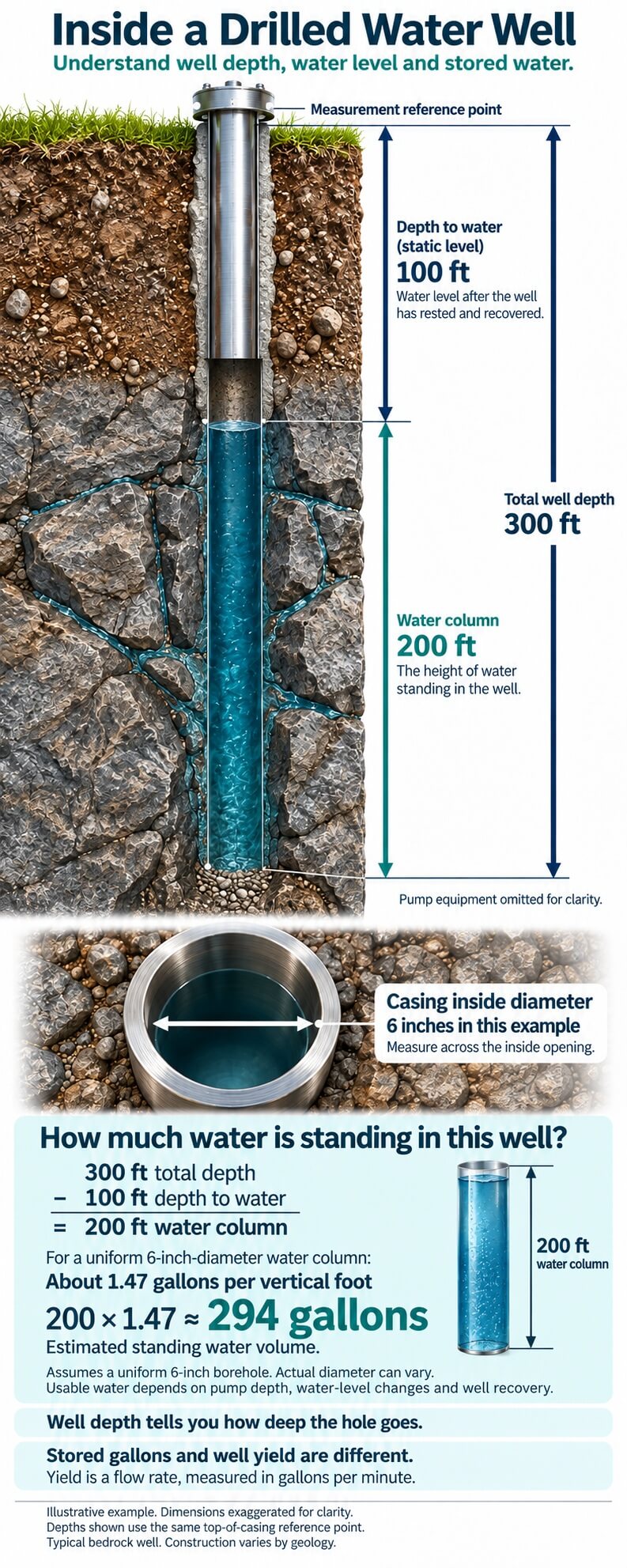
You need two numbers from the well log, or from a contractor: the total depth and the static water level (how far down the water sits when the pump has been off for a while). Subtract one from the other and you have the feet of water in the well. Your state’s well log usually lists both. Our well record finder shows where your state keeps them.
Don’t know the water level? The Minnesota Department of Health says to use the total depth. That counts the well as full, so the dose comes out a little strong, which is the safe side to miss on.
Then multiply by how much each foot of casing holds:
Notice how fast it climbs. An 8-inch casing holds four times what a 4-inch one does, so the bleach amount goes up four times too. Dug wells are another level entirely:
| Dug or bored well diameter | Gallons per foot of water |
|---|---|
| 2 feet (24 in) | 23.5 |
| 3 feet (36 in) | 52.9 |
| 4 feet (48 in) | 94.0 |
| 5 feet (60 in) | 146.9 |
24 and 36 inch figures from University of Georgia and University of Nevada Extension. 48 and 60 inch calculated with the same formula.
For the plumbing, the University of Nevada Extension adds up the pressure tank, the water heater, 3 gallons for each toilet and 10 gallons for the pipes. If you don’t know your tank sizes, the University of Georgia’s method simply adds the same dose you’d use for 100 gallons of well water. The calculator does it either way.
The formula behind the calculator
Here’s the full math, so you can check it yourself or work it out on paper.
- Water in the well. Feet of water times gallons per foot. Gallons per foot is π × (diameter in inches ÷ 24)² × 7.48, which works out to about 0.0408 times the diameter squared.
- Add the plumbing. Tank + heater + 3 gallons per toilet + 10 gallons of pipe, or a flat 100 gallons.
- Bleach needed. Total gallons × target ppm ÷ (bleach strength as a decimal × 0.952 × 1,000,000).
- Round up to a measure you can pour, the same direction the CDC rounds its table.
That 0.952 is the one most calculators skip. A bleach label lists sodium hypochlorite, but the part that disinfects is the available chlorine. By weight, that’s about 95% of the sodium hypochlorite (70.9 against 74.4 in molecular weight), so 8.25% bleach carries about 7.85% available chlorine. It’s a small correction. But it’s the difference between landing on 100 ppm and landing on 95.
When should you shock your well?
Shock chlorination is a fix for specific situations, not a routine chore. Penn State Extension lists three times it makes sense, and the CDC adds a fourth:
- A test came back positive for coliform bacteria. This is the most common reason. Read our coliform bacteria guide first, because the cause matters as much as the cure.
- After a new well is drilled.
- After work on the well, like a new pump or a repair to the pipes.
- After a flood reaches the wellhead. This one comes from the CDC’s emergency well guide.
The University of Nebraska adds one more: iron, manganese or sulfur bacteria, the slimy growth that causes orange slime and rotten egg smells. A shock can knock them back, but Nebraska is clear that it may not get rid of them for good.
How to shock a well, step by step
This is the order the CDC, the Minnesota Department of Health and the University of Georgia all follow, with the small differences between them noted. Set aside a day when nobody needs the water for 12 to 24 hours.
- Get set upBottled water for drinking, cooking and pets. Goggles, rubber gloves and your test strips.
- Bypass the equipmentPut the softener and any filters on bypass. Take out carbon and reverse osmosis cartridges. Check your bladder tank maker’s guide.
- Run the water clearThe CDC says run the pump through the outside tap nearest the well until the water comes out clear.
- Mix the bleachYour calculated amount in a 5-gallon bucket with 3 to 5 gallons of water. Never mix it with other chemicals.
- Power off, pour it inTurn the pump off at the breaker. Open the well cap and pour through a funnel, away from the wires.
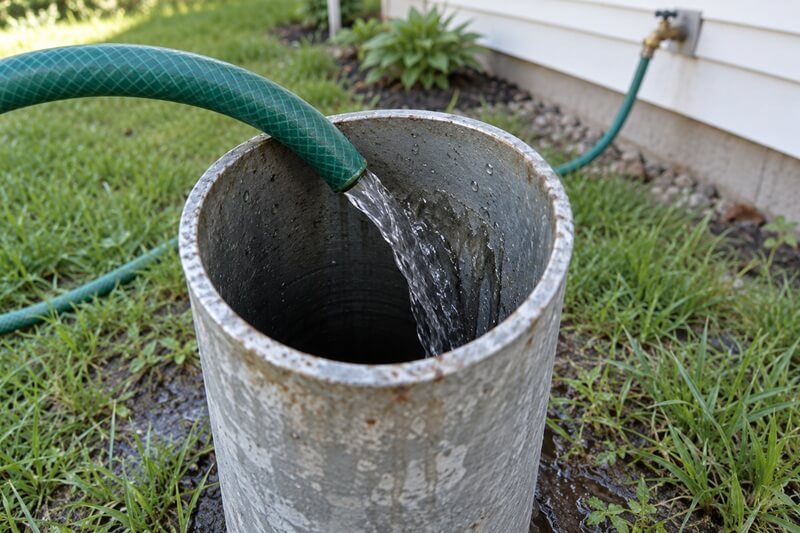
- Circulate itPower back on. Run a hose from the nearest outside tap back into the well, washing down the inside of the casing.
- Pull it through the houseOpen every tap, hot and cold, and flush each toilet until you smell chlorine. Then close them.
- WaitAt least 12 hours, better 24. Don’t use the water.
- FlushOutside hose first, onto gravel or a driveway, then indoor taps, until the chlorine is gone.
- TestBacteria sample 7 to 10 days after flushing.
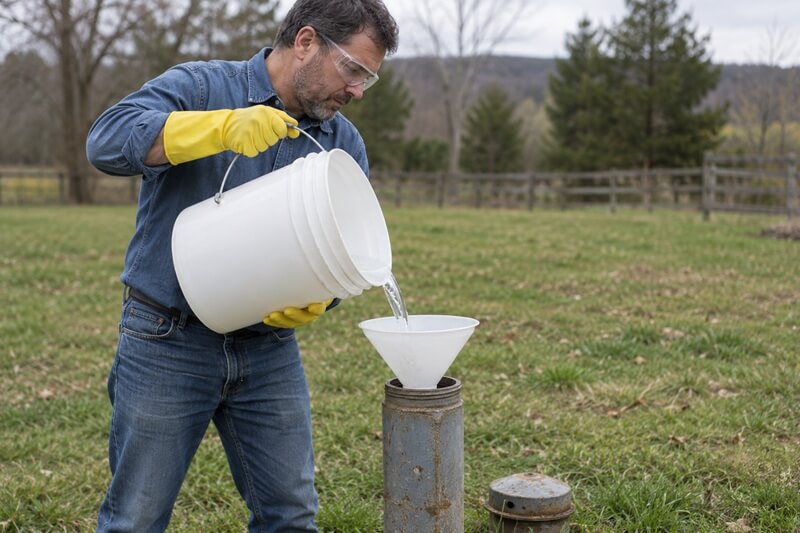
A few details matter more than they look. The recirculating hose isn’t just for mixing. It also washes chlorine down the inside wall of the casing above the water line, a spot that pouring alone misses. The CDC says to rinse it for 5 to 10 minutes. Minnesota goes longer and keeps the hose running for about 30 minutes after you first smell chlorine.
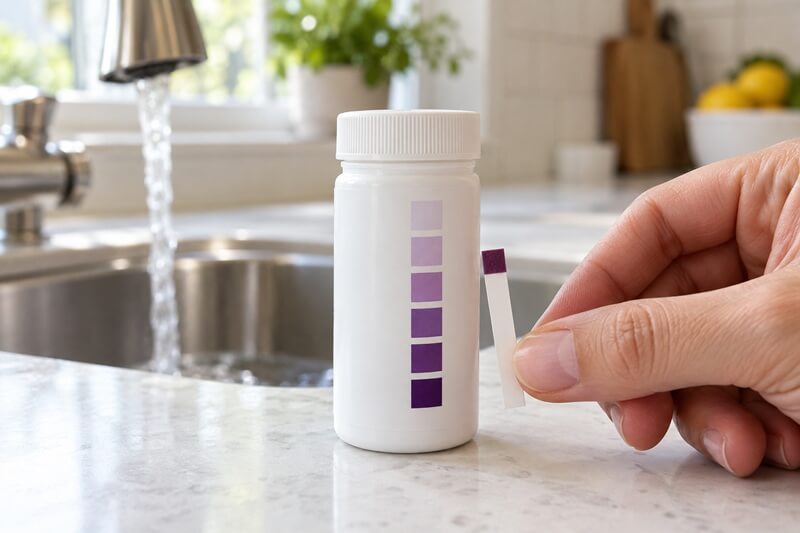
Then there’s the smell test at each tap. It’s a rough check. A high-range chlorine test strip is better, and Minnesota wants it to read at least 50 ppm at the fixtures. If it doesn’t, add more bleach and recirculate again. Hot water needs attention too: Minnesota says chlorinated water has to replace the whole water heater tank, so run the hot side until it smells as strong as the cold.
How strong should the chlorine be?
Here’s something most guides won’t tell you: the official sources don’t agree on one number. They’re all in the same neighborhood, though, and that neighborhood is about 100 ppm.
| Source | Chlorine target | How long to hold it | First bacteria test |
|---|---|---|---|
| CDC | More than 100 mg/L | At least 12 hours | 7 to 10 days after flushing |
| Minnesota Dept. of Health | 50 to 200 ppm, at least 50 at the taps | 2 hours minimum, 6 hours to overnight preferred | Once the chlorine is gone, again at 2 to 4 weeks |
| Wisconsin DNR | About 100 ppm; 200 or 300 as stronger options; no more than 100 in arsenic areas | Overnight, ideally 24 hours | About a week after flushing |
| Pennsylvania DEP | 100 to 150 ppm | At least 4 hours, preferably overnight | 2 to 5 days after the chlorine is gone |
| Oregon State University | 50 to 100 ppm | 6 to 12 hours | About 3 days |
| University of Georgia | About 3 pints of bleach per 100 gallons | 12 to 24 hours | 5 to 7 days |
| University of Nevada | 250 ppm | At least 12 hours | Not stated |
Checked October 2026.
So why not just go stronger to be sure? Because more isn’t better here. Minnesota says chlorine becomes less effective above 200 ppm. Chlorine also works best when pH is low, and Wisconsin DNR notes that chlorine products can push pH up, especially in hard water. Wisconsin puts it plainly: chlorine works best below pH 6 and becomes ineffective above pH 8. Wisconsin also says the mixed solution shouldn’t go above pH 7.5.
That’s why the calculator offers 100 ppm as the standard and 200 ppm as the strong option, and stops there. If your lab report shows a pH over 8, talk to a licensed well contractor before you shock. Don’t pour acid down the well yourself. Wisconsin warns that adjusting pH can release toxic fumes.
Which bleach to buy
Walk down the cleaning aisle and you’ll find a dozen jugs that say bleach. Only some of them belong in your well.
Use
- Plain, unscented household bleach
- A label that lists sodium hypochlorite, usually 6% or 8.25%
- An unopened jug made in the last 6 months (Minnesota)
- Calcium hypochlorite granules, 65% to 70%, dissolved in water first (Pennsylvania DEP)
Skip
- Scented, lemon or “fresh” bleach
- Bleach with added cleaners or thickeners
- Pool and spa products with algicides (Minnesota)
- Stabilized pool chlorine or chlorine-free “pool shock” (Pennsylvania DEP)
Freshness matters more than people think. Bleach loses strength as it sits, which is why Pennsylvania says to use a fresh supply and Minnesota sets the six-month limit. A jug that’s been in the garage for two summers may be well under the strength on the label, and your dose will come up short.
Flushing it out without hurting your septic system
After the wait, all that chlorinated water has to go somewhere. Where you send it matters.
- Start outside. Run a hose from an outside tap onto gravel, a driveway or bare ground, away from your septic system, lawn and garden.
- Keep it out of the septic system. Wisconsin DNR says strong chlorine can kill the bacteria the septic system depends on and overload it with water. Georgia sets a cap of 100 gallons into the septic, total.
- Keep it out of streams, ponds and ditches. The CDC, Pennsylvania, Minnesota, Wisconsin and Georgia all say this. Chlorine kills fish and other aquatic life.
- Finish inside. Once the outside hose runs clear of chlorine, run each indoor tap briefly until the smell is gone.
- Check with a strip. Minnesota suggests one that reads down to 0 ppm, so you know when you’re actually done.
How long does it take? Minnesota says anywhere from 30 minutes to more than 24 hours. Watch the pump. If your well is a slow producer, flush in rounds so you don’t run it dry. When it’s done, put new cartridges in your filters.
Testing after you shock the well
The shock isn’t finished until a lab says so. And timing matters, because testing too soon gives you a false all-clear while there’s still chlorine in the line.
| When | What to do | Source |
|---|---|---|
| Until the first clean result | Boil drinking water for 1 minute, or use bottled | CDC |
| 7 to 10 days after flushing | First test: total coliform and E. coli | CDC |
| 2 to 4 weeks after | Second test | CDC, Minnesota |
| 3 to 4 months after | Third test | CDC |
| From then on | Bacteria at least twice a year, more often if the water changes | CDC emergency guidance |
Use a state-certified lab, not a hardware store kit. Our certified lab finder lists labs near you. If the first result comes back positive, the CDC and Minnesota both say to shock again and retest. If it fails a second time, stop repeating the same fix. Something is letting bacteria in, and that’s the next thing to find.
Does shocking a well actually work?
Sometimes. And it’s worth knowing the odds before you start.
Penn State Extension tracked this. In their study, shock chlorination plus a new sanitary well cap kept the bacteria away for a year in only 15% of wells. It worked best when the original test showed fewer than 10 coliform colonies per 100 mL and no E. coli.
That doesn’t mean shocking is pointless. When bacteria got in during a one-time event, like a pump replacement or a flood, a shock usually clears it. But if the bacteria keep coming back, the well has a path for them: a cracked or loose cap, a casing that doesn’t stick up far enough, a bad seal, surface water pooling at the wellhead, or a septic system too close. Shocking can’t fix any of those.
Shock is likely to work
- Bacteria showed up after a pump job, repair or new well
- One-time flooding that has gone down
- Low coliform count, no E. coli
- The well cap is sealed and in good shape
Look for the cause first
- Coliform keeps coming back after a shock
- E. coli in the sample
- Bacteria after every heavy rain
- A dug or bored well, which the CDC calls hard to disinfect
When it keeps failing, Penn State and the University of Nebraska both point to continuous treatment instead, such as a UV light or a chlorinator. A licensed well contractor can inspect the cap, casing and grout and tell you which path makes sense.
Mistakes that make a shock fail
- Using the well depth instead of the water depth when you know the water level. You’ll overdose, and past 200 ppm the chlorine works worse, not better.
- Old or scented bleach. Weak bleach means a weak dose.
- Skipping the plumbing. Bacteria in the pressure tank and the water heater will reseed the system.
- Not mixing it down the well. Bleach poured on top of a tall water column doesn’t spread to the bottom on its own. That’s why Pennsylvania DEP has you feed it through a hose lowered deep into the well, and why everyone else recirculates.
- Leaving the softener online. The CDC says chlorine can damage a water softener, so bypass it.
- Testing too early. The CDC waits 7 to 10 days so the chlorine is fully flushed. Chlorine left in the sample can hide bacteria that are still in the well.
- Dumping it into the septic system.
Should you do it yourself or hire a pro?
Most homeowners can do this. It takes a jug or two of bleach, a funnel, a garden hose, test strips and a lab test. The hardest part is opening the well cap safely with the power off.
Hiring it out costs about $140 on average, and most jobs run $80 to $200, according to Angi’s July 2026 figures. That’s worth it if you’re not comfortable around the wiring at the wellhead, if the well is in a pit, or if the bacteria keep coming back and you want someone to look at the well itself while they’re there. Wisconsin DNR recommends a licensed well professional for the job, and Georgia notes that licensed well drillers are trained to do it.
Find licensed well and pump contractors near you, with license details from state records.
Shock chlorination FAQ
How much bleach do I need to shock my well?
Enough to bring the water in the well and plumbing to about 100 ppm. For 100 feet of water in a 6-inch well, that’s about 4¼ cups of 6% bleach or 3 cups of 8.25% bleach, plus more for the pressure tank, water heater and pipes. The calculator works it out for your well.
How long after shocking a well can I drink the water?
Not until a lab test comes back clean. The CDC says to wait 7 to 10 days after flushing before you take the sample, and to boil water or drink bottled until the result is back. Don’t drink or bathe in the water while the chlorine is in the system.
How long do I run the water after shocking a well?
Until you can’t smell chlorine at any tap. Minnesota says that can take anywhere from 30 minutes to more than a day. Run an outside hose first, onto gravel or a driveway, then the indoor taps, and confirm with a test strip that reads down to 0 ppm.
How often should I shock my well?
Only when there’s a reason. Penn State Extension ties it to a positive coliform test, a new well, or work on the well or pump, and the CDC adds flooding. If you find yourself shocking every few months, the well has a problem that chlorine won’t fix, and continuous treatment or a repair is the answer.
Can I shock a well for iron bacteria?
Yes, it’s one of the uses the University of Nebraska lists for shock chlorination, along with manganese and sulfur bacteria. But Nebraska warns it may not get rid of them completely, so expect to repeat it or pair it with treatment. See our iron guide for the options.
Will shocking my well hurt my septic system?
It can if you flush the chlorinated water into it. Wisconsin DNR says strong chlorine can kill the septic system’s bacteria and overload it with water. Run the water outside onto gravel or bare ground instead. Georgia limits it to no more than 100 gallons into the septic.
Can I use pool chlorine to shock a well?
Only plain calcium hypochlorite granules, and only dissolved in water first. Pennsylvania DEP says not to use stabilized pool chlorine or chlorine-free pool shock, and Minnesota warns that many pool and spa products contain algicides. In arsenic areas, Wisconsin says to skip granules and tablets altogether.
What if coliform bacteria come back after shocking?
Shock and test once more. If it fails again, look for how the bacteria are getting in: the well cap, casing height, grout seal, drainage around the wellhead and septic setbacks. A licensed well contractor can inspect them. Continuous disinfection such as UV is the usual fix when the source can’t be repaired.
Does bleach go bad?
It loses strength over time. Minnesota says to use an unopened jug made within the last 6 months, and Pennsylvania says to use fresh bleach. Old bleach gives you a weaker dose than the label promises.
Checked October 2026. This calculator is a planning tool based on public health and extension guidance. It doesn’t replace instructions from your state or local health department, your equipment’s manufacturer, or a licensed well contractor.