
Coliform Bacteria in Well Water: What It Means and What to Do
Coliform in your well test means surface water is getting in. Don't drink it untreated: use bottled water or boil it for 1 minute. Find the cause, disinfect the well and retest. E. coli means waste is reaching the water, so act now.
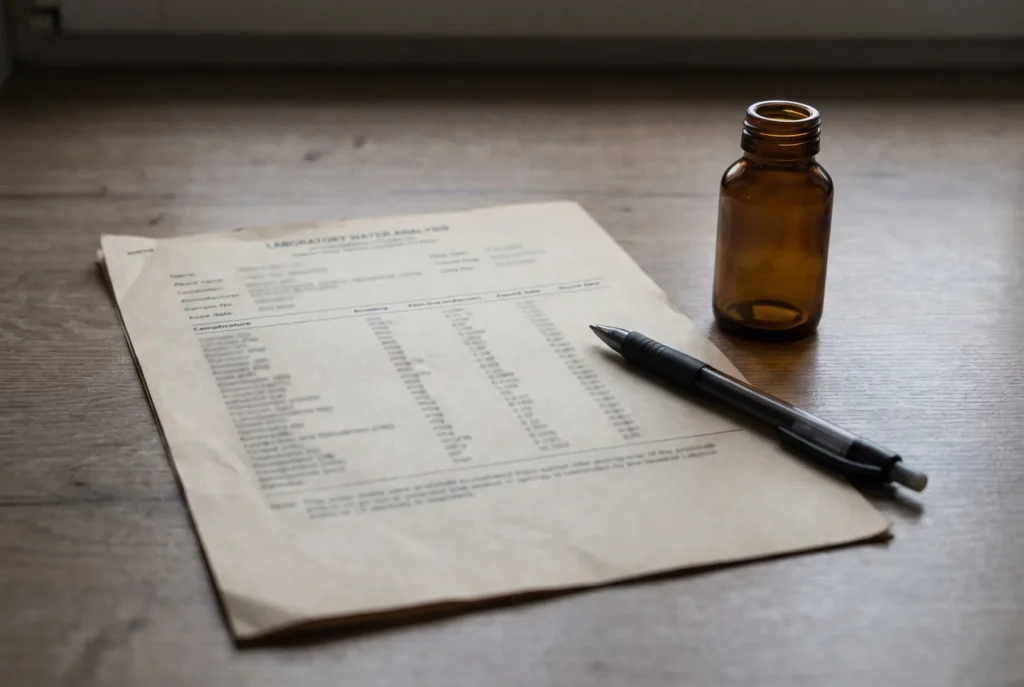
Likely causes
- Loose or cracked well cap
- Cracked or rusted casing
- Casing too short or in a pit
- Surface water pooling at the wellhead
- Septic system or animals too close
- Unsealed old well nearby
- Well or pump work without disinfection
Tests to order
- Total coliform and E. coli
- Confirmation retest
- Nitrate if E. coli is found
- Retest 7 to 14 days after shocking
Treatment options
- Fix the cap and casing first
- Shock chlorination ($80 to $200 by a pro)
- UV disinfection system
- Continuous chlorination
- Repair or replace the well
Short answer: coliform bacteria in a well test mean surface water is getting into your well. Don’t drink the water untreated until it’s fixed. Use bottled water or bring it to a rolling boil for 1 minute. Then find how the water gets in, disinfect the well with chlorine, and retest. If E. coli was also found, human or animal waste is reaching your water, so treat it as urgent.
That last number is the one most guides leave out. Chlorine kills the bacteria in the well today. It does nothing about the crack, loose cap or nearby septic line that let them in. That’s why this guide puts finding the cause ahead of the bleach.
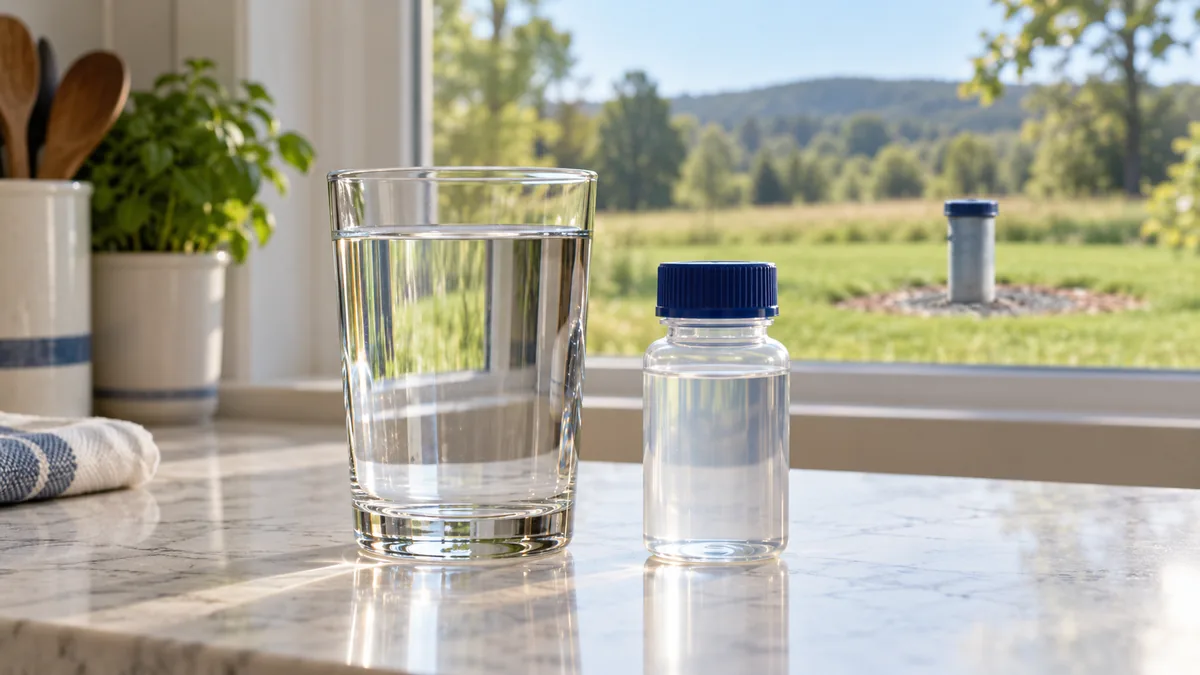
What your test result means
Labs usually report bacteria as “present” or “absent.” Find your result in this table.
| Total coliform | E. coli | What it means | What to do |
|---|---|---|---|
| Absent | Absent | No sign of bacteria today | Keep testing every year |
| Present | Absent | Something from the surface is reaching the water | Boil or use bottled water, find the cause, disinfect, retest |
| Present | Present | Human or animal waste is reaching the water | Stop drinking it now, call your county health department, then fix, disinfect and retest |
| Positive, then negative on retest | Absent | Could be a sampling slip or a problem that comes and goes | Test again in 2 to 3 months before you trust it |
| Positive again after disinfecting | Either | The source is still open | Repair the well, or add continuous disinfection |
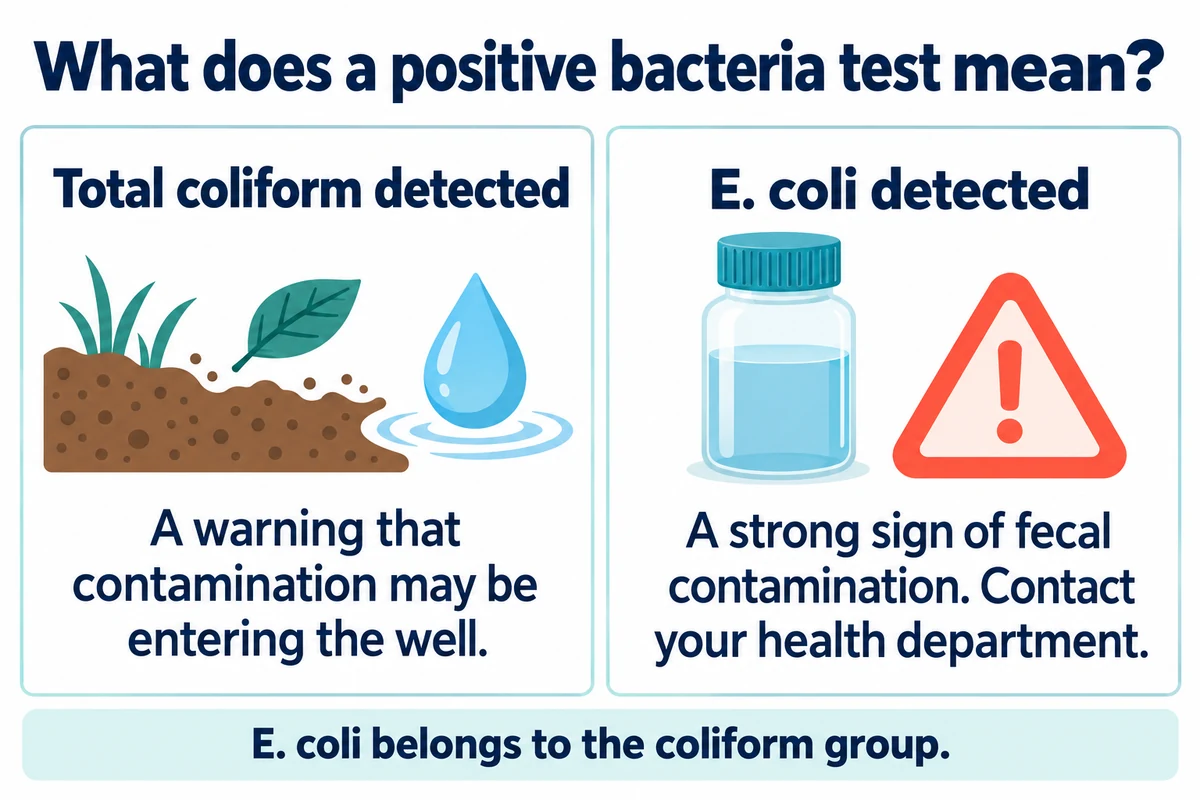
Total coliform vs. E. coli in plain words
Total coliform is a big family of bacteria that live in soil, on plants and in animal guts. Most of them don’t make people sick. Labs test for them because they’re a warning light: if they got in, germs that do make people sick can get in the same way.
E. coli is one member of that family that lives only in the intestines of people and warm-blooded animals. Finding it means sewage or manure is reaching the water.
Is coliform in well water dangerous?
Total coliform on its own usually isn’t what makes people sick. The risk is what comes in with it. Penn State Extension lists the usual symptoms from contaminated well water as stomach upset, fever, cramps and diarrhea, often mistaken for the flu. Children and older adults are at higher risk.
The New York State Department of Health notes that the dangerous E. coli strain O157:H7 is rarely traced to drinking water. Rare isn’t never, though, so an E. coli result means no untreated water for anyone in the house.
What to do in the first 24 hours
- Switch to safe waterBottled water, or water brought to a rolling boil for 1 minute (CDC). Use it for drinking, cooking, baby formula, ice and brushing teeth.
- Order a confirmation testAsk the lab for total coliform and E. coli. A second sample rules out a sampling mistake.
- Walk out to the wellMost causes can be spotted from the ground. Use the checklist below.
- If E. coli was found, call the health departmentYour county environmental health office can help find the source and may check neighbors’ wells.
Find out how the bacteria get in
Penn State Extension says bacteria problems are most common in warm, wet weather, when rain soaks into the ground near the well. The New York Department of Health adds that the main way in is a well defect: a bad cap, a cracked casing, missing grout or flooding at the wellhead.
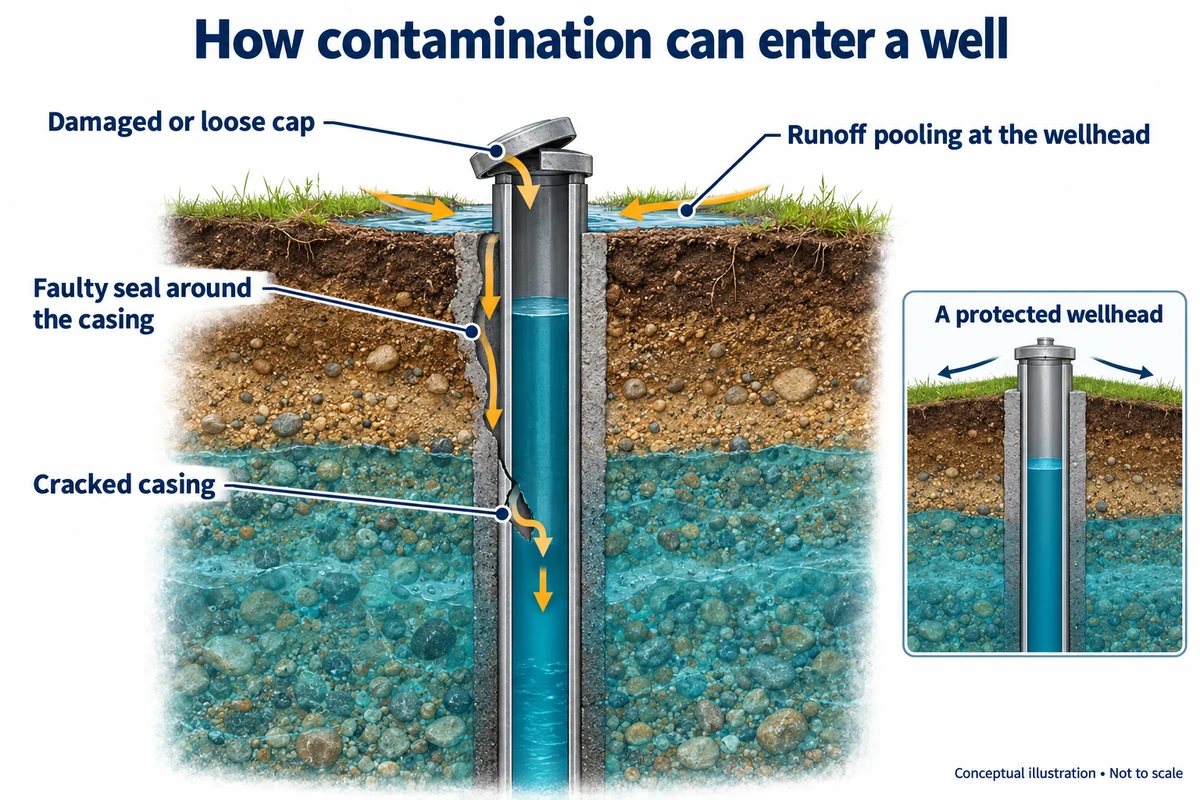
Wellhead checklist
| Check | Good | Problem |
|---|---|---|
| Well cap | Sealed, bolted sanitary cap with a screened vent | Loose plate, cracked cap, insects or nests inside |
| Casing height | Stands well above the ground (state rules range from about 8 to 12 inches) | Flush with the ground, or buried in a pit |
| Ground around it | Slopes away from the well | Puddles or runoff toward the casing |
| Casing | Solid, no holes | Rust holes, cracks, dents from a mower |
| Septic tank | At least 50 feet away | Closer, or uphill and close |
| Drain field | At least 100 feet away | Closer, or soggy ground between them |
| Animals | Pasture, kennels and manure far from the well | Animals kept near the wellhead |
| Old wells on the property | Properly sealed | Open or capped with a board |
| Recent work | Well disinfected after pump or plumbing work | Work done with no disinfection |
Septic distances are the minimums Texas A&M AgriLife and Mississippi State Extension give. Your state may require more. Casing height: Penn State Extension and New York State well standards.
Old, unused wells matter more than people think. Texas A&M AgriLife warns they can act as a direct pipe for contamination into the aquifer your well draws from.
Shallow wells, dug wells and springs are the hardest to keep clean. If your well is one of these, or sits near a pond or stream, the long-term fix is usually continuous disinfection or a deeper drilled well.
How to disinfect (shock chlorinate) a well
Shock chlorination fills the well and your pipes with strong chlorine for several hours, then flushes it out. Do it after fixing the cause, or the bacteria come right back.
Angi puts a professional shock treatment at $80 to $200, about $140 on average. Many owners do it themselves. Here’s the method the Minnesota Department of Health publishes:
Bleach needed
Use plain, unscented household bleach (6% or 8.25% sodium hypochlorite) from an unopened bottle. No scented, splash-less or other bleach with additives, and no pool products.
| Water depth in the well | 2-inch well | 4-inch well | 6-inch well |
|---|---|---|---|
| 10 feet | 2 cups | 2 cups | 2 cups |
| 50 feet | 2 cups | 2 cups | 3 cups |
| 100 feet | 2 cups | 3 cups | 4 cups |
| 300 feet | 3 cups | 4 cups | 10 cups |
Source: Minnesota Department of Health, October 2024. “Water depth” is the depth of water standing in the well, not the total well depth. Your well log shows both.
Step by step
- Bypass treatment equipmentSet softeners, filters and reverse osmosis units to bypass so the chlorine doesn’t damage them.
- Turn off the pump powerAt the breaker. Then open the well cap or vent.
- Mix and pourMix the bleach with a bucket of well water and pour it into the well through a funnel.
- RecirculateTurn the pump on and run a garden hose back into the well until you smell chlorine at the hose. This washes the inside of the casing.
- Run every tapHot and cold, one at a time, until you smell chlorine or a test strip shows at least 50 ppm. Flush toilets too.
- WaitLeave it at least 2 hours, ideally 6 hours or overnight. Don’t use the water during this time.
- Flush it outRun water outside, away from plants, streams and your septic system, until the chlorine is gone. Then run the indoor taps.
- Put things backReturn treatment equipment to service and close the well cap.
The Minnesota Department of Health aims for 50 to 200 ppm of chlorine in the water and no more than 200 ppm. After floods and other emergencies, the CDC calls for leaving the chlorine in for at least 12 hours.
When to retest, and how to take a good sample
| When | What | Source |
|---|---|---|
| 7 to 14 days after the chlorine is flushed out | Total coliform and E. coli | CDC, Penn State Extension |
| 2 to 3 months later | Test again to confirm | Penn State Extension |
| Every year after that | Bacteria, plus nitrate, total dissolved solids and pH | CDC |
| After any well or pump work, or flooding | Bacteria | CDC |
The New York Department of Health suggests late spring or early summer for your yearly test, since bacteria show up most in wet weather. Penn State puts a bacteria test at about $10 to $30 at a certified lab in Pennsylvania. Prices vary by state; our certified lab finder lists labs near you.
Getting a clean sample
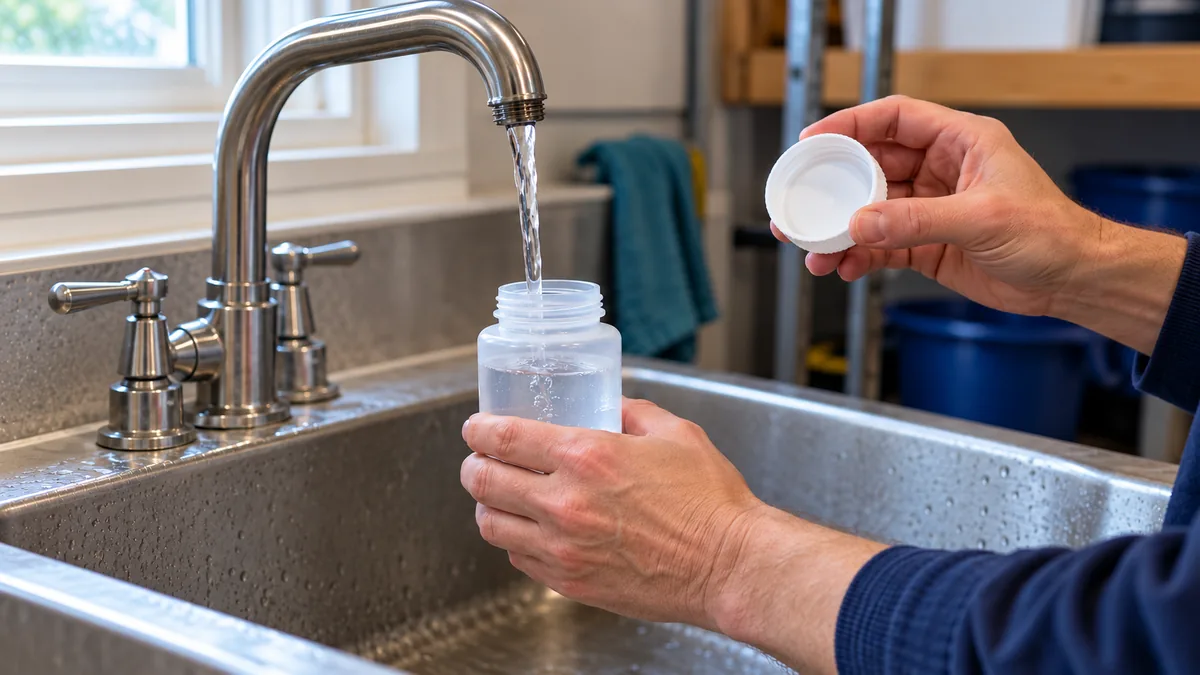
- Use the sterile bottle from a state-certified lab, and follow its instructions.
- Take off the faucet aerator, and don’t sample from a hose or through a filter.
- Wash your hands and don’t touch the inside of the bottle or cap.
- Use the cold tap closest to the well. If you’re retesting, try a different tap than last time.
- Get it to the lab quickly. Ask the lab how soon the sample has to arrive.
Sampling steps: Texas A&M AgriLife and Mississippi State University Extension.
If the bacteria keep coming back
A well that fails again after the cause is fixed and the well is shocked needs a permanent answer. You have four realistic choices.
| Option | Cost | Good to know |
|---|---|---|
| UV disinfection system | $700 to $2,500 installed | Kills bacteria with light, no chemicals. Bulb $50 to $150 a year. Needs clear water. |
| Continuous chlorination | Feed pumps $500 to $2,000 for equipment | Keeps a little chlorine in the water. Needs refills and upkeep. |
| Repair or replace the well | Varies with the repair | A new cap or casing extension is cheap. A new well is not; see our well drilling cost calculator. |
| Connect to public water | Varies | Only where a water line is nearby. |
Costs: HomeGuide, April 2026. Options: New York State Department of Health and Texas A&M AgriLife.
Will a UV system work on my water?
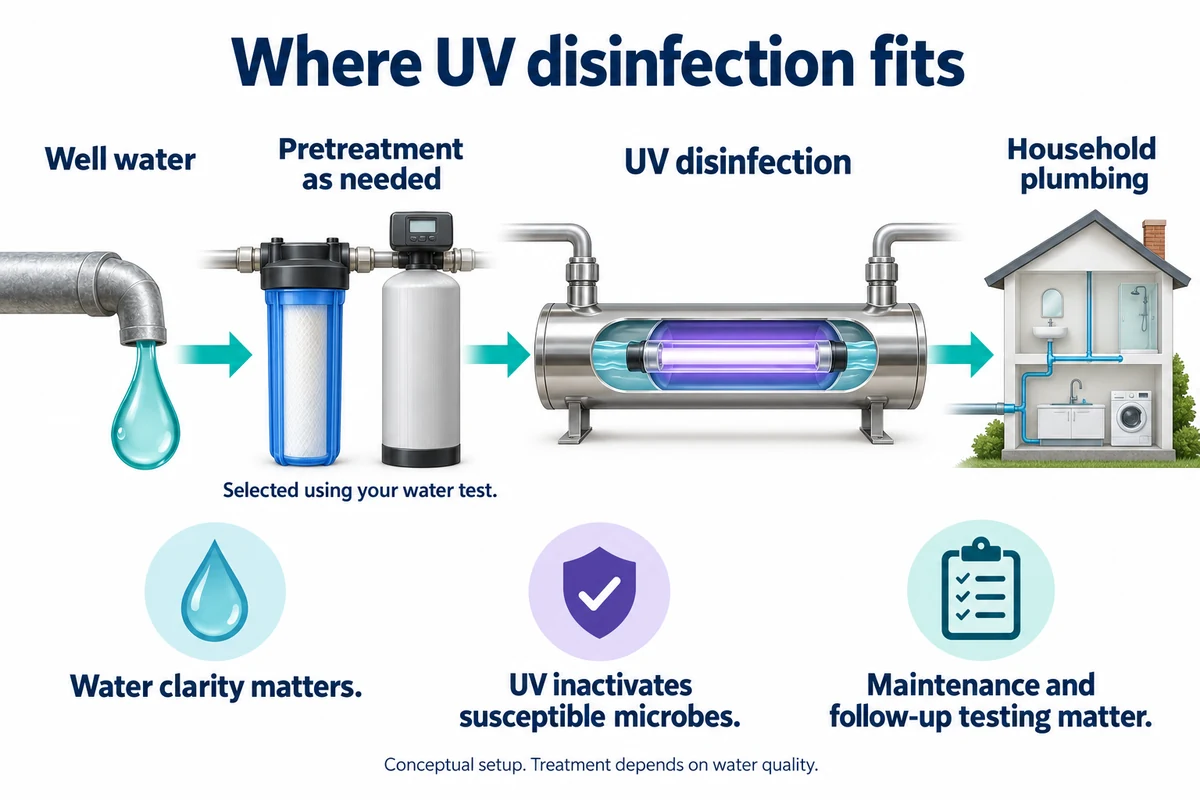
UV light has to shine through the water to work, so the water has to be clear. Penn State says UV isn’t recommended when coliform counts run over 1,000 colonies per 100 mL. A county health department rule for UV systems sets these limits for the water going in:
| Water test | Limit before UV | If you’re over it |
|---|---|---|
| Iron | 0.3 mg/L | Iron filter first |
| Manganese | 0.05 mg/L | Filter first |
| Hardness | 300 mg/L (about 17.5 grains) | Softener first |
| Hydrogen sulfide | 1 mg/L | Sulfur treatment first |
Source: Chautauqua County (NY) Department of Health, UV system requirements.
Plan on a sediment filter ahead of any UV unit too. HomeGuide puts one at $150 to $500 installed. Have a lab report in hand? Our treatment planner checks your numbers against these limits for you.
What it costs, start to finish
| Step | Typical cost |
|---|---|
| Bacteria test at a certified lab | About $10 to $30 in Pennsylvania; varies by state |
| Shock chlorination, DIY | The price of a few bottles of bleach and test strips |
| Shock chlorination, professional | $80 to $200 (Angi) |
| Sediment pre-filter, installed | $150 to $500 (HomeGuide) |
| UV system, installed | $700 to $2,500 (HomeGuide) |
| UV bulb, yearly | $50 to $150 (HomeGuide) |
| UV electricity | About $2 to $4 a month (Penn State) |
Most families get through a single positive test for well under $300. The bigger bills come when the well itself needs work, or when you add continuous treatment.
Find licensed well contractors and water treatment installers near you, verified against state records.
Coliform in well water: FAQ
Can I drink my well water if it has coliform bacteria?
Not untreated. Use bottled water, or bring the water to a rolling boil for 1 minute before drinking or cooking with it, until a retest after disinfection comes back clean.
Can I shower or do laundry with it?
The guidance from health agencies centers on water you swallow: drinking, cooking and brushing teeth (Texas A&M AgriLife). For bathing, especially babies, anyone who is sick, or if E. coli was found, ask your county health department before you rely on the well water.
Does boiling water kill coliform and E. coli?
Yes. The CDC says a rolling boil for 1 minute makes the water safe to drink. One catch from the Minnesota Department of Health: if your water also has nitrate or arsenic, boiling concentrates them, so use bottled water instead. And boiling doesn’t fix the well, so it’s only a stopgap.
Will a regular water filter remove coliform?
Ordinary carbon and sediment filters aren’t made to kill bacteria. To treat bacteria continuously, use UV disinfection or continuous chlorination, ideally after the source is fixed.
How long after shocking can I test the well?
Wait until the chlorine is fully flushed out, then 7 to 14 days. Testing too soon can give a false clean result. Test again 2 to 3 months later to be sure.
Why did my well pass last year and fail now?
Wet seasons push more surface water underground, caps crack and older casings corrode. Bacteria show up most in warm, wet weather, which is why yearly testing matters.
Does shock chlorination fix coliform for good?
Usually not by itself. A Penn State study found one shock kept wells clean for a year in only 15% of cases, mostly wells with low counts and no E. coli. Fixing how the water gets in is what lasts.
Should I test for anything else if coliform was found?
If E. coli was present, add a nitrate test, since septic systems and manure can carry both. Otherwise keep up the CDC’s yearly list: bacteria, nitrate, total dissolved solids and pH.
How common is coliform in private wells?
Quite common. In a Penn State study of 450 private wells, about 35% had coliform bacteria and about 15% had E. coli.
Who can help me find the source?
Your county environmental health office, and a licensed well contractor who can inspect the cap, casing and grout seal. Our contractor finder lists licensed pros by county.
Checked October 2026. This page is general guidance; follow your state or county health department’s instructions where they differ.