
Well Water Smells Like Gasoline or Chemicals? What It Means and What to Do Now
A gasoline, solvent or sweet chemical smell in well water is the one odor that is a stop sign. Here is how to tell it from leftover chlorine, which test to order, who to call, who usually pays, and the treatment that works.
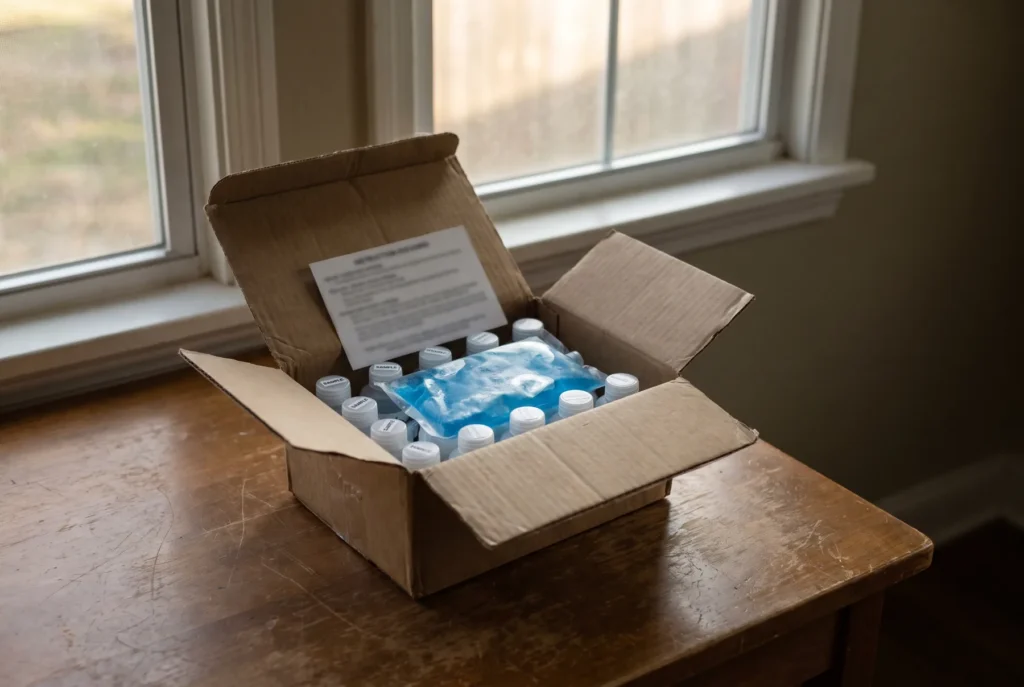
Likely causes
- Leaking underground fuel tank or spill nearby
- Home heating oil tank
- Dry cleaning or industrial solvents (TCE, PCE) in groundwater
- MTBE from older gasoline
- Pesticide mixing or rinsing near the well
- Chlorine left from a recent well disinfection
Tests to order
- Volatile organic compounds (EPA 524.2 or 524.3)
- Total petroleum hydrocarbons
- Pesticide screen
- Chlorine test strip if the well was just shocked
- Total coliform and nitrate
Treatment options
- Stop drinking and cooking with the water
- Report to the state tank or spill program
- Whole-house activated carbon
- Aeration for high VOC levels
- New well or public water hookup for long-term plumes
Short answer: if your well water smells like gasoline, diesel, paint thinner, nail polish remover or a sweet, medicine-like chemical, treat it as a stop sign. The smell almost always means volatile organic compounds (VOCs) have reached your groundwater, usually from a leaking fuel tank, a spill or an old solvent dump nearby. Stop drinking and cooking with the water today, order a VOC test this week, and call your state environmental agency, because these problems usually have a responsible party and a cleanup fund behind them. The one exception is a chlorine or swimming pool smell in the two weeks after a well disinfection, which is expected and flushes out on its own.

First, rule out the harmless one: chlorine after a well shock
Before you worry, think back two weeks. If you, a well contractor or a home inspector disinfected the well recently, a chlorine or swimming pool smell is normal. Shock chlorination fills the well and the pipes with a strong bleach solution, and the Minnesota Department of Health says flushing it back out can take anywhere from 30 minutes to more than 24 hours depending on the well. The smell can linger in the water heater and the far ends of the plumbing for a few days after that.
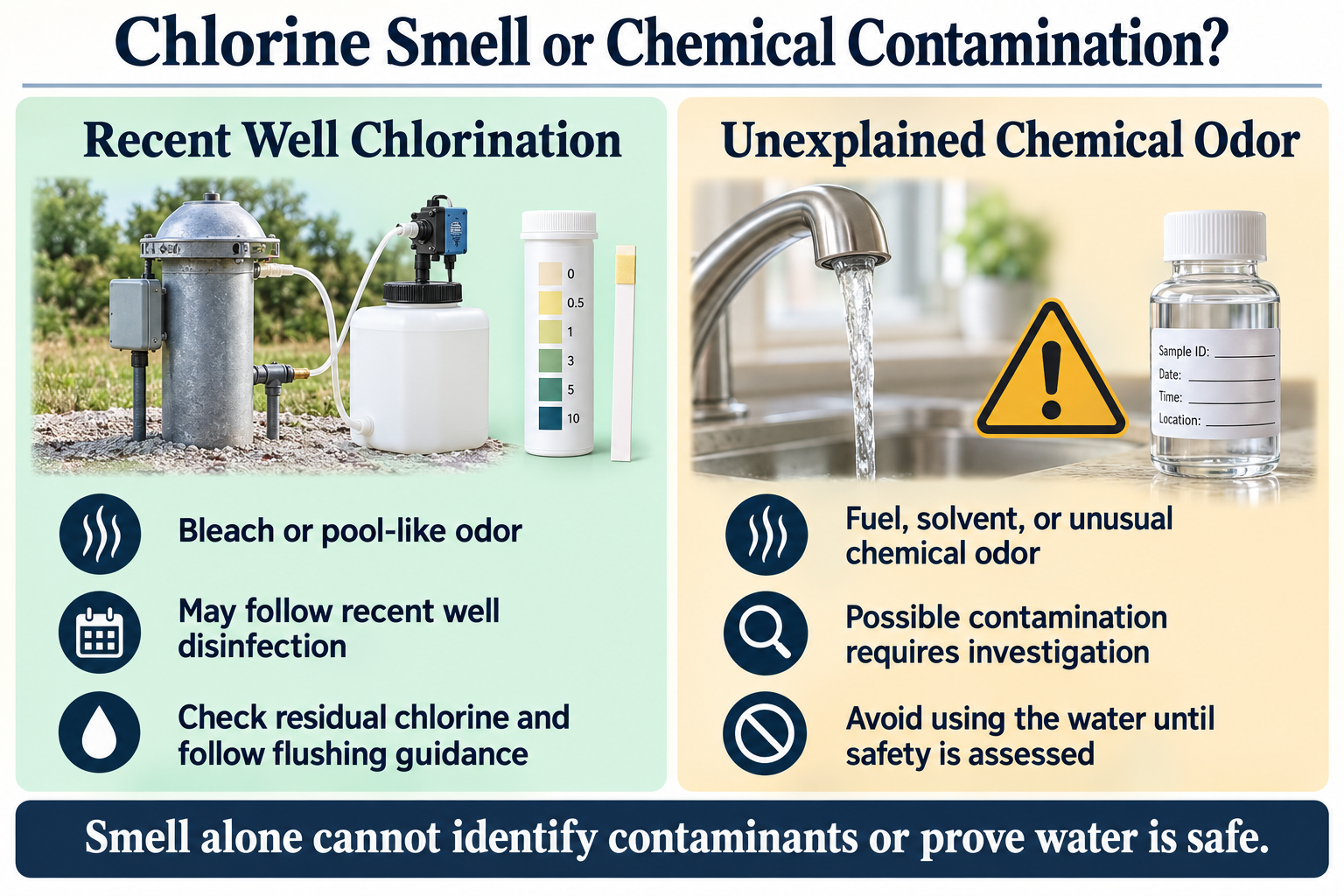
- Flush from an outside tapRun a hose into a gravel area or driveway, away from the septic system, lawn, garden and any pond or stream. Chlorinated water kills the bacteria your septic tank depends on.
- Check with a test stripPool chlorine strips are a couple of dollars. Minnesota’s guidance is to keep flushing until the strip reads zero, not until your nose gives up.
- Then flush the inside tapsRun every faucet, hot and cold, until the smell is gone. Drain a few gallons from the water heater if the hot side still smells.
- Retest for bacteria in 2 to 4 weeksColiform can grow back. A clean follow-up test is what tells you the shock worked.
If nobody has chlorinated your well, or the smell is anything other than bleach, keep reading. A chemical smell that shows up on its own is a different problem.
What the smell is telling you
Your nose is a surprisingly good first screen. Different contaminants smell different, and the smell usually points at the source.
| It smells like | Most likely in the water | Usual source |
|---|---|---|
| Gasoline, diesel or fuel oil | Petroleum hydrocarbons: benzene, toluene, xylenes, plus MTBE in older gasoline | Leaking underground tank at a gas station, farm or home heating oil tank, a spill, a buried pipeline |
| Turpentine or a sharp, sweet solvent | MTBE, a gasoline additive that travels fast in groundwater | Gasoline releases, often years old and some distance away |
| Sweet, like ether, chloroform or an old medicine cabinet | Chlorinated solvents such as TCE or PCE | Dry cleaners, metal degreasing, auto shops, old industrial dumping |
| Paint thinner, nail polish remover, glue | Acetone, toluene, other solvents | Paint and body shops, improper disposal, a spill on the property |
| Bleach or a swimming pool | Chlorine | Recent well disinfection; see above |
| Weed killer or a “farm chemical” smell | Pesticides or herbicides | Spraying, mixing or rinsing equipment near the well, agricultural runoff |
| Rotten eggs or sulfur | Hydrogen sulfide, not a chemical spill | Natural groundwater or the water heater: see our rotten egg smell guide |
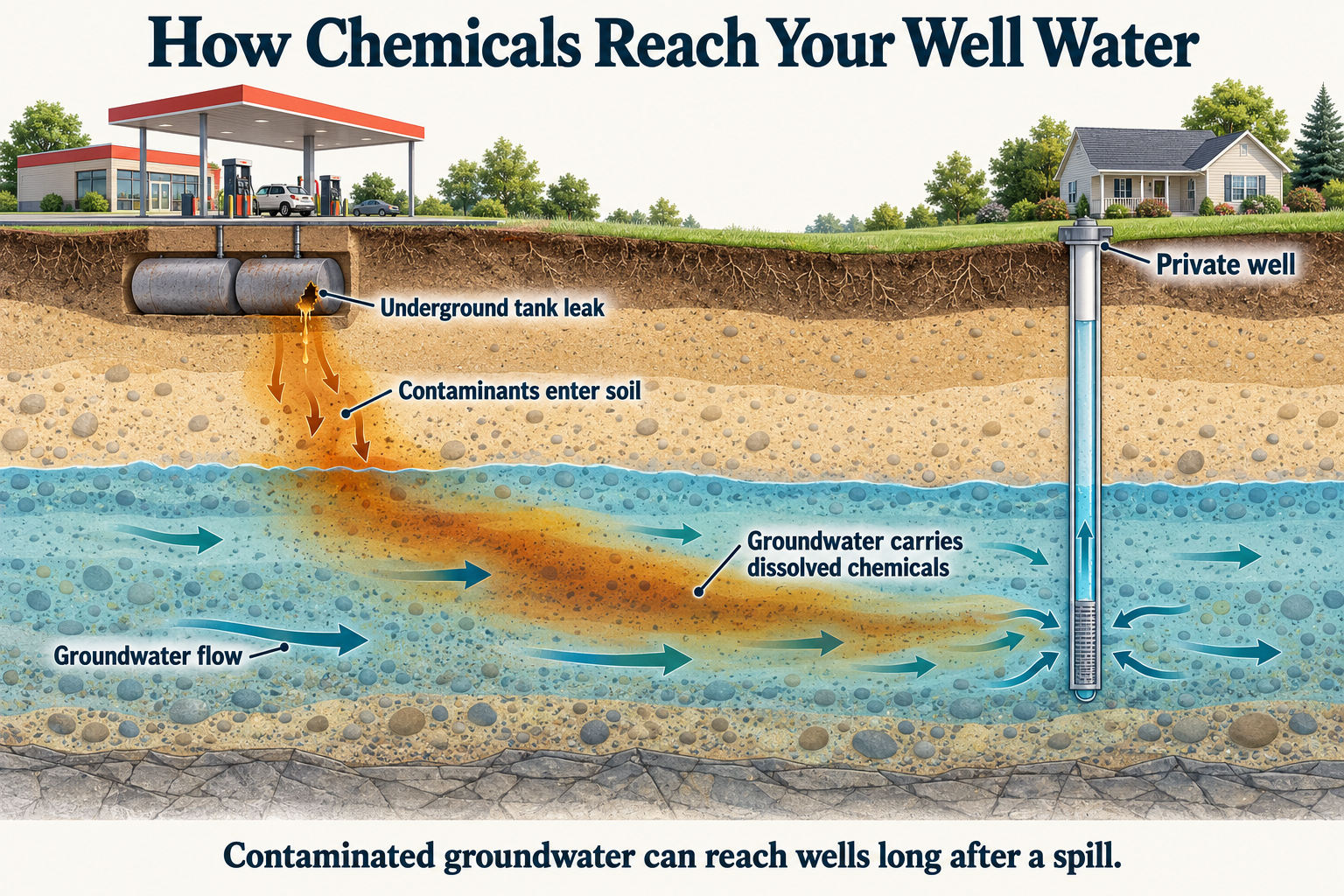
VOCs get into a well the same way every time. The Minnesota Department of Health describes it plainly: a spilled or dumped chemical partly evaporates, the rest soaks into the soil, and rain and snowmelt carry it down until it reaches the water table and drifts toward the nearest wells. That can take months or years, which is why a smell can appear long after a gas station closed or a tank was pulled out. Shallow wells and wells in sandy or gravelly ground are the most exposed; deep wells in dense clay or solid rock are better protected but not immune.
Why you can’t trust your nose to say the water is fine
Here is the part most people get wrong. A chemical smell is bad news, but no smell is not good news. Some of the most dangerous compounds in this group are nearly impossible to smell at the levels that matter. The federal drinking water limit for benzene, the cancer-causing part of gasoline, is 5 micrograms per liter, and most people cannot smell benzene in water until it is far above that. The same is true of the solvents TCE and PCE, which the EPA describes as having a sweet, chloroform-like odor you only notice at high levels, while the limit is again 5 micrograms per liter.
MTBE is the opposite. The EPA set its advisory at 20 to 40 micrograms per liter precisely because that is where people start to taste and smell it, well below the level thought to affect health. So a strong turpentine smell can be a low-risk nuisance, and a faint, barely-there sweetness can be a serious problem. The smell tells you to test. Only the test tells you how bad it is.
What to do today
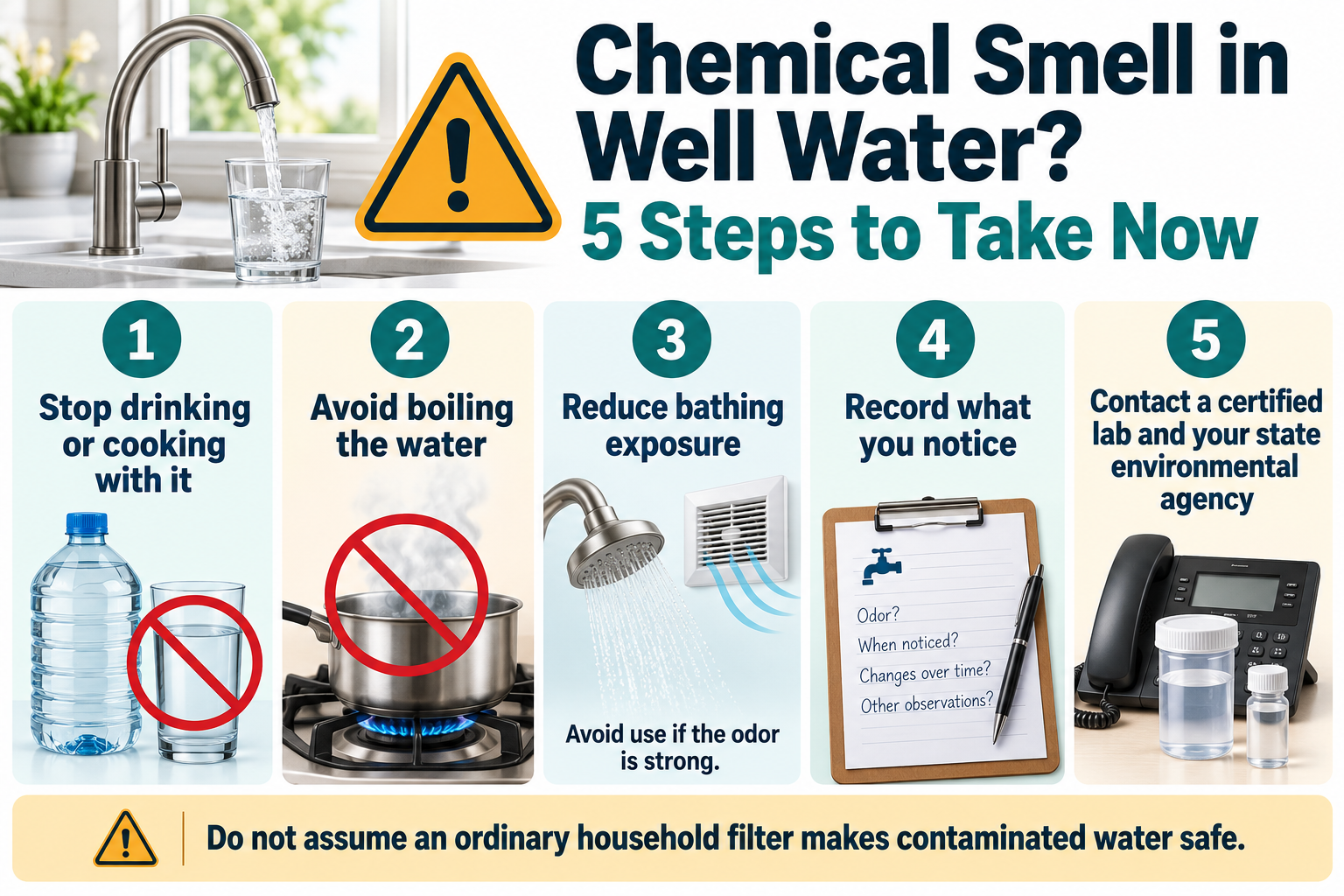
- Stop drinking and cooking with itBottled water for everything that goes in your mouth, including coffee, ice and pet bowls, until a lab says otherwise.
- Shorten showers and ventilateHot water pushes VOCs into the air. Keep showers short, run the fan, and give babies and small children sponge baths with bottled or trucked-in water if the smell is strong.
- Don’t boil the water to fix itBoiling drives the chemicals out of the water and into your kitchen air. It is not a treatment.
- Write down what you noticeWhen the smell started, which taps, hot or cold, how strong, and whether it comes and goes. Note nearby gas stations, shops, farms or tanks. This is useful to the lab and essential if a cleanup fund gets involved.
- Order the test and make the callBoth in the same week. The lab tells you what is in the water; the agency tells you where it came from and who pays.
How to get the water tested
Ask a state-certified lab for a volatile organic compounds panel. Most labs run it by EPA Method 524.2 or 524.3, which covers benzene, toluene, xylenes, MTBE, TCE, PCE and dozens of other solvents in one sample. If fuel or heating oil is the suspect, add total petroleum hydrocarbons, which catches the heavier diesel and oil fractions a VOC panel can miss. If a farm or weed killer smell is the clue, ask for a pesticide screen instead, and add nitrate, which travels with farm runoff; our nitrate guide covers that side.
VOC samples are fussy, and the mistakes are easy to make. Use the lab’s glass vials, not your own bottle. They must be filled with no air bubble at the top, because any headspace lets the gas escape before the lab can measure it. Fill from a cold tap after running it a few minutes, keep the vials cold, and get them to the lab fast. The lab will tell you the holding time, usually a few days. If you want results that will stand up with an agency or an insurer, ask the lab about chain-of-custody paperwork before you sample.
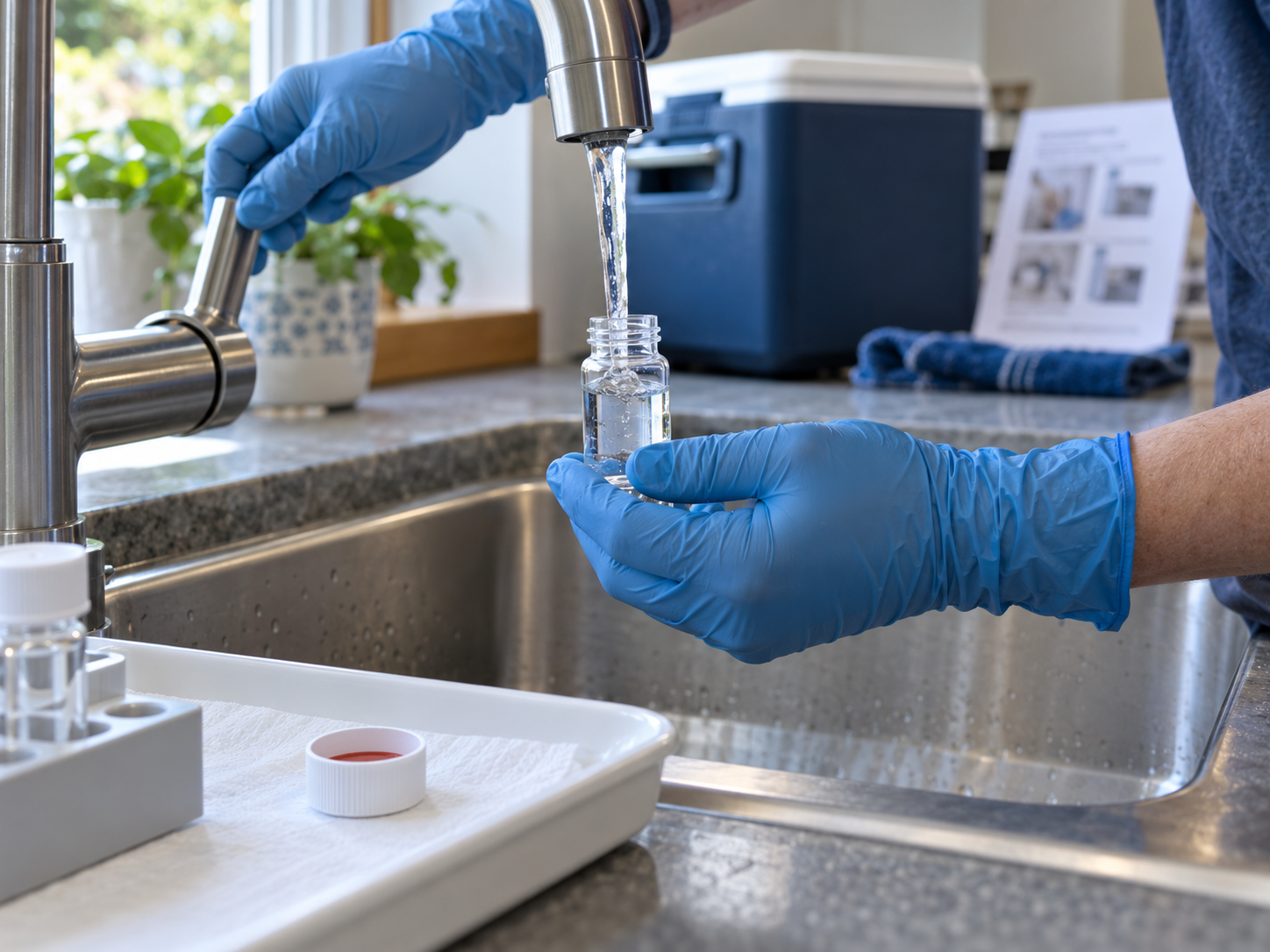
| Test | What it finds | Order it when |
|---|---|---|
| VOC panel (EPA 524.2 / 524.3) | Gasoline components, MTBE, solvents, degreasers | Any fuel, solvent or sweet chemical smell |
| Total petroleum hydrocarbons (TPH) | Diesel, heating oil, motor oil ranges | Fuel oil smell, oily sheen, buried oil tank nearby |
| Pesticide / herbicide screen | Common farm and lawn chemicals | Weed killer smell, well near fields or a sprayer rinse area |
| Chlorine residual (test strip) | Leftover bleach | Well was shocked in the last two weeks |
| Total coliform and nitrate | Bacteria and the usual well basics | Any time you are already paying for sampling |
Find a certified lab near you in our lab finder. Labs that accept homeowner samples will mail you the right vials with instructions.
Who to call, and who pays
Fuel and solvent contamination is different from almost every other well problem in one important way: there is usually someone responsible, and there is usually money set aside to deal with it. Every state runs a program for leaking underground storage tanks, and most keep a cleanup fund paid for by fuel taxes or tank fees. If a nearby tank is the source, that fund, or the tank owner’s insurer, is who typically pays for investigation, replacement water and treatment, not you.
Start with your state environmental agency (the DEQ, DEP, DNR or EPA equivalent) and ask for the tank or spill program. Tell them your address, what the water smells like and when it started. They can check whether a known release site sits near you; many agencies keep these on a public map. Your county or local health department is the second call. Some counties will collect the sample for you, and in confirmed contamination areas some states pay for the testing and the treatment system outright.
Keep every piece of paper: lab reports, dates, photos, the names of the people you spoke with. A documented well test is your evidence. If the source turns out to be a tank on your own property, call the same agency anyway; home heating oil tanks are often covered by state programs or homeowner policies, and the agency will tell you the steps.
Treatment that works, and what doesn’t
Treatment is the second half of the answer, not the first. Agencies and extension services agree on the order: find the source, then treat. A filter on a well sitting in a spreading fuel plume will need its carbon changed again and again, and the level in the water can rise over time. With that said, here is what works once you know what you are dealing with.
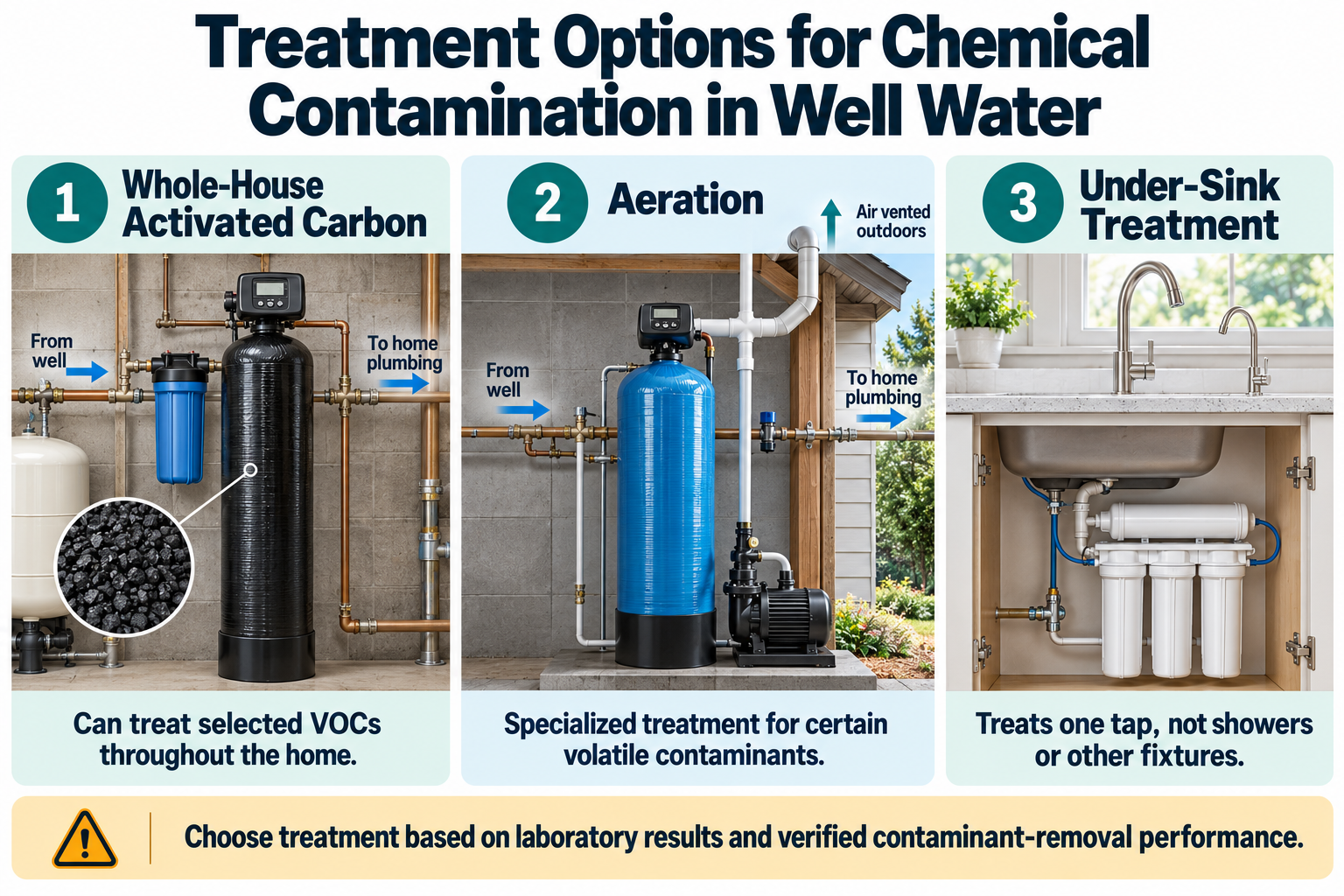
| Option | Best for | Good to know |
|---|---|---|
| Whole-house activated carbon (GAC) | Most fuel components, MTBE, solvents, pesticides | The standard answer from Minnesota Health, Texas A&M and the Water Systems Council. Install at the point of entry so showers and laundry are covered too. Carbon must be replaced on a schedule, sooner with high levels. |
| Aeration (air stripping) | High VOC levels, or as a first stage before carbon | Blows air through the water so the gas leaves before it reaches the house; needs to be vented outdoors and sized by a contractor. |
| Point-of-use carbon or reverse osmosis | Drinking water only | Fine for the kitchen tap while you wait, but it does nothing about the steam in the shower. |
| New well or public water hookup | Long-term plumes, shallow wells that keep getting hit | Minnesota Health calls a new uncontaminated well or a public connection the permanent solution. Often funded by the cleanup program. |
| Water softener | Not a fix | Texas A&M is blunt about it: a typical softener will not remove MTBE, and the same goes for the rest of this list. |
| Boiling | Not a fix | Moves the chemicals from the water into the air you breathe. |
HomeGuide puts most whole-house well water filtration systems at $800 to $4,000 installed, and carbon systems built for VOCs tend to sit in the upper half of that range because they need more carbon and a bigger tank. Once you have a lab report, our treatment planner will match the equipment to your numbers.
How dangerous is it?
It depends on what the lab finds and for how long you were drinking it. The Minnesota Department of Health sums up the group: at high levels VOCs can harm the central nervous system, the kidneys and the liver, and several are known or suspected to cause cancer. Short exposures to a smelly glass of water are unlikely to hurt a healthy adult. Months or years of drinking and showering in contaminated water are the concern, which is why finding the problem now matters more than panicking about last week.
| Compound | Federal limit | Why it’s on the list |
|---|---|---|
| Benzene (gasoline) | 5 µg/L | Known human carcinogen; you can’t smell it at the limit |
| Toluene (gasoline, solvents) | 1,000 µg/L | Nervous system effects at high levels; strong smell is a warning sign |
| MTBE (older gasoline) | Advisory 20 to 40 µg/L | Taste and smell nuisance well below health levels; Texas A&M notes health effects are a concern above about 225 µg/L |
| TCE and PCE (solvents) | 5 µg/L each | Carcinogens tied to dry cleaning and degreasing; sweet smell only at high levels |
| Vinyl chloride | 2 µg/L | Forms as TCE and PCE break down underground; more toxic than its parents |
Limits from the EPA National Primary Drinking Water Regulations as summarized by the Water Systems Council; MTBE advisory from the EPA, via Texas A&M AgriLife Extension.
One more point the Minnesota Department of Health makes: when several chemicals show up together, their effects add up, so a report with five compounds all “below the limit” is not automatically a clean bill of health. Ask the lab or your health department to walk you through a mixed result.
Cheat sheet: what you notice and what to do
| You notice | Most likely | First step | Who pays |
|---|---|---|---|
| Bleach smell, well shocked recently | Chlorine residual | Flush outside until a test strip reads zero | Nobody; a couple of days of hose time |
| Gasoline or diesel smell | Petroleum from a tank or spill | Bottled water, VOC + TPH test, call the state tank program | Usually the tank owner or state fund |
| Turpentine, sharp sweet solvent | MTBE | VOC test, report it, carbon filter if confirmed | Usually the state fund |
| Sweet, chloroform or medicine smell | TCE / PCE solvents | Bottled water, VOC test, ask the agency about nearby sites | Responsible party if one is found; some states cover treatment |
| Paint thinner or glue smell | Acetone, toluene, other solvents | Check for a spill on your own property first, then VOC test | You, if it’s your spill; otherwise as above |
| Weed killer smell | Pesticides | Pesticide screen, move mixing and rinsing away from the well | Usually you; county programs sometimes help |
| Rotten eggs | Hydrogen sulfide, not a spill | Glass test, see the rotten egg guide | You; low risk, nuisance fix |
Find licensed well and water treatment contractors near you, verified against state records, plus certified labs that test for VOCs.
Well water smells like chemicals: FAQ
Why does my well water smell like gasoline?
Gasoline or diesel has most likely reached the groundwater from a leaking underground tank, a spill or a buried heating oil tank, and your well is pulling it in. Stop drinking the water, order a VOC and petroleum hydrocarbon test from a certified lab, and call your state’s underground storage tank program; they can check for known releases near you.
Is it safe to shower in water that smells like chemicals?
Keep showers short and ventilate until you have results. Volatile compounds leave hot water as vapor, and the Water Systems Council notes they enter the body through the skin and lungs as well as by drinking. If the smell is strong, bathe small children with water from another source.
My well was just disinfected. Is the chlorine smell a problem?
No. A bleach smell for a day or two after shock chlorination is expected. Flush from an outside tap, away from the septic system, until a chlorine test strip reads zero, then flush the inside taps and retest for bacteria in two to four weeks.
Can I boil the water to get rid of the chemical smell?
Don’t. Boiling drives VOCs out of the water and into the air in your kitchen, which moves the exposure rather than removing it. Use bottled water until the lab results are back.
Which test do I ask for?
A volatile organic compounds panel, usually EPA Method 524.2 or 524.3. Add total petroleum hydrocarbons if the smell is fuel or heating oil, or a pesticide screen if it smells like weed killer. Use the lab’s vials and fill them with no air space.
Will a water softener or a Brita filter fix it?
A softener will not. Texas A&M AgriLife Extension states plainly that a typical softener does not remove MTBE, and the same applies to other VOCs. Small pitcher filters are not designed for fuel or solvent levels. Whole-house activated carbon, sometimes with aeration ahead of it, is the proven approach.
Who pays if a nearby gas station leaked?
Usually the tank owner or the state’s leaking underground storage tank fund, which is why reporting matters. A dated lab report from a certified lab is your evidence. Your state environmental agency runs the program and can tell you whether a release has already been confirmed near you.
Why can’t I smell anything but my neighbor’s well tested positive?
Benzene, TCE and PCE are nearly odorless in water at the levels that matter; the federal limit for each is 5 micrograms per liter and the smell only shows up far higher. If a nearby well is contaminated, test yours even if it smells fine.
How long does a carbon filter last on contaminated water?
It depends on the level in the water. Carbon fills up faster with higher concentrations, so a well in an active plume may need carbon changes every few months, while a well with a trace of MTBE may go a year or more. The installer should set a replacement schedule from your lab results, and a retest after a few months tells you whether it is holding.
Could the chemical smell be coming from my own property?
Yes. An old buried heating oil tank, fuel stored near the wellhead, a spill while filling equipment, or pesticides mixed and rinsed next to the well are common home-grown sources. Walk the area within a few hundred feet of the well before you assume it came from somewhere else.
Checked October 2026. General guidance; follow your state environmental agency, health department and lab where they differ.