
Well Water Tastes Metallic
A metallic taste is a dissolved metal, and which one depends on your rock and your plumbing. Iron and manganese are harmless nuisances. Copper, zinc and lead from low-pH water are not.
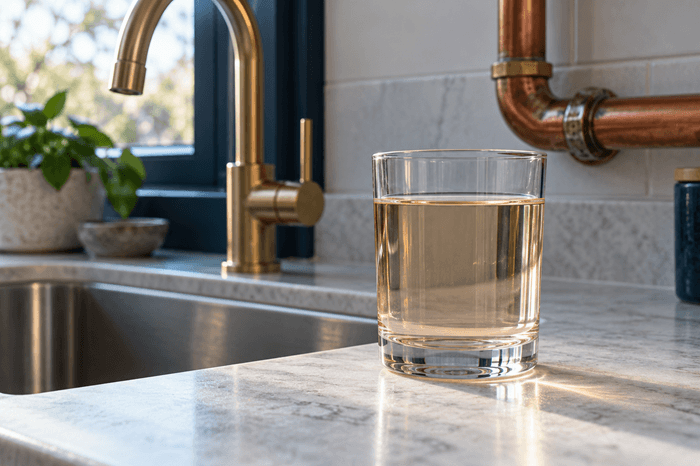
Likely causes
- Iron or manganese from the aquifer
- Copper from pipes attacked by acidic water
- Zinc from galvanized pipe
- Lead solder in homes built before 1991
- Low pH and corrosive water
Tests to order
- pH and alkalinity
- Iron
- Manganese
- Copper (first draw and flushed)
- Lead (first draw)
- Zinc
Treatment options
- Acid neutralizer or soda ash feed
- Oxidizing filter for iron and manganese
- Water softener under 5 mg/L iron
- Reverse osmosis at the kitchen tap
- Flush the tap before drinking
Short answer: a metallic taste in well water is a dissolved metal, and there are only four likely ones: iron, manganese, copper and zinc. Two of them come out of the ground and two come out of your pipes. A two-glass test first thing in the morning tells you which group you are dealing with in about two minutes, and the fix is completely different for each.
The two-glass test: your pipes or your well?
Metals that come from your plumbing build up while the water sits still, so they are strongest in the first water you draw and they wash away once the tap runs. Metals that come from the aquifer arrive at the same strength all day. That one difference does almost all of the diagnosing for you, and it costs nothing.
Do this before anyone in the house runs a tap:
- Fill the first glass the moment you wake upCold tap, no flushing. This water has been sitting against your pipes all night.
- Run the cold tap for two minutes, then fill a second glassNow you are tasting water straight from the well, not from the plumbing.
- Compare the twoLet both reach the same temperature first, because cold water hides taste.
- Try the hot tap lastHot water pulls more metal out of pipes and out of the heater itself.
| What you find | What it points to | Jump to |
|---|---|---|
| First glass tastes metallic, the flushed glass is fine | Copper, zinc or lead coming out of your plumbing | Pipe fixes |
| Both glasses taste the same, flushing changes nothing | Iron or manganese coming out of the well | Well fixes |
| Hot water tastes far worse than cold | Plumbing and the water heater, not the aquifer | Pipe fixes |
| Metallic taste plus blue-green stains in sinks | Copper dissolved by acidic water | Blue-green stains |
| Metallic taste plus orange or rusty stains | Iron from the well | Iron stains |
| Metallic taste plus black specks or black stains | Manganese from the well | Manganese |
| Only one person in the house tastes it, and a lab panel is clean | Probably not the water at all | Not the water |
If the taste changed suddenly rather than creeping in over years, note when. A new taste after work on the well, after flooding, or after drilling nearby is worth a full test rather than a metals panel alone.
Which metal tastes like what
Each of these metals announces itself differently, and most of them leave a stain somewhere in the house before anyone complains about the taste. The limits below are EPA secondary standards, which are set for taste, color and staining rather than for health. Private wells are not covered by federal rules, so treat them as benchmarks rather than requirements.
| Metal | What it tastes and looks like | Where it comes from | Noticeable above |
|---|---|---|---|
| Iron | Metallic, like blood or old pennies. Rusty color, orange or reddish stains, sediment | The aquifer, more often in deeper wells | 0.3 mg/L |
| Manganese | Bitter and metallic. Black to brown color, black stains and specks | The aquifer, often alongside iron | 0.05 mg/L |
| Copper | Sharp metallic taste, blue-green stains in sinks and tubs | Copper pipe and brass fixtures attacked by acidic water | 1.0 mg/L |
| Zinc | Metallic taste, no strong stain of its own | Galvanized pipe and brass | 5 mg/L |
| Lead | No taste, no color, no smell | Solder at copper joints, older brass, rarely lead pipe | Only a lab test finds it |
Notice how far apart those numbers are. It takes 100 times more zinc than manganese before anyone says the water tastes off, which is why a manganese problem is usually spotted in the laundry long before it is spotted in a glass.
If the taste comes from your pipes
When only the first glass tastes metallic, your water is corrosive. Corrosive water is soft and slightly acidic, and it slowly dissolves the metal it sits in. Penn State Extension puts the line at a pH below 7.0 and notes that about 60% of the wells, springs and cisterns serving individual homes in Pennsylvania deliver corrosive water, with the problem worst in areas without limestone bedrock.
Two things have to line up for you to taste it, and both are fixable:
The water chemistry
Low pH, low hardness and low dissolved solids all make water hungrier for metal. Penn State uses the Langelier Saturation Index for this, where a negative number means corrosive and the target is above zero.
The contact time
The longer water sits in a pipe, the more metal it picks up. That is why the taste peaks overnight, after a weekend away, or in a guest bathroom nobody uses.
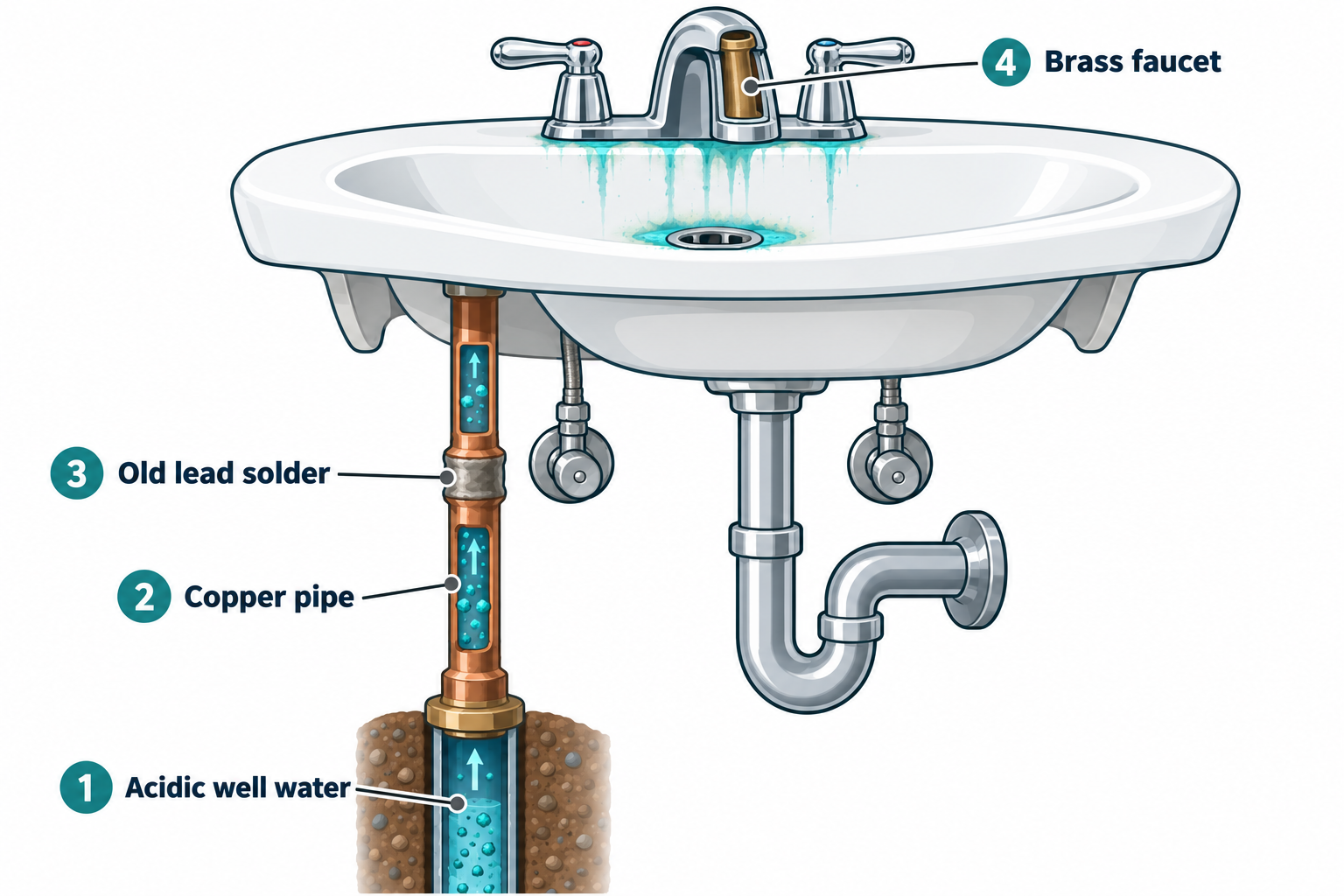
What the water is dissolving depends on the age of the house. Penn State notes that lead solder was banned in 1991, so homes built before then with metal plumbing most likely contain some lead at the joints. Galvanized pipe adds zinc. Brass faucets can contribute both zinc and a little lead.
Flush first, then fix
Flushing is the free stopgap while you plan a permanent fix. Penn State says to run the water for one minute before drinking, and that flushing is only needed when the water has been sitting in the plumbing for at least an hour. Catch a sample after that one minute flush and have it tested, so you know what you are actually drinking rather than guessing.
Raising the pH is the real repair
Fixing the water stops the corrosion everywhere in the house at once, including at the joints you cannot see. Penn State describes two point-of-entry approaches, both installed after the pressure tank:
| Approach | How it works | What to expect |
|---|---|---|
| Calcite neutralizing filter | Water passes through a tank of calcium carbonate or magnesium oxide chips that dissolve slowly and raise the pH | Adds hardness, can reduce pressure, media needs topping up from weeks to months apart |
| Soda ash or sodium hydroxide feed | A small pump injects solution ahead of the pressure tank | No added hardness and no pressure loss, but the pump and solution tank need regular attention. Soda ash is the safer of the two to handle |
| Reverse osmosis or distillation at one tap | Removes copper and lead from drinking and cooking water only | Good safety net while the house fix is planned. Penn State does not recommend plain carbon filters for copper or lead |
| Replacing the pipe | Copper or substandard plastic swapped for pipe stamped NSF and Drinking Water | The permanent answer for a short run or a known bad section, and the most disruptive |
Sizing a neutralizer takes more than a pH reading, so order alkalinity and hardness with the panel. Our treatment sizing tool puts the equipment in the right order once you have the numbers.
If the taste comes from your well
When flushing changes nothing, the metal is already in the water when it reaches the house, and for a metallic taste that nearly always means iron, manganese or both. Penn State explains that these are more common in deeper wells, where water has been in contact with rock the longest, and in coal mining regions. In a Penn State survey of private supplies in Pennsylvania, 17% had excessive iron.
Before you shop, get the combined iron plus manganese number from a lab, because that single figure decides which equipment can handle your water:
| Treatment | Works at about | Good to know |
|---|---|---|
| Catalytic carbon | Dissolved iron under 1.0 mg/L | Needs at least 4.0 mg/L of dissolved oxygen in the water |
| Polyphosphate feed | Dissolved iron under 2 mg/L | Holds the iron in solution rather than removing it, so some taste can remain. Generally ineffective for manganese |
| Water softener | Dissolved iron under 5 mg/L | Needs pH above 6.7 and hardness of 3 to 20 grains per gallon. Cannot handle iron that has already turned to rust particles |
| Oxidizing filter (manganese greensand) | Combined iron and manganese of about 3 to 10 mg/L | Regenerated with potassium permanganate on a schedule |
| Oxidation then filtration | Combined iron and manganese above 10 mg/L | Chlorine, potassium permanganate or hydrogen peroxide ahead of a filter. Significant upkeep |
Source: Penn State Extension. Iron and manganese have to be removed from all the water entering the home rather than at one tap, since they stain laundry and fixtures everywhere.
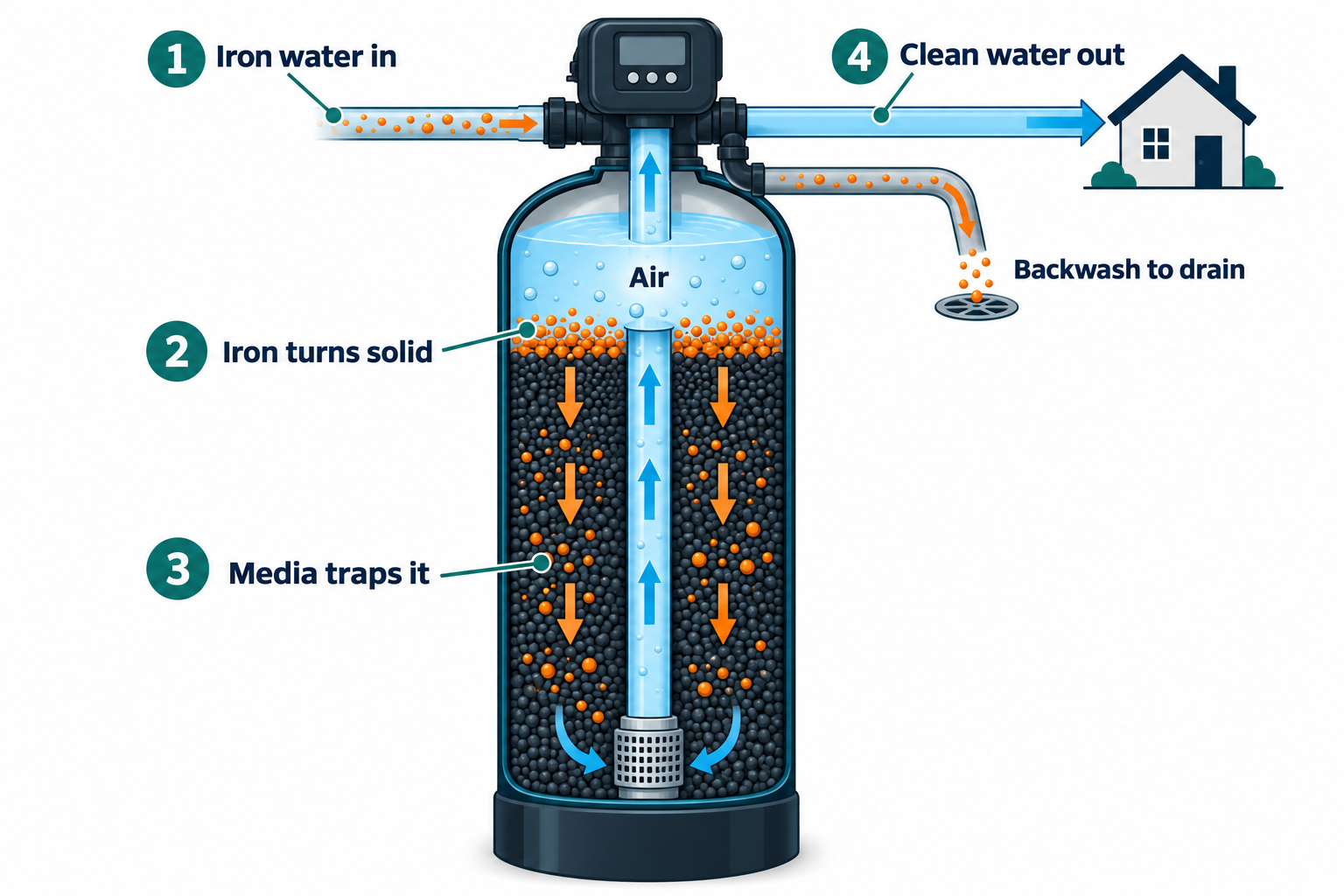
One trap worth knowing: a softener is the cheapest piece of equipment on that list, which is why it gets recommended for iron water it cannot actually handle. If your iron has already turned orange in the glass, it is no longer dissolved and a softener will foul instead of fixing it. The longer version is on our iron page, and the manganese side is on our manganese page.
Is metallic tasting water safe to drink?
It depends entirely on which metal it is, which is the strongest argument for testing instead of guessing:
| Metal | Health picture | What to do |
|---|---|---|
| Iron | A nuisance rather than a health risk. The 0.3 mg/L limit is about taste, color and stains | Treat for comfort, laundry and fixtures |
| Manganese | EPA sets a lifetime health advisory of 0.3 mg/L, and 1.0 mg/L for a short 10-day exposure for a child. Water at or below 0.3 mg/L is considered suitable for mixing formula | Test before using the water for an infant, then treat |
| Copper | Taste shows up at 1.0 mg/L. The health standard is 1.3 mg/L, above which stomach cramps and intestinal illness become the concern | Flush the tap, then fix the pH |
| Zinc | Aesthetic only at the 5 mg/L mark | Usually a sign of galvanized pipe worth looking at |
| Lead | No safe level and no taste. The EPA action level is 0.015 mg/L today and drops to 0.010 mg/L on 1 November 2027. Children are at the greatest risk | Test first draw water, use cold only, act on any result |
What to order from the lab
A metals panel is cheap compared to the equipment it stops you from buying by mistake. Ask for these together, and tell the lab you want both a first draw and a flushed sample for the plumbing metals:
| Test | Why it earns its place |
|---|---|
| pH | Under 7.0 points at corrosive water and explains copper, zinc and lead |
| Alkalinity and hardness | Needed to size a neutralizer, and a softener needs hardness anyway |
| Iron | Separates a well problem from a plumbing problem, and sets the equipment |
| Manganese | The lowest taste threshold of the group, and the one with infant guidance |
| Copper, first draw and flushed | The gap between the two samples is the proof that your pipes are the source |
| Lead, first draw | The one metal the taste test can never tell you about |
| Zinc | Confirms galvanized pipe as a contributor |
Penn State describes the pattern to look for once the results arrive: metal levels that drop after flushing point to the plumbing, and levels that stay put after flushing point to the well water itself. Use a state-certified lab, which you can find in our lab finder.
When it turns out not to be the water
If the panel comes back clean and nobody else in the house tastes anything, the water is probably not the problem. A metallic taste in the mouth has plenty of causes that have nothing to do with a well, from medications to dental work, and a doctor or dentist is the right next stop rather than a filter salesperson. Testing first is what makes that answer trustworthy.
Cheat sheet: what you notice and what to do
| You notice | Most likely | First step | Typical cost |
|---|---|---|---|
| Metallic only in the first glass of the morning | Copper or zinc from corrosive water | Flush one minute, order pH plus metals, first draw and flushed | One lab panel |
| Metallic all day, flushing changes nothing | Iron or manganese from the well | Get the combined iron and manganese number | One lab panel |
| Hot water much worse than cold | Plumbing and water heater | Stop drinking from the hot tap, test cold first draw | Free |
| Metallic taste plus blue-green stains | Copper, acidic water | Acid neutralizer or soda ash feed | $800 to $4,000 installed (HomeGuide) |
| Metallic taste plus orange stains | Iron above 0.3 mg/L | Match the filter to your iron number | $800 to $4,000 installed (HomeGuide) |
| Metallic taste plus black specks | Manganese above 0.05 mg/L | Oxidizing filter, and test before using for formula | $800 to $4,000 installed (HomeGuide) |
| House built before 1991 with copper pipe | Lead solder at the joints, whatever the taste | Lead test on a first draw sample | One lab panel |
| Clean panel, nobody else tastes it | Not the water | Talk to a doctor or dentist | Free |
Find licensed well and water treatment contractors near you, verified against state records.
Well water tastes metallic: FAQ
Why does my well water taste metallic?
A dissolved metal. Iron and manganese come from the aquifer, copper and zinc come from your pipes. Fill one glass first thing in the morning and another after running the tap two minutes. If only the first tastes metallic, it is your plumbing. If both taste the same, it is your well.
Is it safe to drink water that tastes metallic?
Iron and manganese at normal household levels are nuisances rather than hazards, though EPA sets a manganese health advisory at 0.3 mg/L. Copper and zinc from corroding pipes are a different matter, because the same corrosion releases lead, which has no taste. Flush the tap and get a metals panel before deciding.
Why does my water taste metallic in the morning only?
Because the water sat in your pipes all night and picked up metal the whole time. Penn State notes that copper in particular causes a metallic taste in the first water drawn in the morning. That pattern points at your plumbing and at corrosive water, not at the well.
Why does only my hot water taste metallic?
Heat speeds up corrosion, so hot water carries more copper, zinc and lead from the same pipes. It also sits in the water heater. Use cold water for anything you drink, cook with or mix formula with, and heat it on the stove instead.
Can you taste lead in water?
No. Penn State is clear that lead cannot be detected by taste or sight and requires a water test. Water that tastes perfectly fine can still contain lead, which is why a lead test belongs on the order whenever the house has copper pipe with soldered joints.
Does a metallic taste mean my pipes are corroding?
If the taste fades after flushing, yes. Corrosive water is soft and acidic, below about pH 7.0, and it dissolves copper from pipe, zinc from galvanized runs and lead from old solder. Blue-green stains and pinhole leaks are the other signs that go with it.
Will a water softener fix a metallic taste?
Only in some cases. A softener can remove dissolved iron under about 5 mg/L when the pH is above 6.7, but it does nothing for iron that has already turned to rust particles, little for manganese in many setups, and nothing for the low pH that causes copper and zinc to leach.
Will a carbon filter or a pitcher filter remove it?
Not reliably. Penn State does not recommend granular activated carbon for removing copper and lead. For those metals at a single tap, reverse osmosis, distillation or activated alumina are the options that work. For iron and manganese the treatment has to cover the whole house.
What pH causes a metallic taste?
Penn State puts corrosive water below pH 7.0, and EPA’s recommended range for drinking water is 6.5 to 8.5, noting that low pH brings a bitter metallic flavor and corrosion. The further below 7.0 your water sits, the more metal it will pull out of your plumbing.
Why does my water taste like blood or pennies?
That description usually means iron. Iron above 0.3 mg/L tastes metallic and stains fixtures and laundry orange or reddish. If the taste is more bitter than coppery and you are finding black specks, manganese is the better suspect.
How much does it cost to fix metallic tasting water?
Flushing the tap is free and a lab panel is modest. Equipment is the real cost: HomeGuide puts most whole-house well water filtration systems at $800 to $4,000 installed, and the price depends on which metal you have and how much of it, which is exactly what the test tells you.
Can I use metallic tasting water for baby formula?
Not until it has been tested. EPA considers water at or below 0.3 mg/L of manganese suitable for making formula, and lead has no safe level and no taste. Use cold, flushed water and get manganese and lead results back before you rely on the tap.
Checked October 2026. Limits from the EPA secondary drinking water standards and the Lead and Copper Rule Improvements. Treatment and sampling guidance from Penn State Extension. General guidance for private wells, which are not covered by federal drinking water rules. Follow your lab, your health department or a licensed water treatment contractor where their advice differs.