
Hard Well Water: Hardness Chart, Health Facts and How to Treat It
Hard well water is calcium and magnesium picked up from rock underground. It's safe to drink, but above about 7 grains per gallon it costs you in scale and soap. Here's the hardness chart, how to test, softener vs salt-free, sizing and sodium.
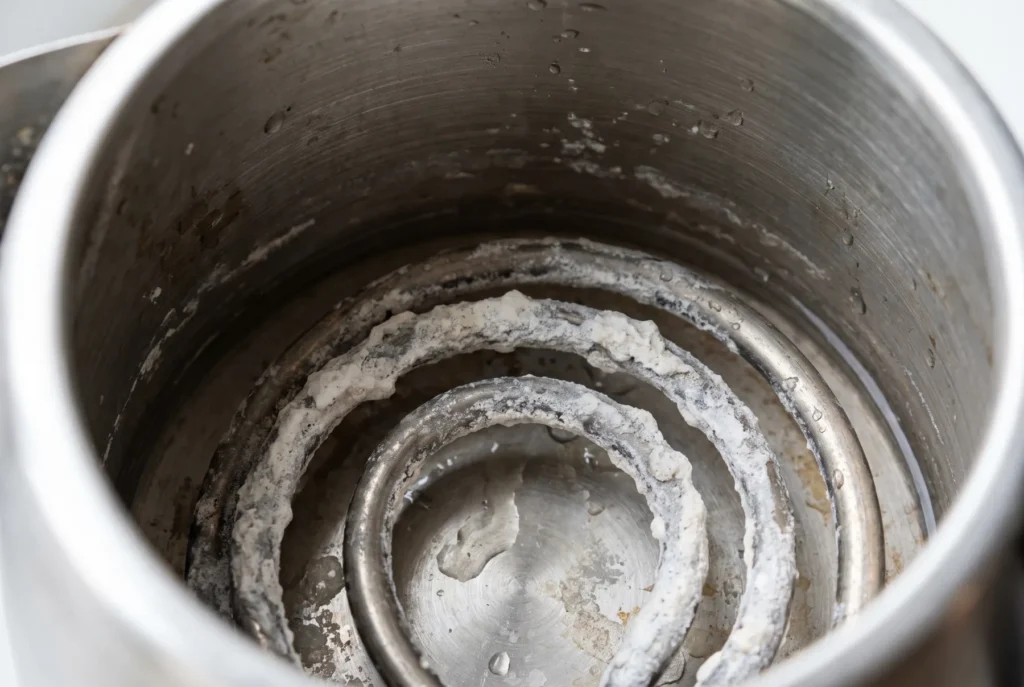
Likely causes
- Calcium and magnesium dissolved from limestone or dolomite aquifers
- High total dissolved solids
- Iron and manganese adding to scale
Tests to order
- Hardness
- Total dissolved solids
- Iron
- Manganese
- pH
Treatment options
- Ion exchange water softener
- Salt-free conditioner for light scale
- Point-of-use reverse osmosis for drinking water
Short answer: hard well water means your water carries a lot of dissolved calcium and magnesium, picked up as it soaks through limestone and other rock underground. It isn’t a health risk, and the EPA has no drinking water limit for it. But above about 7 grains per gallon (120 mg/L) it starts to cost you money in scale, wasted soap and shorter appliance life. A lab test tells you the exact number, and a properly sized ion exchange softener is the only home system that actually takes the hardness out.
Signs your well water is hard
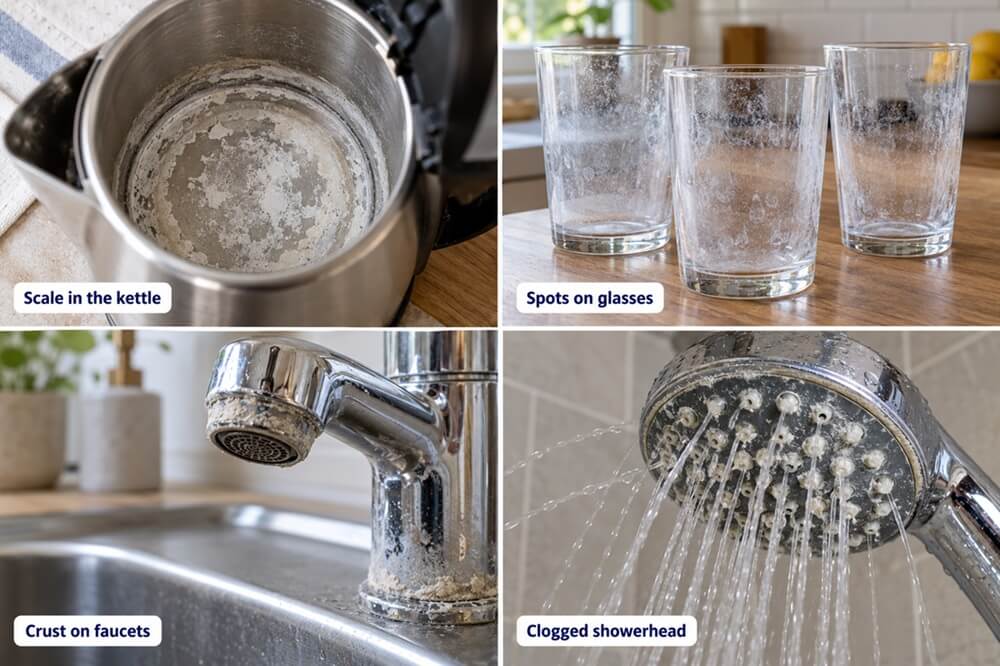
Any one of these by itself could have another cause, so don’t buy equipment on a hunch. If you’re seeing two or three of them, though, hardness is the likely reason. One thing to rule out: hard water leaves white or gray deposits. Orange or brown stains point to iron, and black stains point to manganese. Plenty of wells have hardness and iron together, which matters when you pick a treatment.
Why well water gets hard
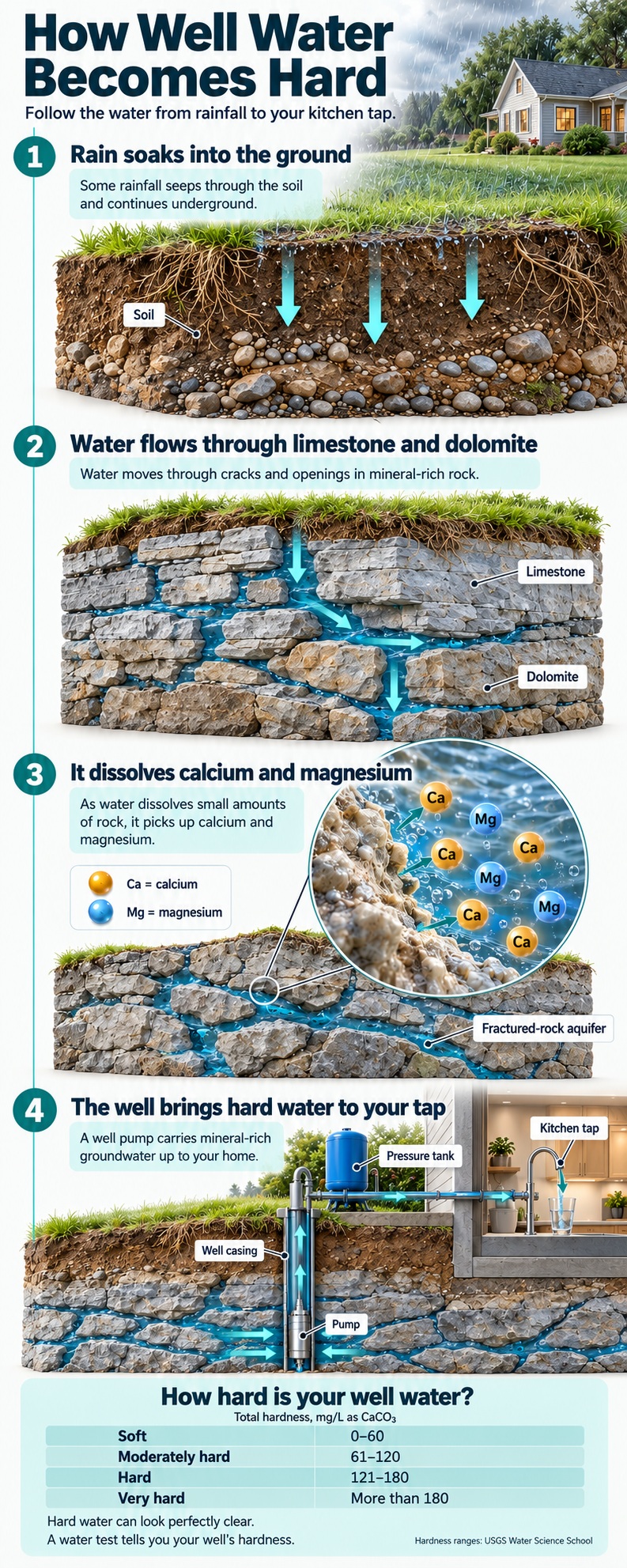
City water often reaches the tap already treated. The USGS notes that utilities try to avoid supplying water in the very hard range because of the scale and soap problems it causes. With a private well nobody does that for you. Whatever the rock gave the water is what comes out of your faucet, and it can change from one well to the next even on the same road, depending on the rock each well is drilled into.
Water hardness chart: what your number means
Labs usually report hardness in milligrams per liter (mg/L) or parts per million (ppm) “as calcium carbonate.” Softener dealers talk in grains per gallon (gpg). They’re the same measurement in different units. To convert, divide mg/L by 17.1. So a lab result of 250 mg/L is about 14.6 gpg.
| Classification | Grains per gallon | mg/L (ppm) | Treatment usually needed? |
|---|---|---|---|
| Soft | Under 1 | Under 17.1 | No |
| Slightly hard | 1 to 3.5 | 17.1 to 60 | No |
| Moderately hard | 3.5 to 7 | 60 to 120 | Usually not |
| Hard | 7 to 10.5 | 120 to 180 | Worth considering |
| Very hard | Over 10.5 | Over 180 | Most homes soften |
Scale from Nebraska Extension and Penn State Extension. Virginia Tech’s water quality program says levels under 7 gpg generally don’t need treatment. The USGS uses a slightly simpler scale that calls anything up to 60 mg/L soft.
Under 7 gpg, most people live with it fine. NDSU Extension says folks typically start calling hardness a problem somewhere around 6 or 7 gpg. And remember, softening is a choice. The Minnesota Department of Health is clear there’s no requirement to soften your water at all.
Is hard well water safe to drink?
Yes. Nebraska Extension puts it plainly: hard water is not a health hazard. The calcium and magnesium in it are the same minerals your body needs anyway, and drinking water supplies a small share of them. That’s why the EPA never set a legal limit for hardness. Some studies have even linked hard water with lower heart disease deaths, but researchers haven’t drawn firm conclusions from that, so don’t treat it as a reason to keep it either.
What about dry skin and eczema? A lot of people blame hard water for it. Here the research is clearer than you’d expect. A UK trial run by the University of Nottingham gave ion exchange softeners to the homes of 336 children with eczema, ages 6 months to 16 years. After 12 weeks, the softened homes did no better than the others when the eczema was measured objectively. Some parents still felt it helped, and many kept their softeners for the other benefits. So softened water may feel nicer on your skin, but don’t count on it as an eczema treatment.
What hard water does to your home
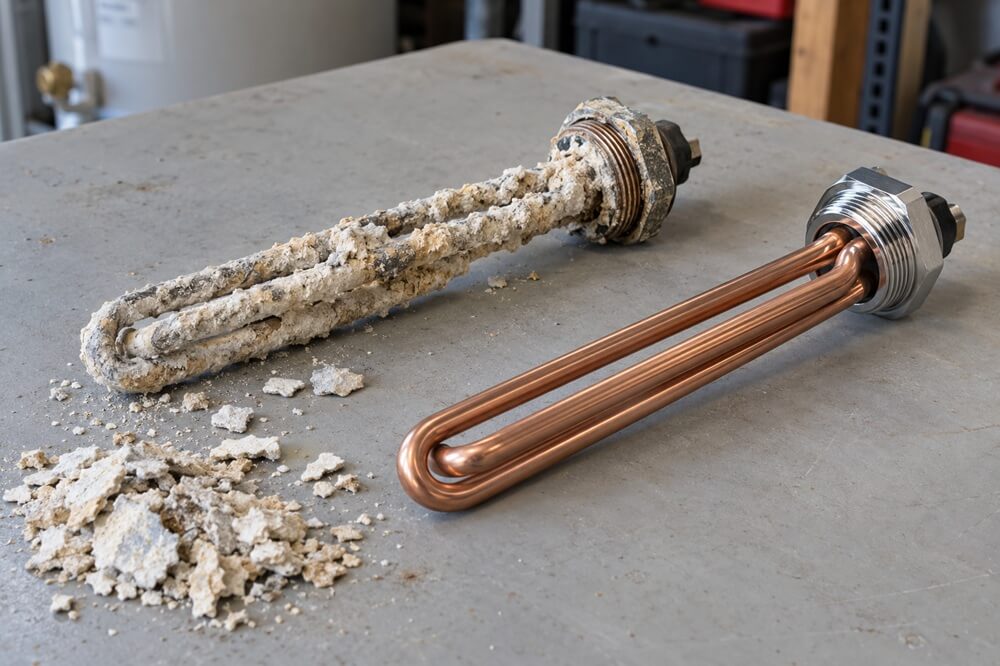
Virginia Tech’s extension program notes that scale in water heaters raises heating costs by cutting efficiency, and it shortens the life of smaller appliances too. The same buildup forms inside pipes. Over the years it narrows them, so hard water can slowly drag down your water pressure even when the pump and tank are healthy. If that sounds familiar, our low water pressure guide goes through how to tell scale apart from a pump problem.
How to test your well for hardness
A strip is fine for a quick yes or no. Before you buy a softener, though, get a real lab number. Penn State Extension recommends having the water tested by an independent lab rather than leaning on a test from the company that’s selling you equipment. Order these together, since the extra results change which system you need:
| Test | Why order it |
|---|---|
| Total hardness | Sets the softener size and its hardness setting |
| Iron and manganese | Both foul softener resin. High levels need their own filter first |
| pH | Low pH water can corrode pipes and may need a different fix |
| Total dissolved solids | A general picture of how much is in the water |
| Total coliform bacteria | Every well should be tested for this yearly anyway |
You can find a state-certified lab near you in our lab finder.
Hard water treatment options compared
| Option | Removes hardness? | Uses salt and a drain? | Best for |
|---|---|---|---|
| Ion exchange softener | Yes | Yes | Whole house, any level over about 7 gpg |
| Salt-free conditioner | No | No | Unproven. See below |
| Reverse osmosis at the kitchen tap | Yes, at that one tap | No salt, small drain line | Drinking and cooking water, often paired with a softener |
| Do nothing | No | No | Soft to moderately hard water under 7 gpg |
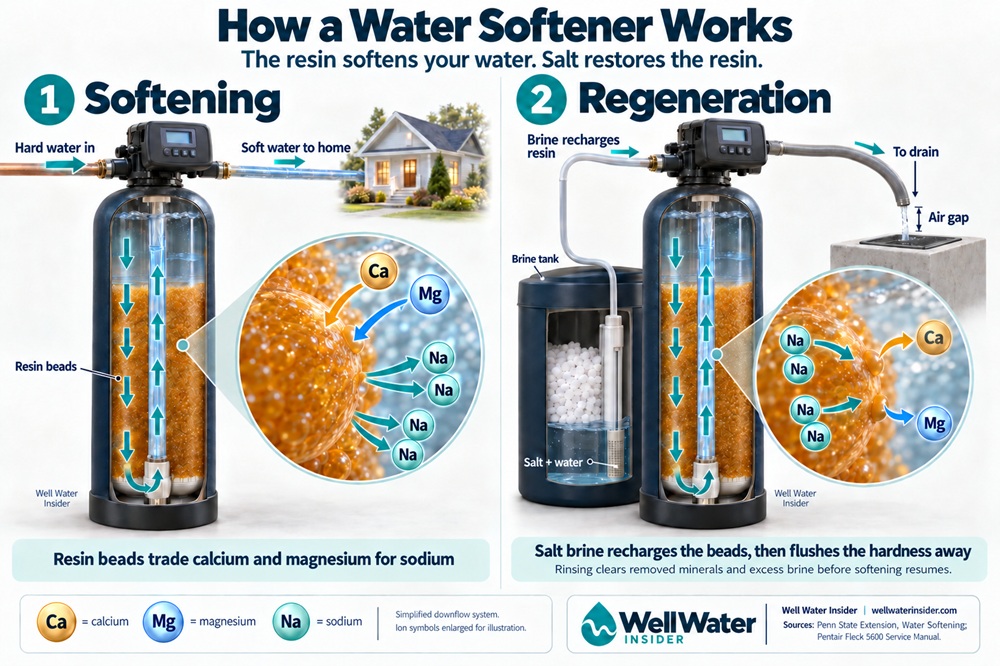
Penn State Extension lists the usual maintenance headaches with softeners on wells: periodic clogging, bacteria building up in the resin, and iron fouling. Most of those trace back to skipping the iron and manganese tests, or to a unit that wasn’t sized for the water.
Do salt-free water softeners work?
Here’s the honest answer. Salt-free conditioners, magnetic devices and electronic descalers don’t remove hardness. Your water tests the same before and after. Most claim instead to change how the minerals behave so they stick less. Virginia Tech points out that no U.S. agency has a protocol to test whether these devices work, and Nebraska Extension says there are few conclusive studies backing them for home use. If you try one anyway, check hardness and watch a fixture like the showerhead for a few months before trusting it.
How to size a softener for well water
An undersized softener runs out of capacity fast and regenerates over and over, wasting salt and water. An oversized one costs more up front. The math is simple. Multiply the people in the house by the gallons each uses per day, then by your hardness in gpg. That gives you the grains the softener must remove each day.
| Step | Penn State example |
|---|---|
| People in the home | 4 |
| Water used per day | 75 gallons (shared) |
| Hardness | 10 gpg |
| Grains removed per day | 75 x 10 = 3,000 |
| Softener capacity | 20,000 grains |
| Regenerates about every | 6 to 7 days |
Not sure how much water you use? This chart from Penn State’s numbers shows where it goes. Notice how little of it you actually drink.
Our treatment sizing calculator runs this math for you. One thing to add if your well has iron: NDSU Extension says some softeners handle up to 10 ppm of iron and manganese, but water above that may need a dedicated iron removal system ahead of the softener. Tell the installer your iron number so the unit is set up for it.
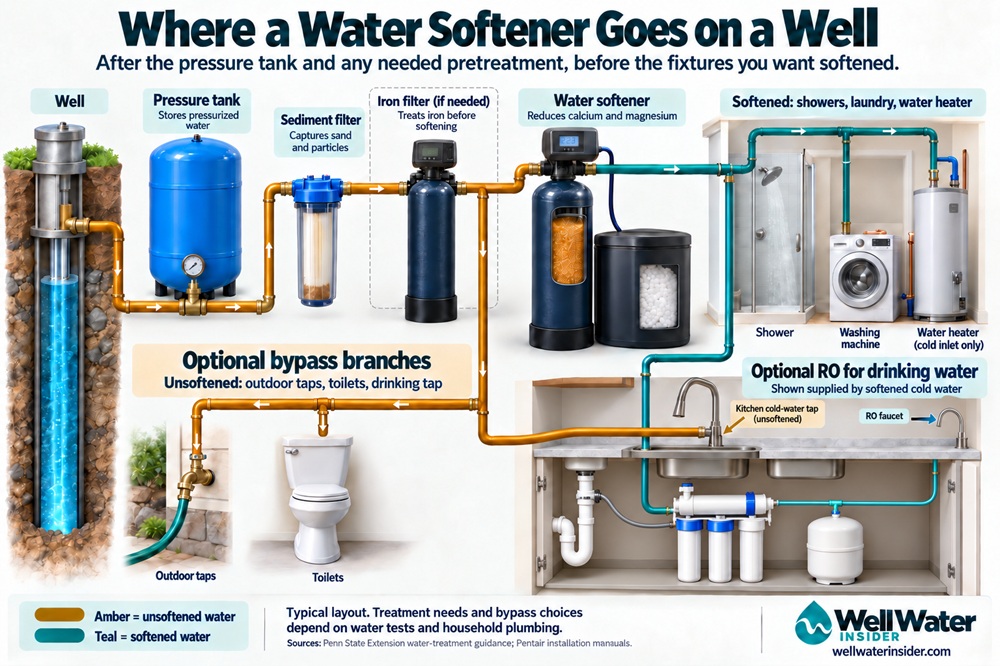
One tip from the Minnesota Department of Health: if you just had new copper plumbing put in, hold off running the softener for the first few weeks.
Sodium in softened water
A softener trades hardness for sodium, and Nebraska Extension puts that at about 8 mg/L of sodium for every grain of hardness removed. The harder your well, the more sodium ends up in the softened water.
For most healthy adults that’s not a big deal. If someone in your home is on a low-sodium diet, though, ask their doctor, and keep one cold line at the kitchen sink unsoftened or add a small reverse osmosis unit there. Another route is filling the softener with potassium chloride instead of regular salt. It costs more, and NDSU says the softener uses about 10% more of it.
| Cost item | Typical range | Source |
|---|---|---|
| Softener hardware | $400 to $2,700 retail, depending on size and type | NDSU Extension |
| Sodium chloride salt | $5 to $10 per 40-pound bag | NDSU Extension |
| Potassium chloride | Up to $25 per 40-pound bag | NDSU Extension |
| Water per regeneration | About 50 gallons | Penn State Extension |
Prices don’t include installation. Get quotes from local contractors.
How to run a softener without wasting salt and water
On a well, every regeneration pulls water from your well and sends brine to your septic system or drain. So efficiency matters more than it does in town. The EPA’s WaterSense program recommends demand-initiated softeners, which regenerate based on how much water you’ve actually used, over ones that run on a fixed timer. It also points to the NSF/ANSI 44 efficiency rating, which requires a softener to use 5 gallons of water or less per 1,000 grains of hardness removed.
- Set it to your real hardnessThe Minnesota Department of Health warns that a setting higher than your water needs wastes water and money.
- Look for the NSF/ANSI 44 or WQA Gold Seal markVirginia Tech suggests buying from pros with one of these certifications.
- Keep salt in the brine tankCheck it every month or so, and break up any hard crust that forms across the top.
- Retest every few yearsWell water changes over time. If hardness drops, turn the setting down.
Find a licensed well or pump contractor near you, verified against state records.
Hard well water: FAQ
Is hard well water safe to drink?
Yes, hard well water is safe to drink. Calcium and magnesium aren’t harmful, and the EPA has no health limit for hardness. Hardness is a problem for plumbing, appliances and cleaning, not your health. You should still test your well yearly for bacteria, since hardness tells you nothing about that.
Do I need a water softener if I have a well?
Only if your water is hard enough to bother you. Most experts say levels under 7 grains per gallon (120 mg/L) don’t need treatment, and the Minnesota Department of Health notes softening is a personal choice. Test first, then decide.
What is a good hardness level for well water?
Anything under 7 grains per gallon, or 120 mg/L, is generally fine. Under 3.5 gpg counts as slightly hard or soft. Above 10.5 gpg (180 mg/L) is very hard, and most homes at that level choose to soften.
Can a water softener remove iron from well water?
Some can, in small amounts. NDSU Extension says some softeners remove up to 10 ppm of iron and manganese combined, but higher levels need a dedicated iron filter before the softener. Iron is also a common cause of fouled softener resin, so always test for it before buying.
Does a water softener make water salty?
It doesn’t make it taste salty, but it does add sodium. It’s about 8 mg/L for each grain of hardness removed, so 10 gpg water ends up with about 80 mg/L. People on a sodium-restricted diet can use potassium chloride or keep an unsoftened tap for drinking.
Do salt-free water softeners work on well water?
They don’t remove hardness, so they aren’t really softeners. Some claim to reduce scale by changing how the minerals behave, but no U.S. agency has a standard test for that, and university extension programs say the evidence for home use is thin.
Why does softened water feel slippery?
That slick feeling is soap rinsing off without leaving the film that hard water does. Your skin is actually clean. Most people stop noticing it after a week or two.
Sources: USGS, Nebraska Extension, Penn State Extension, NDSU Extension, Minnesota Department of Health, Virginia Tech, EPA WaterSense and the University of Nottingham. Checked October 2026. General guidance; follow your state or county health department where it differs.